Acanthopyge (Acanthopyge) haueri
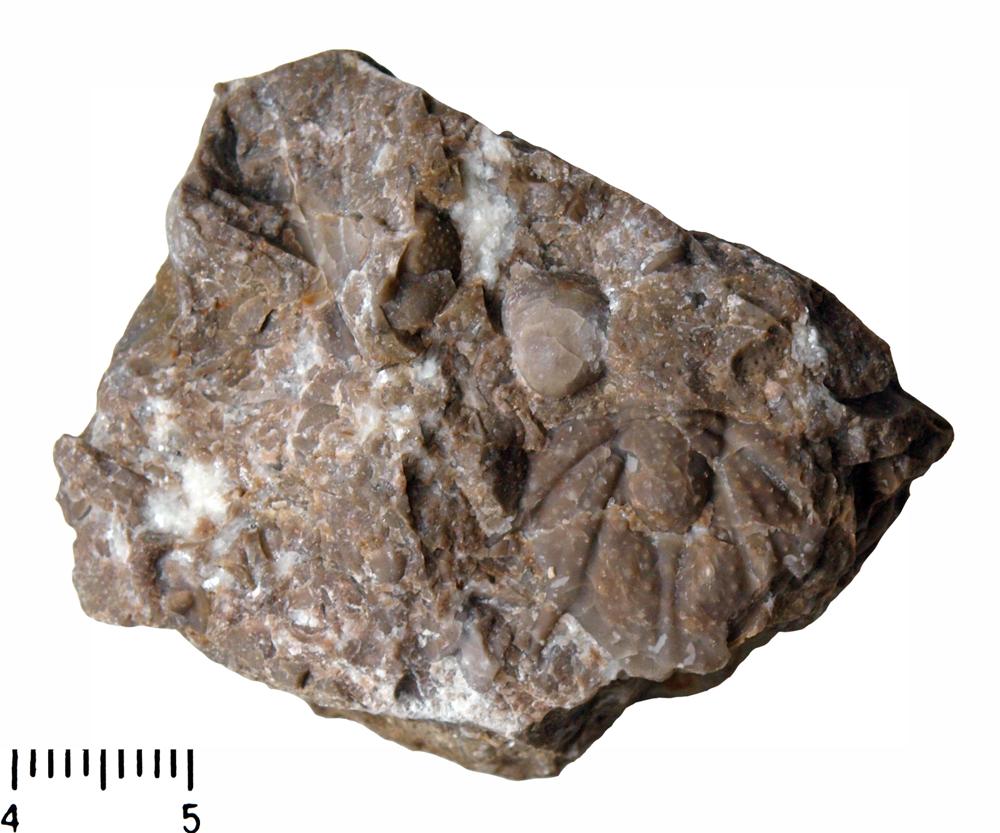
via GBIF · CC BY-NC 4.0 · via GBIF. May be a photograph of a specimen, or an artist’s reconstruction — an interpretation of a skeleton, since colour and soft tissue are almost never preserved.
On record
Recorded, not inferred- Sits inside
- Acanthopyge (Acanthopyge)PBDB
- Diet
- carnivorePBDB, for Lichida
- Life habit
- low-level epifaunalPBDB, for Trilobita
- Motility
- fast-movingPBDB, for Trilobita
- Vision
- well-developedPBDB, for Lichidae
- Environment
- marinePBDB, for Trilobita
Time the record covers
At most 5.6 million years on record.
Every occurrence read is dated to somewhere between 393.47 Mya and 387.95 Mya, and nothing in the dating separates them, so that window is what the record shows rather than a span.
6 occurrences of Acanthopyge (Acanthopyge) haueri on record, most of them in the Devonian. Bar height is expected occurrences, not a count: each fossil is spread across the span it is dated to, so a tall narrow bar means tight dating and a low wide one means loose.
When
6 occurrences- Devonian100%
These are dates about fossils, not the animal: the record can only begin after it arose and end before it died out, so either end may reach further. Shares are expected occurrences: a fossil dated to a span is counted partly in each period it straddles. More on what this infers.
Found in
3 formations
Loading coastlines…
The named rock units Acanthopyge (Acanthopyge) haueri has been recovered from, largest first. Drawn where the rock is now, not where it formed. 2 occurrences have no formation on record, which is common for older literature.
Acanthopyge (Acanthopyge) haueri and its relatives
DevonianWhere Acanthopyge (Acanthopyge) haueri and its relatives were recorded in the Devonian.
Found in the same rock
153 taxa- Aulacopleurina peltata5 sites
- Cyphaspis lacrimara5 sites
- Leonaspis5 sites
- Thysanopeltis speciosa5 sites
- Aulacopleura beyrichi4 sites
- Chotecops auspex4 sites
- Chotecops hoseri4 sites
- Proetopeltis (Proetopeltis) neglecta4 sites
- Aulacopleura bohemica3 sites
- Crotalocephalus affinis3 sites
- Cyphaspides holinensis3 sites
- Isoprusia3 sites
- Koneprusia3 sites
- Nowakia sulcata3 sites
- Phaetonellus3 sites
- Phaetonellus planicaudus3 sites
- Pinacites jugleri3 sites
- Xiphogonium3 sites
- Alberticoryphe chemazur2 sites
- Benesovella lusor2 sites
- Buchiproetus postcomplanatus2 sites
- Cabrieroceras2 sites
- Chotecops breviceps2 sites
- Crinoidea2 sites
The Paleobiology Database records 6 sites for Acanthopyge (Acanthopyge) haueri, and this reads all of them. The number is how many of those sites it was catalogued from too. The 24 sharing the most are listed.
This is not a list of everything alive at the time. It is only what has come out of the same ground as this animal and been written down.
Entered from
4 references- Trilobite assemblages in the Devonian of the Barrandian area and their relations to palaeoenvironments2
- The Bohemian Lower Devonian Stages2
- Die Trilobiten von Greifenstein/Hörre—Ableger einer böhmischen Fauna im Rheinischen Schiefergebirge1
- Trilobiten des juengeren Siluriums sowie des Unter- und Mitteldevons. I. Mit Beitraegen zur Silur-Devon-Stratigraphie einiger Gebiete Marokkos und Oberfrankens1
Each of the 6 occurrences read was entered from one of these publications, ordered by how many each accounts for. This is not a search for papers mentioning the name. Entries link to doi.org where the Paleobiology Database holds an identifier, and to its own record where it does not. Relayed as the Paleobiology Database holds them, not checked against what they resolve to.
Media and terms
Media content1
Picture of Acanthopyge (Acanthopyge) haueri
- Source
- GBIF
- Credit
- via GBIF
- Licence
- CC BY-NC 4.0
- Commercial use
- the licence does not allow it
No 3D scan of Acanthopyge (Acanthopyge) haueri was found in MorphoSource and Sketchfab.
Smithsonian Open Access was not reached for this taxon, so this list is what the others held rather than everything there is.
This is what the site found, which is not the same as what exists.
Keep going
What may have been alongside itAcanthopyge (Acanthopyge) through timeFormations of the DevonianThe world it lived on
Occurrence data from the Paleobiology Database, CC BY 4.0. (Barrande 1846)