Acropora pharaonis
Acropora pharaonis is a species of acroporid coral that was first described by Milne-Edwards and Haime in 1860. Found in marine, tropical, reefs on slopes sheltered from wave action, it occurs at depths of between 5 and 25 m. It is classed as a vulnerable species on the IUCN Red List, and it has a decreasing population. It is common and found over a large area and is classified under CITES Appendix II.
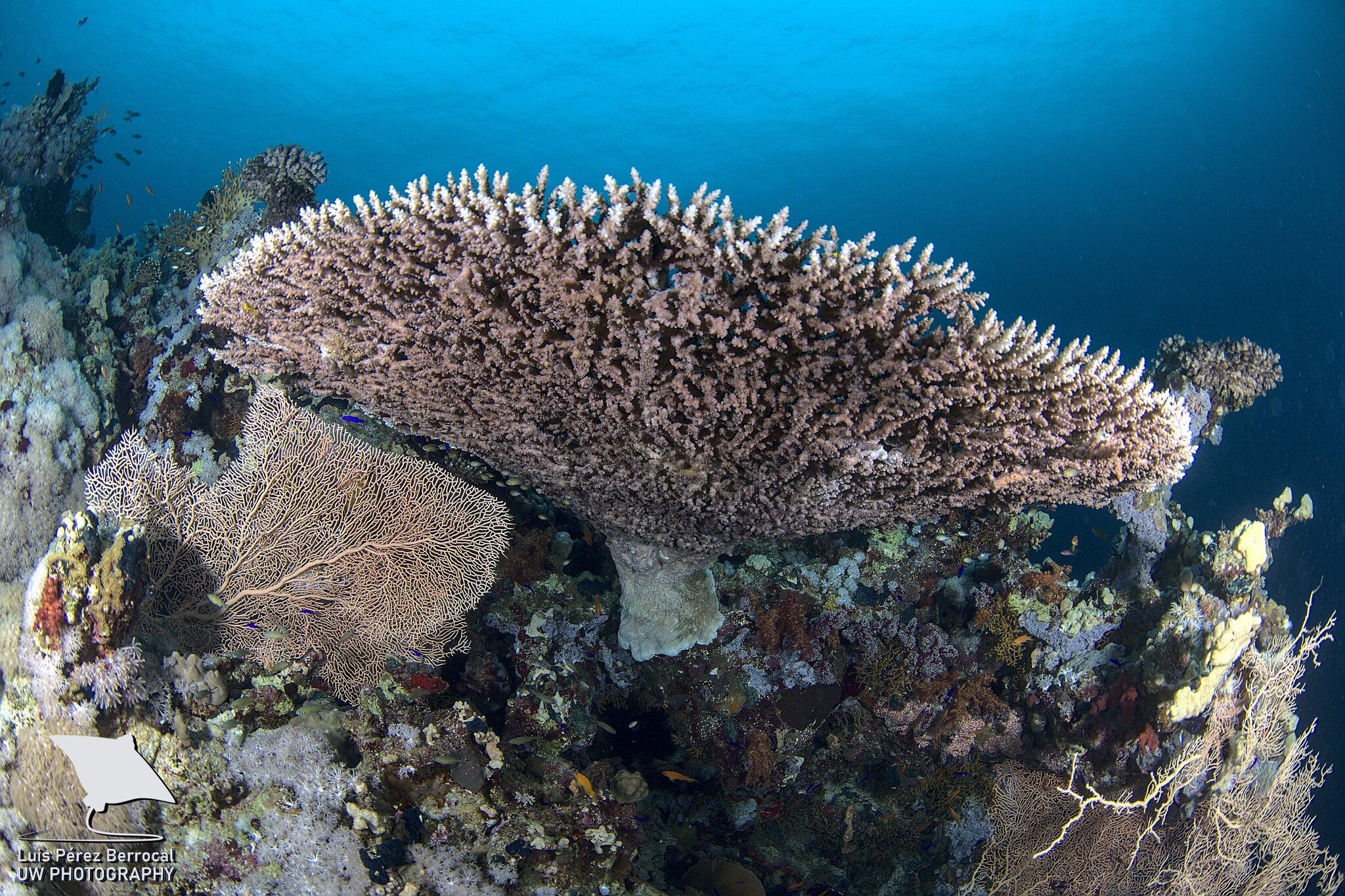
Luis P. B. · CC BY-NC 4.0 · via GBIF. May be a photograph of a specimen, or an artist’s reconstruction — an interpretation of a skeleton, since colour and soft tissue are almost never preserved.
On record
Recorded, not inferred- Sits inside
- AcroporaPBDB
- Diet
- photosymbiotic, suspension feederPBDB, for Acroporidae
- Life habit
- colonial, clonalPBDB, for Acroporidae
- Motility
- stationary, attachedPBDB, for Scleractinia
- Vision
- blindPBDB, for Anthozoa
- Environment
- marinePBDB, for Scleractinia
Time the record covers
At least 117 thousand years on record.
The record covers at least 129 ka to 11.7 ka. No occurrence read is dated outside 2.58 Mya to 0 Mya.
14 occurrences of Acropora pharaonis on record, most of them in the Pleistocene. The Paleobiology Database records this as a living group. Bar height is expected occurrences, not a count: each fossil is spread across the span it is dated to, so a tall narrow bar means tight dating and a low wide one means loose.
When
14 occurrences- Pleistocene93%
- Holocene7%
These are dates about fossils, not the animal: the record can only begin after it arose and end before it died out, so either end may reach further. Shares are expected occurrences: a fossil dated to a span is counted partly in each period it straddles. More on what this infers.
Acropora pharaonis and its relatives
PleistoceneWhere Acropora pharaonis and its relatives were recorded in the Pleistocene.
Found in the same rock
224 taxa- Galaxea fascicularis4 sites
- Dipsastraea favus3 sites
- Dipsastraea pallida3 sites
- Goniastrea retiformis3 sites
- Platygyra daedalea3 sites
- Pocillopora damicornis3 sites
- Stylophora pistillata3 sites
- Anadara (Anadara) antiquata2 sites
- Cerithium caeruleum2 sites
- Codakia tigerina2 sites
- Conus2 sites
- Conus arenatus2 sites
- Dipsastraea laxa2 sites
- Dipsastraea speciosa2 sites
- Echinopora gemmacea2 sites
- Favites flexuosa2 sites
- Gafrarium pectinatum2 sites
- Glycymeris pectunculus2 sites
- Goniastrea pectinata2 sites
- Goniastrea stelligera2 sites
- Goniopora planulata2 sites
- Hydnophora microconos2 sites
- Lithophyllon concinna2 sites
- Lithophyllon repanda2 sites
The Paleobiology Database records 7 sites for Acropora pharaonis, and this reads all of them. The number is how many of those sites it was catalogued from too. The 24 sharing the most are listed.
This is not a list of everything alive at the time. It is only what has come out of the same ground as this animal and been written down.
Entered from
9 references- Facies, Fossil Record, and Age of Pleistocene Reefs from the Red Sea (Saudi Arabia)3
- Biofacies and diagenetic alterations of the Pleistocene coral reefs, northwest Red Sea coast, Saudi Arabia2
- Ricerche eseguite negli anni 1941-1942 sopra i Coralli delle scogliere emerse di Massaua e Gibuti [Research done between 1941 and 1942 on emersed coral reefs of Massawa and Djibouti]2
- Die Anthozoenfauna des Jungtertiärs von Borneo [Anthozoa from the Upper Tertiary of Borneo]2
- Pleistocene Reefs of the Red Sea Coast, Sudan: Depositional Environments, Fossil Coral, Age Dating and Diagenesis1
- Facies pattern and molluscan fauna of the Late Pleistocene raised coral reef of Rabigh area, Red Sea coast, Saudi Arabia1
- Contributions to the Pleistocene coral reefs of the Red Sea coast, Egypt1
- Holocene sea level changes and reef development in the southwestern Indian Ocean1
- Progressive diagenetic sequence from Pleistocene coral reefs in the area between Quseir and Mersa Alam, Red Sea coast, Egypt1
Each of the 14 occurrences read was entered from one of these publications, ordered by how many each accounts for. This is not a search for papers mentioning the name. Entries link to doi.org where the Paleobiology Database holds an identifier, and to its own record where it does not. Relayed as the Paleobiology Database holds them, not checked against what they resolve to.
Media and terms
Media content1
Picture of Acropora pharaonis
- Source
- GBIF
- Credit
- Luis P. B.
- Licence
- CC BY-NC 4.0
- Commercial use
- the licence does not allow it
No 3D scan was found. Smithsonian Open Access, MorphoSource and Sketchfab were all searched.
The description on this site
- Licence
- CC BY-SA 4.0
This is what the site found, which is not the same as what exists.
Keep going
What may have been alongside itAcropora through timeFormations of the PleistoceneThe world it lived on
Occurrence data from the Paleobiology Database, CC BY 4.0. (Milne-Edwards and Haime 1860)