Aegoceras (Beaniceras)
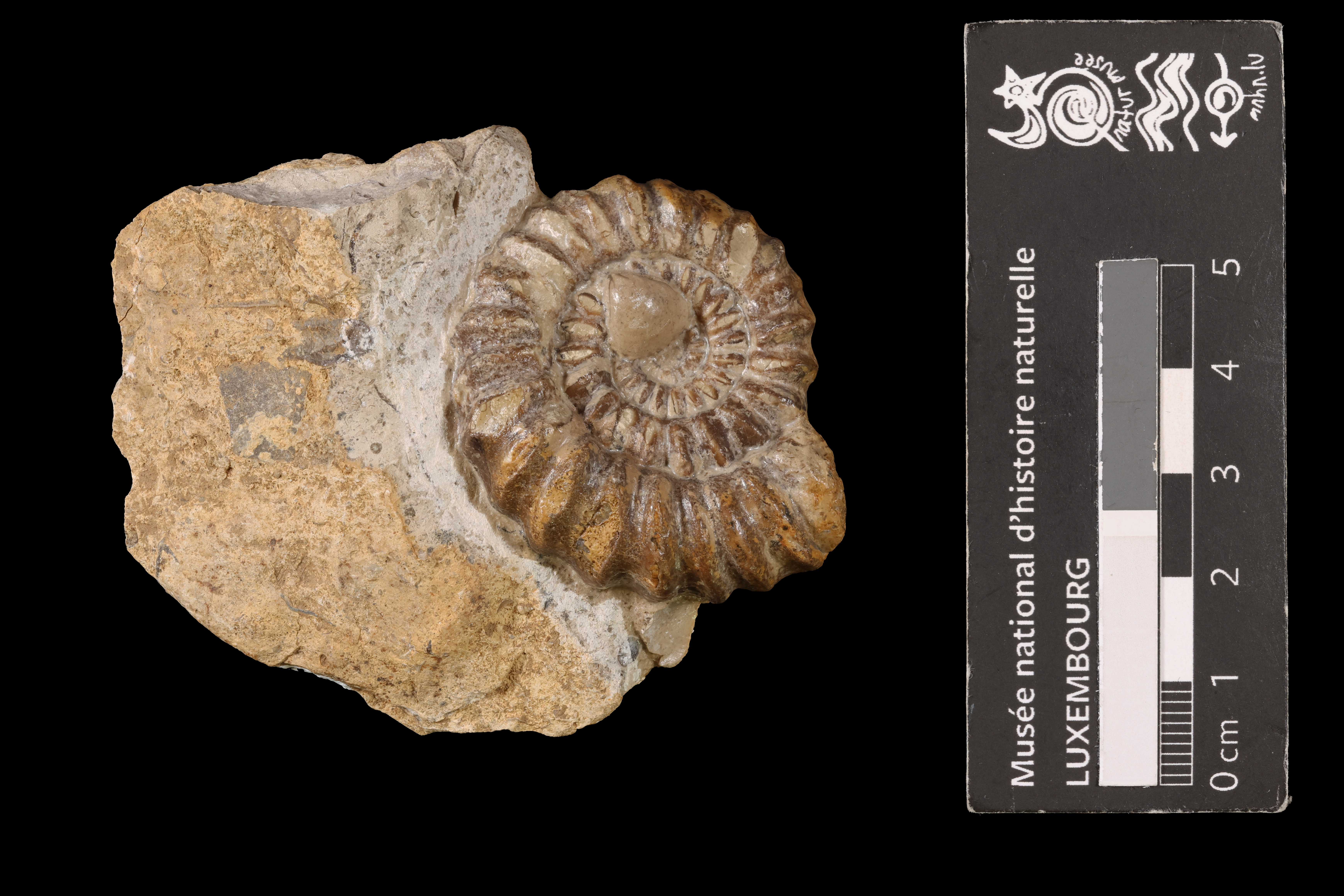
Not Aegoceras (Beaniceras). This is Beaniceras Buckman, 1913, a relative — both are Liparoceratidae.
Kurt Meiers · CC0 · via GBIF. May be a photograph of a specimen, or an artist’s reconstruction — an interpretation of a skeleton, since colour and soft tissue are almost never preserved.
On record
Recorded, not inferred- Sits inside
- AegocerasPBDB
- Diet
- carnivorePBDB, for Ammonoidea
- Life habit
- nektonicPBDB, for Ammonoidea
- Motility
- fast-movingPBDB, for Ammonoidea
- Vision
- well-developedPBDB, for Cephalopoda
- Environment
- marinePBDB, for Cephalopoda
Time the record covers
At most 8.7 million years on record.
Every occurrence read is dated to somewhere between 192.9 Mya and 184.2 Mya, and nothing in the dating separates them, so that window is what the record shows rather than a span.
59 occurrences of Aegoceras (Beaniceras) on record, most of them in the Early Jurassic. Bar height is expected occurrences, not a count: each fossil is spread across the span it is dated to, so a tall narrow bar means tight dating and a low wide one means loose.
When
59 occurrences- Early Jurassic100%
These are dates about fossils, not the animal: the record can only begin after it arose and end before it died out, so either end may reach further. Shares are expected occurrences: a fossil dated to a span is counted partly in each period it straddles. More on what this infers.
Found in
4 formations
- Charmouth Mudstone Formation · Lias Group4
- Almonacid de la Cuba Formation3
- Lower Lias Formation · Lias Group3
- Staithes Sandstone Formation1
Loading coastlines…
The named rock units Aegoceras (Beaniceras) has been recovered from, largest first. Drawn where the rock is now, not where it formed. 48 occurrences have no formation on record, which is common for older literature.
Aegoceras (Beaniceras) and its relatives
Early JurassicWhere Aegoceras (Beaniceras) and its relatives were recorded in the Early Jurassic.
Found in the same rock
165 taxa- Lytoceras fimbriatum21 sites
- Beaniceras centaurus12 sites
- Liparoceras9 sites
- Derolytoceras tortum5 sites
- Parainoceramya ventricosa5 sites
- Tragophylloceras loscombi5 sites
- Liparoceras kilsbiense4 sites
- Radstockiceras gemmellaroi4 sites
- Androgynoceras geyeri3 sites
- Liparoceras (Liparoceras) cheltiense3 sites
- Pleuromya3 sites
- Tragophylloceras ibex3 sites
- Acanthopleuroceras lepidum2 sites
- Acanthopleuroceras maugenesti2 sites
- Acanthopleuroceras valdani2 sites
- Aegoceras maculatum2 sites
- Amberleya2 sites
- Androgynoceras capricornus2 sites
- Astarte2 sites
- Cardinia2 sites
- Cirsostylus euomphalus2 sites
- Cryptaulax slatteri2 sites
- Gibbirhynchia curviceps2 sites
- Hastites2 sites
The Paleobiology Database records 40 sites for Aegoceras (Beaniceras), and this reads all of them. The number is how many of those sites it was catalogued from too. The 24 sharing the most are listed.
This is not a list of everything alive at the time. It is only what has come out of the same ground as this animal and been written down.
Entered from
10 references- Les ammonites du Carixien des Causses (France)39
- Late Triassic and early Jurassic biostratigraphy of the Felixkirk Borehole, North Yorkshire4
- The Belemnite marls of Charmouth, a series in the Lias of the Dorset Coast4
- El Jurasico Inferior en la seccion de Almonacid de la Cuba (sector central de la Cordillera Iberica, Zaragoza, Espana) [Lower Jurassic at the Almonacid de la Cuba section (central sector of the Iberian Range, Zaragoza, Spain)]3
- The Liassic Ammonite Faunas of the Stowell Park Borehole3
- Brachiopodes liasiques de la Bordure Sud du Massif Armoricain2
- The bipolar bivalve Oxytoma (Palmoxytoma) cygnipes (Young and Bird, 1822) in the Upper Pliensbachian of Germany1
- Pliensbachian magnetostratigraphy: new data from Paris Basin (France)1
- The Lower Jurassic Rocks of East Greenland Part 11
- Paléontologie Française - Description zoologique et géologique de tous les animaux mollusques et rayonnés fossiles de France - Terrains jurassiques. [Céphalopodes]1
Each of the 59 occurrences read was entered from one of these publications, ordered by how many each accounts for. This is not a search for papers mentioning the name. Entries link to doi.org where the Paleobiology Database holds an identifier, and to its own record where it does not. Relayed as the Paleobiology Database holds them, not checked against what they resolve to.
Media and terms
Media content1
Picture of Beaniceras Buckman, 1913
- Source
- GBIF
- Credit
- Kurt Meiers
- Licence
- CC0
- Commercial use
- the licence allows it
No 3D scan of Aegoceras (Beaniceras) was found in MorphoSource and Sketchfab.
Smithsonian Open Access was not reached for this taxon, so this list is what the others held rather than everything there is.
This is what the site found, which is not the same as what exists.
Keep going
What may have been alongside itAegoceras through timeFormations of the Early JurassicThe world it lived on
Occurrence data from the Paleobiology Database, CC BY 4.0. (Buckman 1913)