Agoniatites
Agoniatites is a genus of primitive ammonoids belonging to the order Agoniatitida and family Agoniatitidae.

Uncredited · via Wikipedia/Commons. May be a photograph of a specimen, or an artist’s reconstruction — an interpretation of a skeleton, since colour and soft tissue are almost never preserved.
On record
Recorded, not inferred- Sits inside
- AgoniatitidaePBDB
- Diet
- carnivorePBDB, for Ammonoidea
- Life habit
- nektonicPBDB, for Agoniatitida
- Motility
- fast-movingPBDB, for Ammonoidea
- Vision
- well-developedPBDB, for Cephalopoda
- Environment
- marinePBDB, for Cephalopoda
Time the record covers
At least 5.5 million years on record.
The record covers at least 393.47 Mya to 387.95 Mya. No occurrence read is dated outside 419.62 Mya to 358.86 Mya.
86 occurrences of Agoniatites on record, most of them in the Devonian. Bar height is expected occurrences, not a count: each fossil is spread across the span it is dated to, so a tall narrow bar means tight dating and a low wide one means loose.
When
86 occurrences- Devonian100%
These are dates about fossils, not the animal: the record can only begin after it arose and end before it died out, so either end may reach further. Shares are expected occurrences: a fossil dated to a span is counted partly in each period it straddles. More on what this infers.
Found in
10 formations
- Srbsko Formation35
- Chotec Formation4
- Marcellus Formation3
- Union Springs Formation · Hamilton Group2
- Trebotov Formation2
- Headless Formation1
Loading coastlines…
The named rock units Agoniatites has been recovered from, largest first. Drawn where the rock is now, not where it formed. 35 occurrences have no formation on record, which is common for older literature.
Agoniatites and its relatives
DevonianWhere Agoniatites and its relatives were recorded in the Devonian.
Found in the same rock
254 taxa- Cabrieroceras crispiforme13 sites
- Subanarcestes macrocephalus13 sites
- Holzapfeloceras10 sites
- Pinacites jugleri10 sites
- Fidelites fidelis9 sites
- Cabrieroceras housei8 sites
- Fidelites clariondi8 sites
- Pinacites eminens8 sites
- Polygnathus linguiformis8 sites
- Crispoceras tureki7 sites
- Fidelites occultus7 sites
- Subanarcestes marhoumensis7 sites
- Anarcestes plebeius6 sites
- Polygnathus6 sites
- Foordites veniens5 sites
- Paraphyllites tabuloides5 sites
- Styliolina fissurella5 sites
- Subanarcestes coronatus5 sites
- Diallagites testatus4 sites
- Exopinacites singularis4 sites
- Fidelites ruppachensis4 sites
- Leiorhynchus4 sites
- Polygnathus costatus4 sites
- Sobolewia inflata4 sites
The Paleobiology Database records 60 sites for Agoniatites, and this reads all of them. The number is how many of those sites it was catalogued from too. The 24 sharing the most are listed.
This is not a list of everything alive at the time. It is only what has come out of the same ground as this animal and been written down.
Entered from
11 references- Devonian goniatites from the Barrandian area, Czechoslovakia35
- Quantitative stratigraphy and taxonomy of late Emsian and Eifelian ammonoids of the eastern Anti-Atlas (Morocco)23
- Devonische Goniatiten aus SW-Algerien und ihre stratigraphische Einordnung in die Conodonten-Abfolge10
- The Bohemian Lower Devonian Stages7
- Quantitative Analysis of Paleocommunities in the Lower Part of the Hamilton Group near Cazenovia, New York3
- Stratigraphy and Paleontology of the Richfield Springs and Cooperstown Quadrangles, New York3
- Lower Givetian brachiopods from Central Nevada1
- Facies and Faunal Relations at Edge of Early Mid-Devonian Carbonate Shelf South Nahanni River Area, NWT1
- Middle Devonian Reefs in Spanish Sahara1
- Ordovician, Silurian, and Devonian biostratigraphy of east-central Alaska1
- The classification and distribution of the Hamilton and Chemung series of central and eastern New York1
Each of the 86 occurrences read was entered from one of these publications, ordered by how many each accounts for. This is not a search for papers mentioning the name. Entries link to doi.org where the Paleobiology Database holds an identifier, and to its own record where it does not. Relayed as the Paleobiology Database holds them, not checked against what they resolve to.
Media and terms
Media content2

Picture of Agoniatites
- Source
- Wikipedia/Commons
- Credit
- nobody named on the record
- Licence
- not stated by the source
- Commercial use
- cannot be read from the licence given — check the record
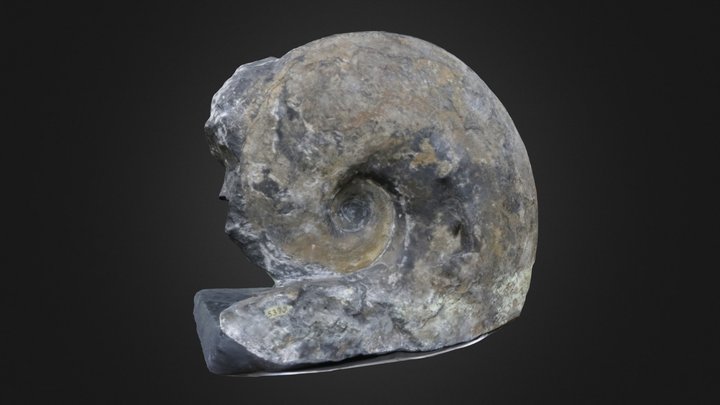
3D model
- Source
- Sketchfab
- Licence
- CC0 Public Domain
- Commercial use
- the licence allows it
Smithsonian Open Access and MorphoSource were not reached for this taxon, so this list is what the others held rather than everything there is.
The description on this site
- Source
- Wikipedia, “Agoniatites”
- Licence
- CC BY-SA 4.0
This is what the site found, which is not the same as what exists.
Keep going
What may have been alongside itAgoniatitidae through timeFormations of the DevonianThe world it lived on
Occurrence data from the Paleobiology Database, CC BY 4.0. (Meek 1877)