Akera
Akera is a marine genus of sea hare in the family Akeridae, known from the late Callovian (Jurassic) to the recent periods.

Francisco Welter Schultes · Public Domain · via Wikipedia/Commons. May be a photograph of a specimen, or an artist’s reconstruction — an interpretation of a skeleton, since colour and soft tissue are almost never preserved.
On record
Recorded, not inferred- Sits inside
- AkeridaePBDB
- Life habit
- epifaunalPBDB, for Gastropoda
- Motility
- actively mobilePBDB, for Gastropoda
- Vision
- limitedPBDB, for Gastropoda
Time the record covers
At least 165 million years on record.
The record covers at least 165.3 Mya to 129 ka. No occurrence read is dated outside 170.9 Mya to 11.7 ka.
31 occurrences of Akera on record, most of them in the Eocene. The Paleobiology Database records this as a living group. Bar height is expected occurrences, not a count: each fossil is spread across the span it is dated to, so a tall narrow bar means tight dating and a low wide one means loose.
When
31 occurrences- Middle Jurassic10%
- Early Cretaceous3%
- Late Cretaceous13%
- Paleocene3%
- Eocene58%
- Oligocene6%
- Miocene3%
- Pleistocene3%
These are dates about fossils, not the animal: the record can only begin after it arose and end before it died out, so either end may reach further. Shares are expected occurrences: a fossil dated to a span is counted partly in each period it straddles. More on what this infers.
Found in
15 formations
- Shekhan Formation6
- Dhruma Formation · Shaqra Group2
- Llajas Formation2
- Weches Formation · Claiborne Group2
- Galala Formation2
- Nacatoch Sand Formation1
Loading coastlines…
The named rock units Akera has been recovered from, largest first. Drawn where the rock is now, not where it formed. 7 occurrences have no formation on record, which is common for older literature.
Akera and its relatives
EoceneWhere Akera and its relatives were recorded in the Eocene.
Found in the same rock
494 taxa- Ampullella nuttalli4 sites
- Gosavia multidentata4 sites
- Tibia (Hippochrenes) ampla4 sites
- Arca3 sites
- Pachycrommium flemingi3 sites
- Pitar3 sites
- Rimella pakistanica3 sites
- Terebellum carcassense3 sites
- Ampullina2 sites
- Ancilla staminea2 sites
- Anisomyon2 sites
- Athleta petrosa2 sites
- Calyptraea (Trochita) aperta2 sites
- Cardium2 sites
- Cerithiopsis2 sites
- Cerithium2 sites
- Chama2 sites
- Chlamys2 sites
- Corbula (Caryocorbula) carmenensis2 sites
- Coronia carmenensis2 sites
- Crassatella2 sites
- Dentalium2 sites
- Ectinochilus olssoni2 sites
- Electroma2 sites
The Paleobiology Database records 25 sites for Akera, and this reads all of them. The number is how many of those sites it was catalogued from too. The 24 sharing the most are listed.
This is not a list of everything alive at the time. It is only what has come out of the same ground as this animal and been written down.
Entered from
21 references- A contribution to the study of the Eocene in Western Pakistan and Western India: C. The description of the Scaphopoda and Gastropoda from standard sections in the Rakhi Nala and Zindar Pir areas of the Western Punjab and in the Kohat District7
- Fauna de moluste a depozitelor Paleogene din nord-vestul Transilvaniei [Molluscan fauna from Paleogene deposits from NW Transilvania]3
- Additions to the Eocene megafossil fauna of the Llajas Formation, Simi Valley, southern California2
- Le Jurassique D`Arabie Centrale2
- Resilience of marine invertebrate communities during the early Cenozoic hyperthermals1
- Taxonomy and palaeoecology of the Cenomanian-Turonian macroinvertebrates from eastern Sinai, Egypt (part A)1
- Late Cretaceous macrofossils from Sinai, Egypt1
- Turonian inoceramids and biostratigraphy of the Sergipe Basin, northeastern Brazil: an integrated study of the Votorantim and Nassau quarries1
- Révision des Gastropoda (Mollusca) du stratotype de L'Aquitanien (Miocéne inf.) site de Saucats "Lariey", Gironde, France1
- The new species Terebellum oympiae n. sp. (Gastropoda, Seraphidae) from the Middle Eocene mollusc assemblage of Nanggulan (Yogokarta province, Java, Indonesia)1
- La faune danienne de Vigny (Val-d’Oise, France): importance pour l’étude de la diversification des mollusques au début du Tertiaire1
- Fossil cuttlebones in the Vicentinian Priabonian (Late Eocene, Veneto Region, NE Italy)1
Each of the 31 occurrences read was entered from one of these publications, ordered by how many each accounts for. This is not a search for papers mentioning the name. 9 further references are not listed. Entries link to doi.org where the Paleobiology Database holds an identifier, and to its own record where it does not. Relayed as the Paleobiology Database holds them, not checked against what they resolve to.
Media and terms
Media content1
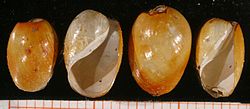
Picture of Akera
- Source
- Wikipedia/Commons
- Credit
- Francisco Welter Schultes
- Licence
- Public Domain
- Commercial use
- the licence allows it
No 3D scan of Akera was found in MorphoSource and Sketchfab.
Smithsonian Open Access was not reached for this taxon, so this list is what the others held rather than everything there is.
The description on this site
- Source
- Wikipedia, “Akera”
- Licence
- CC BY-SA 4.0
This is what the site found, which is not the same as what exists.
Keep going
What may have been alongside itAkeridae through timeFormations of the EoceneThe world it lived on
Occurrence data from the Paleobiology Database, CC BY 4.0. (Muller 1776)