Amphidonte

via iDigBio · CC BY-NC-ND · via iDigBio. May be a photograph of a specimen, or an artist’s reconstruction — an interpretation of a skeleton, since colour and soft tissue are almost never preserved.
On record
Recorded, not inferred- Sits inside
- NanogyriniPBDB
- Diet
- suspension feederPBDB, for Gryphaeidae
- Life habit
- epifaunalPBDB, for Gryphaeidae
- Motility
- stationary, attachedPBDB, for Gryphaeidae
- Vision
- blindPBDB, for Bivalvia
- Environment
- marine,brackishPBDB, for Ostreida
Time the record covers
At least 82 million years on record.
The record covers at least 154.8 Mya to 72.2 Mya. No occurrence read is dated outside 157.9 Mya to 66 Mya.
117 occurrences of Amphidonte on record, most of them in the Late Cretaceous. Bar height is expected occurrences, not a count: each fossil is spread across the span it is dated to, so a tall narrow bar means tight dating and a low wide one means loose.
When
117 occurrences- Late Jurassicunder 1%
- Early Cretaceous20%
- Late Cretaceous79%
These are dates about fossils, not the animal: the record can only begin after it arose and end before it died out, so either end may reach further. Shares are expected occurrences: a fossil dated to a span is counted partly in each period it straddles. More on what this infers.
Found in
29 formations
- Jagüel Formation · Malargüe Group11
- Kahuitara Tuff Formation · Pitt Island Group10
- Roca Formation · Malargüe Group8
- Bilá Formation6
- Qishn Formation5
- Blackdown Greensand Formation4
Loading coastlines…
The named rock units Amphidonte has been recovered from, largest first. Drawn where the rock is now, not where it formed. 5 further formations hold fewer occurrences each and are not listed. 34 occurrences have no formation on record, which is common for older literature.
Amphidonte and its relatives
Late CretaceousWhere Amphidonte and its relatives were recorded in the Late Cretaceous.
Found in the same rock
1,047 taxa- Spondylus28 sites
- Pycnodonte vesicularis22 sites
- Lyriochlamys21 sites
- Entolium membranaceum16 sites
- Modiolus16 sites
- Panopea16 sites
- Agerostrea ungulatus14 sites
- Lima14 sites
- Crassatella13 sites
- Limatula13 sites
- Pseudolimea13 sites
- Pycnodonte13 sites
- Nucula12 sites
- Chlamys11 sites
- Glycymerita11 sites
- Granocardium11 sites
- Mesocallista11 sites
- Plicatula11 sites
- Anomia10 sites
- Barbatia10 sites
- Cucullaea10 sites
- Echinoidea10 sites
- Astarte9 sites
- Ctenoides9 sites
The Paleobiology Database records 95 sites for Amphidonte, and this reads all of them. The number is how many of those sites it was catalogued from too. The 24 sharing the most are listed.
This is not a list of everything alive at the time. It is only what has come out of the same ground as this animal and been written down.
Entered from
38 references- Unpublished data on Cretaceous-Paleocene molluscan assemblages17
- Molluscs at the K/Pg boundary in Argentina: Extinction and recovery patterns. unpublished Ph.D. thesis12
- A systematic survey of the Mesozoic Bivalvia from Japan9
- Late Cretaceous environments and communities as recorded at Chrtníky (Bohemian Cretaceous Basin, Czech Republic)7
- Cretaceous oysters from North Africa : origin and distribution6
- The Jurassic and Lower Cretaceous of Wadi Hajar, southern Yemen5
- Tectonic and palaeobiogeographic significance of the Chatham Islands, South Pacific, Late Cretaceous fauna5
- Cretaceous-Cenozoic geology and biostratigraphy of the Chatham Islands, New Zealand5
- Die Oberkreide der Sack-Mulde bei Alfeld (Cenoman-Unter-Coniac) Lithologie, Biostratigraphie und Inoceramen5
- Las ostras del límite Cretácico-Paleógeno de la cuenca Neuquina (Argentina). Su importancia bioestratigráfica y paleobiogeográfica4
- Upper Cretaceous molluscs and brachiopods from Badakhshan4
- The sedimentology and biostratigraphy of a temporary exposure of Blackdown Greensand (Lower Cretaceous, upper Albian) at Blackborough, Devon3
Each of the 117 occurrences read was entered from one of these publications, ordered by how many each accounts for. This is not a search for papers mentioning the name. 26 further references are not listed. Entries link to doi.org where the Paleobiology Database holds an identifier, and to its own record where it does not. Relayed as the Paleobiology Database holds them, not checked against what they resolve to.
Media and terms
Media content2
Picture of Amphidonte
- Source
- iDigBio
- Credit
- via iDigBio
- Licence
- CC BY-NC-ND
- Commercial use
- the licence does not allow it
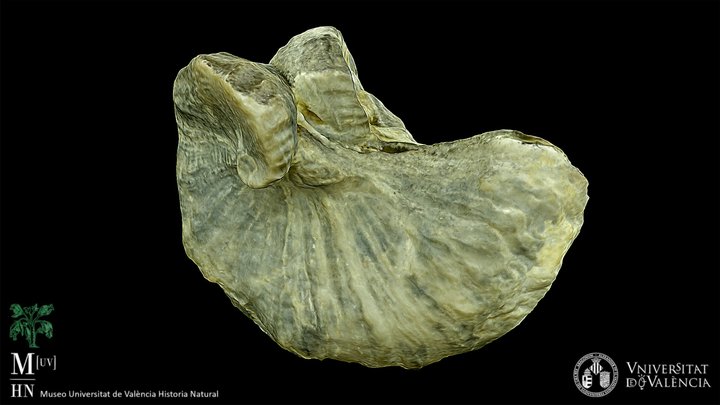
3D model
- Source
- Sketchfab
- Licence
- CC Attribution
- Commercial use
- cannot be read from the licence given — check the record
Smithsonian Open Access was not reached for this taxon, so this list is what the others held rather than everything there is.
This is what the site found, which is not the same as what exists.
Keep going
What may have been alongside itNanogyrini through timeFormations of the Late CretaceousThe world it lived on
Occurrence data from the Paleobiology Database, CC BY 4.0. Fischer von Waldheim 1829