Anacodon
Anacodon is a genus of arctocyonid from the Eocene of North America. It is known from the type species, A. ursidens, a second species, A. cultridens, and a possible third, A. nexus. Initially believed to be a relative of Phenacodon, it was subsequently found to be an arctocyonid, possibly related to Claenodon. Anacodon was extremely robust compared to other members of its family, and may have been capable of climbing and digging like modern bears.
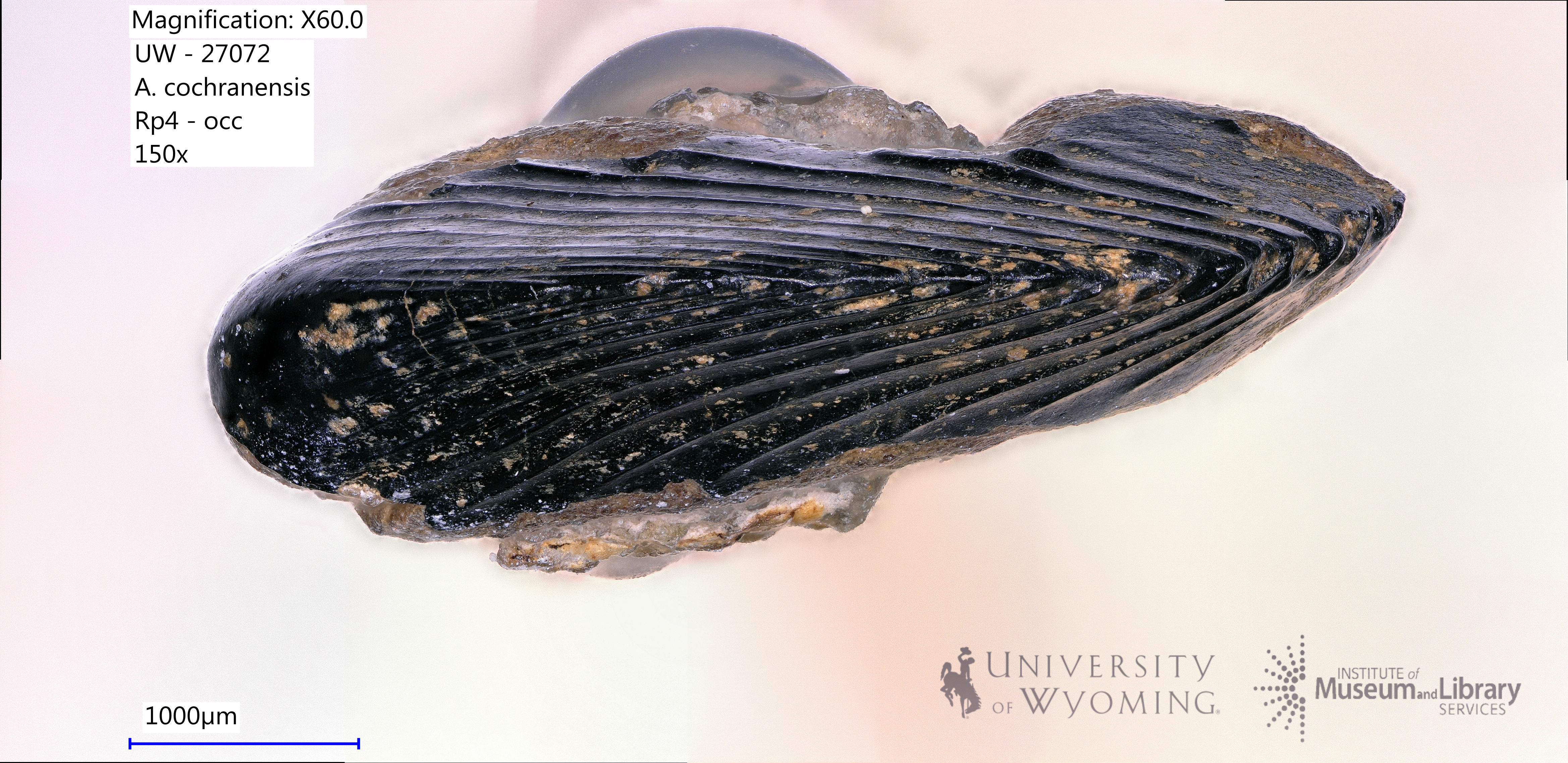
via iDigBio · via iDigBio. May be a photograph of a specimen, or an artist’s reconstruction — an interpretation of a skeleton, since colour and soft tissue are almost never preserved.
On record
Recorded, not inferred- Sits inside
- ArctocyonidaePBDB
- Diet
- omnivorePBDB, for Arctocyonidae
- Life habit
- ground dwellingPBDB, for Arctocyonidae
- Motility
- actively mobilePBDB, for Osteichthyes
- Environment
- terrestrialPBDB, for Eutheria
Time the record covers
At least 1.5 million years on record.
The record covers at least 57.5 Mya to 56 Mya. No occurrence read is dated outside 60.9 Mya to 48.07 Mya.
29 occurrences of Anacodon on record. Bar height is expected occurrences, not a count: each fossil is spread across the span it is dated to, so a tall narrow bar means tight dating and a low wide one means loose.
When
29 occurrencesThese are dates about fossils, not the animal: the record can only begin after it arose and end before it died out, so either end may reach further. Shares are expected occurrences: a fossil dated to a span is counted partly in each period it straddles. More on what this infers.
Found in
4 formations
- Willwood Formation26
- Fort Union Formation1
- Wind River Formation1
- Margaret Formation · Eureka Sound Group1
Loading coastlines…
The named rock units Anacodon has been recovered from, largest first. Drawn where the rock is now, not where it formed.
Found in the same rock
214 taxa- Cantius abditus22 sites
- Esthonyx bisulcatus22 sites
- Phenacodus vortmani17 sites
- Diacodexis metsiacus15 sites
- Coryphodon14 sites
- Arenahippus pernix12 sites
- Heptodon calciculus12 sites
- Hyopsodus12 sites
- Vulpavus australis12 sites
- Absarokius abbotti11 sites
- Absarokius metoecus11 sites
- Hyopsodus minor11 sites
- Microsyops latidens11 sites
- Bunophorus etsagicus10 sites
- Didymictis10 sites
- Palaeictops bicuspis10 sites
- Bunophorus9 sites
- Paramys excavatus9 sites
- Phenacolemurinae9 sites
- Prototomus9 sites
- Viverravus9 sites
- Didymictis protenus8 sites
- Palaeosinopa veterrima8 sites
- Paramys copei8 sites
The Paleobiology Database records 29 sites for Anacodon, and this reads all of them. The number is how many of those sites it was catalogued from too. The 24 sharing the most are listed.
This is not a list of everything alive at the time. It is only what has come out of the same ground as this animal and been written down.
Entered from
6 references- Stratigraphy and mammalian paleontology of the McCullough Peaks, northern Bighorn Basin, Wyoming: Implications for biochronology, basin development, and community reorganization across the Paleocene-Eocene boundary14
- Faunal Zonation of the Willwood Formation in the Central Bighorn Basin, Wyoming8
- Distribution and stratigraphic correlation of upper Paleocene and lower Eocene fossil mammal and plant localities of the Fort Union, Willwood, and Tatman formations, southern Bighorn Basin, Wyoming4
- Early Eocene Leptictida, Pantolesta, Creodonta, Carnivora, and Mesonychidae (Mammalia) from the Eureka Sound Group, Ellesmere Island, Nunavut1
- Late Paleocene (Tiffanian) mammalian fauna of two localities in eastern Montana1
- The mammalian fauna of the Lysite Member, Wind River Formation (early Eocene) of Wyoming1
Each of the 29 occurrences read was entered from one of these publications, ordered by how many each accounts for. This is not a search for papers mentioning the name. Entries link to doi.org where the Paleobiology Database holds an identifier, and to its own record where it does not. Relayed as the Paleobiology Database holds them, not checked against what they resolve to.
Media and terms
Media content1
Picture of Anacodon
- Source
- iDigBio
- Credit
- via iDigBio
- Licence
- not stated by the source
- Commercial use
- cannot be read from the licence given — check the record
No 3D scan of Anacodon was found in Sketchfab.
Smithsonian Open Access and MorphoSource were not reached for this taxon, so this list is what the others held rather than everything there is.
The description on this site
- Source
- Wikipedia, “Anacodon”
- Licence
- CC BY-SA 4.0
This is what the site found, which is not the same as what exists.
Keep going
What may have been alongside itArctocyonidae through timeThe world it lived on
Occurrence data from the Paleobiology Database, CC BY 4.0. Cope 1882