Anaspida
Anaspida is an extinct group of jawless fish that existed from the early Silurian period to the late Devonian period. They were classically regarded as the ancestors of lampreys, but this is denied in recent phylogenetic analyses, although some analyses show these groups would be at least related. Anaspids were small marine fish that lacked a heavy bony shield and paired fins, but were distinctively hypocercal.

Apokryltaros · CC BY-SA 4.0 · via Wikipedia/Commons. May be a photograph of a specimen, or an artist’s reconstruction — an interpretation of a skeleton, since colour and soft tissue are almost never preserved.
On record
Recorded, not inferred- Sits inside
- CyclostomataPBDB
- Motility
- actively mobilePBDB, for Chordata
Time the record covers
At least 418 million years on record.
The record covers at least 430.6 Mya to 11.63 Mya. No occurrence read is dated outside 443.1 Mya to 3.6 Mya.
36 occurrences of Anaspida on record, most of them in the Silurian. The Paleobiology Database records this as a living group, and the chart stops with its fossils rather than at the present. Bar height is expected occurrences, not a count: each fossil is spread across the span it is dated to, so a tall narrow bar means tight dating and a low wide one means loose.
When
36 occurrencesThese are dates about fossils, not the animal: the record can only begin after it arose and end before it died out, so either end may reach further. Shares are expected occurrences: a fossil dated to a span is counted partly in each period it straddles. More on what this infers.
Found in
14 formations
- Halla Formation9
- Sundvollen Formation3
- Kip Burn Formation · Priesthill Group2
- Fish Bed Formation · Glenbuck Group2
- Cowie Formation · Stonehaven Group2
- Klinteberg Formation2
Loading coastlines…
The named rock units Anaspida has been recovered from, largest first. Drawn where the rock is now, not where it formed. 7 occurrences have no formation on record, which is common for older literature.
Anaspida and its relatives
SilurianWhere Anaspida and its relatives were recorded in the Silurian.
Found in the same rock
271 taxa- Paralogania martinssoni8 sites
- Thelodus laevis8 sites
- Pterygolepis nitida6 sites
- Birkenia elegans5 sites
- Ctenognathodus murchisoni5 sites
- Oeselia5 sites
- Oulodus excavatus5 sites
- Oulodus siluricus5 sites
- Ozarkodina bohemica5 sites
- Ozarkodina confluens5 sites
- Rhyncholepis parvula5 sites
- Rytidolepis quenstedtii5 sites
- Thyestes verrucosus5 sites
- Tremataspis milleri5 sites
- Tremataspis schmidti5 sites
- Wurmiella excavata5 sites
- Ctenognathodus4 sites
- Loganellia4 sites
- Oeselaspis pustulata4 sites
- Saaremaaspis mickwitzi4 sites
- Ateleaspis tessellata3 sites
- Gomphonchus sandelensis3 sites
- Lanarkia horrida3 sites
- Lanarkia spinosa3 sites
The Paleobiology Database records 25 sites for Anaspida, and this reads all of them. The number is how many of those sites it was catalogued from too. The 24 sharing the most are listed.
This is not a list of everything alive at the time. It is only what has come out of the same ground as this animal and been written down.
Entered from
16 references- End-Wenlock terminal Mulde carbon isotope excursion in Gotland, Sweden: Integration of stratigraphy and taphonomy for correlations across restricted facies and specialized faunas11
- Silurian and earliest Devonian birkeniid anaspids from the Northern Hemisphere4
- Silurian communities of the Oslo Region, Norway3
- Silurian fossil fishes sites of Scotland3
- Habitat of Llandoverian-Lochkovian eurypterids3
- Vertebrate remains from Upper Silurian – Lower Devonian beds of Hall Land, North Greenland2
- Age of the basal ‘Lower Old Red Sandstone’ Stonehaven Group of Scotland: The oldest reported air-breathing land animal is Silurian (late Wenlock) in age1
- New birkeniid anaspid from the Lower Devonian of Scotland and its phylogenetic implications1
- A partial articulated acanthodian from the Silurian of New Brunswick, Canada1
- A new anapsid fish from the middle Silurian Cowie Harbour fish bed of Stonehaven, Scotland1
- Comparison of the Escuminac Formation ichthyofauna with other late Givetian/early Frasnian ichthyofaunas1
- Locality 6:6 Himmiste Quarry1
Each of the 36 occurrences read was entered from one of these publications, ordered by how many each accounts for. This is not a search for papers mentioning the name. 4 further references are not listed. Entries link to doi.org where the Paleobiology Database holds an identifier, and to its own record where it does not. Relayed as the Paleobiology Database holds them, not checked against what they resolve to.
Media and terms
Media content1
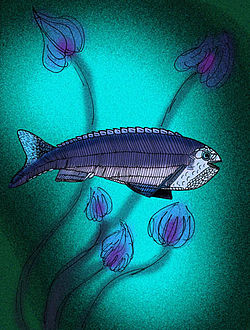
Picture of Anaspida
- Source
- Wikipedia/Commons
- Credit
- Apokryltaros
- Licence
- CC BY-SA 4.0
- Commercial use
- the licence allows it
No 3D scan of Anaspida was found in MorphoSource and Sketchfab.
Smithsonian Open Access was not reached for this taxon, so this list is what the others held rather than everything there is.
The description on this site
- Source
- Wikipedia, “Anaspida”
- Licence
- CC BY-SA 4.0
This is what the site found, which is not the same as what exists.
Keep going
What may have been alongside itCyclostomata through timeFormations of the SilurianThe world it lived on
Occurrence data from the Paleobiology Database, CC BY 4.0. (Traquair)