Anomalocardia
Anomalocardia is a genus of bivalves belonging to the family Veneridae.

DW · CC BY 4.0 · via Wikipedia/Commons. May be a photograph of a specimen, or an artist’s reconstruction — an interpretation of a skeleton, since colour and soft tissue are almost never preserved.
On record
Recorded, not inferred- Sits inside
- VenerinaePBDB
- Diet
- suspension feederPBDB
- Life habit
- infaunalPBDB
- Motility
- facultatively mobilePBDB
- Vision
- blindPBDB, for Bivalvia
Time the record covers
At least 23 million years on record.
The record covers at least 23.04 Mya to 11.7 ka. No occurrence read is dated outside 27.3 Mya to 0 Mya.
137 occurrences of Anomalocardia on record, most of them in the Pleistocene. The Paleobiology Database records this as a living group. Bar height is expected occurrences, not a count: each fossil is spread across the span it is dated to, so a tall narrow bar means tight dating and a low wide one means loose.
When
137 occurrences- Oligocene7%
- Miocene13%
- Pliocene34%
- Pleistocene37%
- Holocene9%
These are dates about fossils, not the animal: the record can only begin after it arose and end before it died out, so either end may reach further. Shares are expected occurrences: a fossil dated to a span is counted partly in each period it straddles. More on what this infers.
Found in
27 formations
- Pico Formation22
- Caloosahatchee Formation · Okeechobee Group16
- Towsley Formation15
- Arcadia Formation · Hawthorn Group11
- Fort Thompson Formation9
- Bermont Formation5
Loading coastlines…
The named rock units Anomalocardia has been recovered from, largest first. Drawn where the rock is now, not where it formed. 3 further formations hold fewer occurrences each and are not listed. 25 occurrences have no formation on record, which is common for older literature.
Anomalocardia and its relatives
PleistoceneWhere Anomalocardia and its relatives were recorded in the Pleistocene.
Found in the same rock
1,859 taxa- Chione (Anomalocardia) fernandoensis35 sites
- Turritella cooperi29 sites
- Glossaulax reclusiana23 sites
- Chione cancellata22 sites
- Calyptraea filosa20 sites
- Saccella taphria20 sites
- Pusio humerosus19 sites
- Dallocardia quadragenarium16 sites
- Olivella mutica16 sites
- Anadara15 sites
- Arcopsis adamsi15 sites
- Bostrycapulus aculeatus15 sites
- Parvilucina multistriata15 sites
- Bulla striata14 sites
- Crepidula plana14 sites
- Nassarius vibex14 sites
- Tellina14 sites
- Turritella14 sites
- Anomia simplex13 sites
- Lucinoma annulata13 sites
- Marginella13 sites
- Mercenaria campechiensis13 sites
- Panopea generosa13 sites
- Plicatula gibbosa13 sites
The Paleobiology Database records 97 sites for Anomalocardia, and this reads all of them. Of that, one read hit the database's own return limit, so every count below is a floor rather than a total. The number is how many of those sites it was catalogued from too. The 24 sharing the most are listed.
This is not a list of everything alive at the time. It is only what has come out of the same ground as this animal and been written down.
Entered from
44 references- Geology of southeastern Ventura basin, Los Angeles County, California17
- Unpublished census data from Atlantic coastal plain and circum-Caribbean Neogene assemblages and taxonomic opinions16
- Early Pliocene marine climate and environment of the eastern Ventura Basin, Southern California11
- Molluscs of the Tampa and Suwannee Limestones11
- Neogene Biostratigraphy of the Charlotte Harbor Area in Southwestern Florida7
- Late Pliocene megafossils of the Pico Formation, Newhall area, Los Angeles County, Southern California6
- Cenozoic Mollusks from the drillholes Cassino and Palmares do Sul of the Coastal Plain of Rio Grande do Sul5
- The Pleistocene molluscan fauna from Leisley Shell Pit 1, Hillsborough County, Florida4
- Miocene and Pliocene mollusks from Trinidad4
- Taphonomy of the Late Pleistocene marine molluscan assemblages from Uruguay3
- Unpublished notes on Caribbean collection of Jack and Winifred Gibson-Smith, Naturhistorisches Museum Basel3
- Petuch and Roberts, 20073
Each of the 137 occurrences read was entered from one of these publications, ordered by how many each accounts for. This is not a search for papers mentioning the name. 32 further references are not listed. Entries link to doi.org where the Paleobiology Database holds an identifier, and to its own record where it does not. Relayed as the Paleobiology Database holds them, not checked against what they resolve to.
Media and terms
Media content2
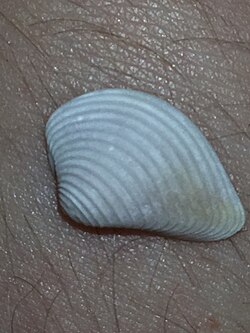
Picture of Anomalocardia
- Source
- Wikipedia/Commons
- Credit
- DW
- Licence
- CC BY 4.0
- Commercial use
- the licence allows it
CT scan
- Source
- MorphoSource
- Licence
- not stated by the source
- Commercial use
- cannot be read from the licence given — check the record
- Specimen
- Anomalocardia puella · USNM:IZ:USNM 653508
Smithsonian Open Access was not reached for this taxon, so this list is what the others held rather than everything there is.
The description on this site
- Licence
- CC BY-SA 4.0
This is what the site found, which is not the same as what exists.
Keep going
What may have been alongside itVenerinae through timeFormations of the PleistoceneThe world it lived on
Occurrence data from the Paleobiology Database, CC BY 4.0. (Schumacher 1817)