Aplodinotus grunniens
The freshwater drum, Aplodinotus grunniens, is a fish endemic to North and Central America. It is the only species in the genus Aplodinotus, and is a member of the family Sciaenidae. It is the only North American member of the group that inhabits freshwater for its entire life. Its generic name, Aplodinotus, comes from Greek meaning "single back", and the specific epithet, grunniens, comes from a Latin word meaning "grunting". It is given to it because of the grunting noise that mature males make. This noise comes from a special set of muscles within the body cavity that vibrate against the swim bladder. The purpose of the grunting is unknown, but due to it being present in only mature males and during the spawning season, it is assumed to be linked to spawning.

Drawing by Dunana Raver · Public Domain · via Wikipedia/Commons. May be a photograph of a specimen, or an artist’s reconstruction — an interpretation of a skeleton, since colour and soft tissue are almost never preserved.
On record
Recorded, not inferred- Also called
- freshwater drumPBDB
- Sits inside
- AplodinotusPBDB
- Motility
- actively mobilePBDB, for Osteichthyes
Time the record covers
At least 12 million years on record.
The record covers at least 12.5 Mya to 11.7 ka. No occurrence read is dated outside 16.3 Mya to 0 Mya.
8 occurrences of Aplodinotus grunniens on record, most of them in the Pleistocene. The Paleobiology Database records this as a living group. Bar height is expected occurrences, not a count: each fossil is spread across the span it is dated to, so a tall narrow bar means tight dating and a low wide one means loose.
When
8 occurrences- Miocene25%
- Pleistocene50%
- Holocene25%
These are dates about fossils, not the animal: the record can only begin after it arose and end before it died out, so either end may reach further. Shares are expected occurrences: a fossil dated to a span is counted partly in each period it straddles. More on what this infers.
Found in
3 formations
- Valentine Formation · Ogallala Group1
- Ogallala Formation1
- Shuler Formation1
Loading coastlines…
The named rock units Aplodinotus grunniens has been recovered from, largest first. Drawn where the rock is now, not where it formed. 5 occurrences have no formation on record, which is common for older literature.
Aplodinotus grunniens and its relatives
PleistoceneWhere Aplodinotus grunniens and its relatives were recorded in the Pleistocene.
Found in the same rock
418 taxa- Ictalurus4 sites
- Lepisosteus4 sites
- Odocoileus virginianus4 sites
- Amia calva3 sites
- Castor canadensis3 sites
- Ictalurus punctatus3 sites
- Ondatra zibethicus3 sites
- Procyon lotor3 sites
- Rana pipiens3 sites
- Sciurus carolinensis3 sites
- Trionychidae3 sites
- Ursus americanus3 sites
- Alligator mississippiensis2 sites
- Amnicola2 sites
- Anserinae2 sites
- Atractosteus spatula2 sites
- Bufo hibbardi2 sites
- Bufo valentinensis2 sites
- Canidae2 sites
- Carychium2 sites
- Catostomus2 sites
- Catostomus catostomus2 sites
- Cricetidae2 sites
- Cyprinidae2 sites
The Paleobiology Database records 8 sites for Aplodinotus grunniens, and this reads all of them. The number is how many of those sites it was catalogued from too. The 24 sharing the most are listed.
This is not a list of everything alive at the time. It is only what has come out of the same ground as this animal and been written down.
Entered from
8 references- After Hopewell in Southern Québec1
- Pleistocene vertebrates from the pre-late Wisconsinan Mill Creek site, St. Clair County, Michigan1
- Vertebrate paleontology of the proposed Norden Reservoir Area, Brown, Cherry and Keya Paha counties, Nebraska1
- The Taylor Bayou Local Fauna (Pleistocene) near Houston, Texas1
- Systematics and faunal analysis of a Lower Pliocene vertebrate assemblage from Trego County, Kansas1
- The Pleistocene vertebrates of Michigan1
- The Moore Pit local fauna; Pleistocene of Texas1
- Animal remains from Ohio rock shelters1
Each of the 8 occurrences read was entered from one of these publications, ordered by how many each accounts for. This is not a search for papers mentioning the name. Entries link to doi.org where the Paleobiology Database holds an identifier, and to its own record where it does not. Relayed as the Paleobiology Database holds them, not checked against what they resolve to.
Media and terms
Media content1
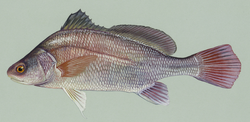
Picture of Aplodinotus grunniens
- Source
- Wikipedia/Commons
- Credit
- Drawing by Dunana Raver
- Licence
- Public Domain
- Commercial use
- the licence allows it
No 3D scan of Aplodinotus grunniens was found in Sketchfab.
Smithsonian Open Access and MorphoSource were not reached for this taxon, so this list is what the others held rather than everything there is.
The description on this site
- Licence
- CC BY-SA 4.0
This is what the site found, which is not the same as what exists.
Keep going
What may have been alongside itAplodinotus through timeFormations of the PleistoceneThe world it lived on
Occurrence data from the Paleobiology Database, CC BY 4.0. Rafinesque 1819