Arctocephalus townsendi
The Guadalupe fur seal is one of eight members of the fur seal genus Arctocephalus. They are the northernmost members of this genus. Sealers reduced the population to just a few dozen by the late 19th century, but the species had recovered to about 10,000 individuals by the late 1990s. Many individuals can be found on Mexico's Guadalupe Island.

Uncredited · Public Domain · via Wikipedia/Commons. May be a photograph of a specimen, or an artist’s reconstruction — an interpretation of a skeleton, since colour and soft tissue are almost never preserved.
On record
Recorded, not inferred- Also called
- Guadalupe fur sealPBDB
- Sits inside
- ArctocephalusPBDB
- Diet
- piscivorePBDB, for Otariidae
- Life habit
- amphibiousPBDB, for Pinnipedia
- Motility
- actively mobilePBDB, for Osteichthyes
- Environment
- marinePBDB, for Pinnipedia
Time the record covers
At most 129 thousand years on record.
Every occurrence read is dated to somewhere between 129 ka and 0 Mya, and nothing in the dating separates them, so that window is what the record shows rather than a span.
62 occurrences of Arctocephalus townsendi on record, most of them in the Holocene. The Paleobiology Database records this as a living group. Bar height is expected occurrences, not a count: each fossil is spread across the span it is dated to, so a tall narrow bar means tight dating and a low wide one means loose.
When
62 occurrences- Pleistocene1%
- Holocene99%
These are dates about fossils, not the animal: the record can only begin after it arose and end before it died out, so either end may reach further. Shares are expected occurrences: a fossil dated to a span is counted partly in each period it straddles. More on what this infers.
Arctocephalus townsendi and its relatives
HoloceneWhere Arctocephalus townsendi and its relatives were recorded in the Holocene.
Found in the same rock
22 taxa- Mirounga angustirostris2 sites
- Mytilus californianus2 sites
- Semicossyphus pulcher2 sites
- Callorhinus ursinus1 site
- Caretta caretta1 site
- Caulolatilus1 site
- Chione1 site
- Clinidae1 site
- Embiotocidae1 site
- Enhydra lutris1 site
- Haliotis cracherodii1 site
- Haliotis rufescens1 site
- Megastraea undosa1 site
- Ophiodon elongatus1 site
- Phoebastria albatrus1 site
- Phyllospadix1 site
- Sebastes1 site
- Sphyraena argentea1 site
- Sylvilagus1 site
- Tivela (Pachydesma) stultorum1 site
- Urocyon littoralis1 site
- Zalophus californianus1 site
The Paleobiology Database records 62 sites for Arctocephalus townsendi, and this reads all of them. The number is how many of those sites it was catalogued from too.
This is not a list of everything alive at the time. It is only what has come out of the same ground as this animal and been written down.
Entered from
3 references- A trans-Holocene archaeological record of Guadalupe fur seals (Arctocephalus townsendi) on the California coast60
- Investigations at an eroded shell midden reveal direct evidence for fur seal hunting and diverse subsistence strategies on Late Holocene Santa Rosa (Wima) Island, California1
- Terminal Pleistocene and Early Holocene Occupations of Isla de Cedros, Baja California, Mexico1
Each of the 62 occurrences read was entered from one of these publications, ordered by how many each accounts for. This is not a search for papers mentioning the name. Each entry links to doi.org. Relayed as the Paleobiology Database holds them, not checked against what they resolve to.
Media and terms
Media content2
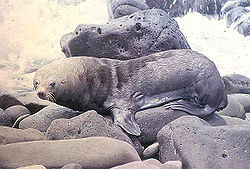
Picture of Arctocephalus townsendi
- Source
- Wikipedia/Commons
- Credit
- nobody named on the record
- Licence
- Public Domain
- Commercial use
- the licence allows it
Structured light scan
- Source
- MorphoSource
- Licence
- In Copyright
- Commercial use
- cannot be read from the licence given — check the record
- Specimen
- Arctocephalus townsendi · lepblb:AT-CSL-988-281111
Smithsonian Open Access was not reached for this taxon, so this list is what the others held rather than everything there is.
The description on this site
- Licence
- CC BY-SA 4.0
This is what the site found, which is not the same as what exists.
Keep going
What may have been alongside itArctocephalus through timeFormations of the HoloceneThe world it lived on
Occurrence data from the Paleobiology Database, CC BY 4.0. (Merriam 1897)