Argopecten invalidus
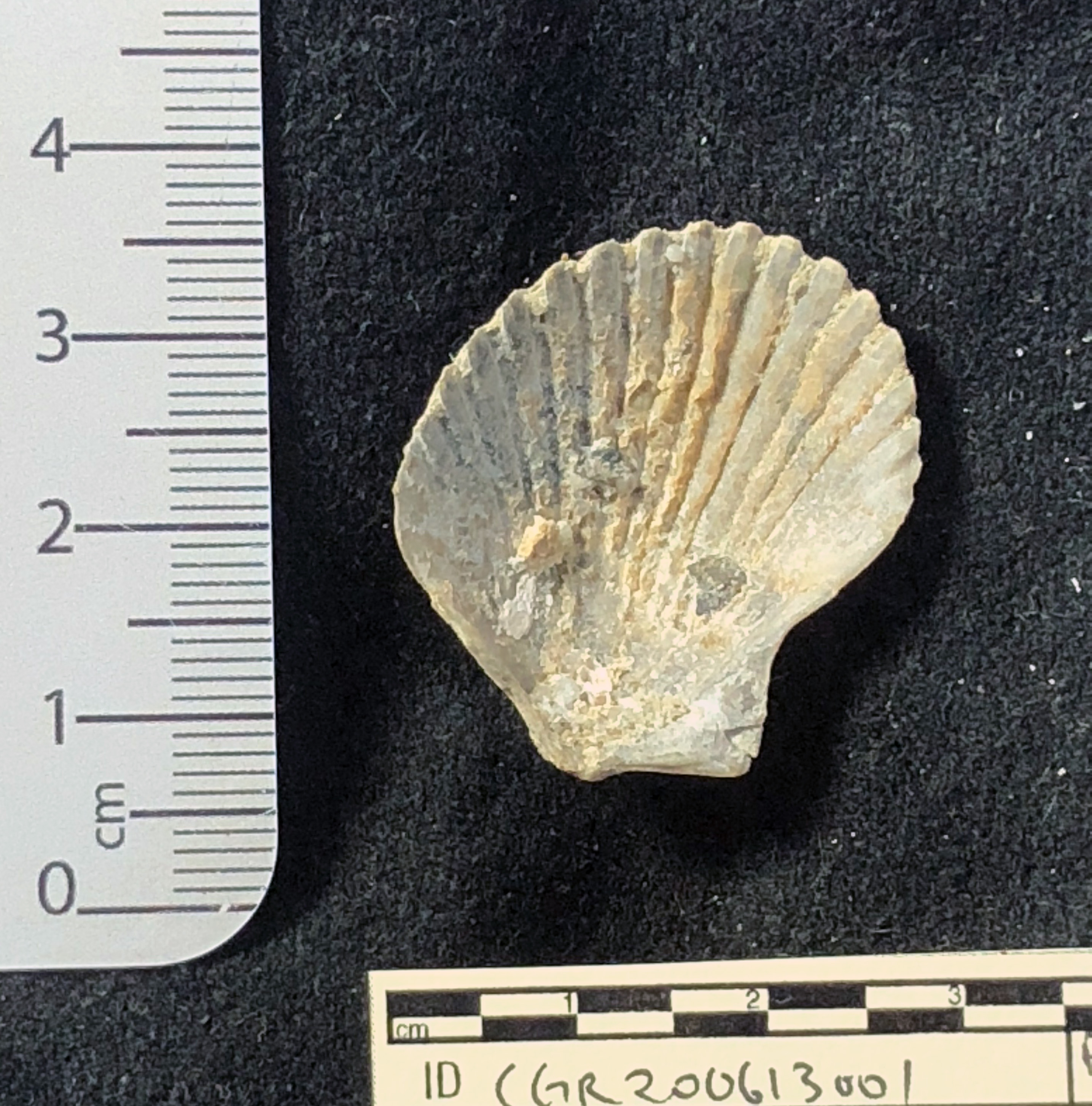
via iDigBio · via iDigBio. May be a photograph of a specimen, or an artist’s reconstruction — an interpretation of a skeleton, since colour and soft tissue are almost never preserved.
On record
Recorded, not inferred- Sits inside
- ArgopectenPBDB
- Diet
- suspension feederPBDB, for Argopecten
- Life habit
- epifaunalPBDB, for Argopecten
- Motility
- facultatively mobilePBDB, for Argopecten
- Vision
- limitedPBDB, for Pectinidae
- Environment
- marinePBDB, for Pectinida
Time the record covers
At most 3.6 million years on record.
Every occurrence read is dated to somewhere between 5.333 Mya and 1.8 Mya, and nothing in the dating separates them, so that window is what the record shows rather than a span.
52 occurrences of Argopecten invalidus on record, most of them in the Pliocene. Bar height is expected occurrences, not a count: each fossil is spread across the span it is dated to, so a tall narrow bar means tight dating and a low wide one means loose.
When
52 occurrences- Pliocene94%
- Pleistocene6%
These are dates about fossils, not the animal: the record can only begin after it arose and end before it died out, so either end may reach further. Shares are expected occurrences: a fossil dated to a span is counted partly in each period it straddles. More on what this infers.
Found in
4 formations
Loading coastlines…
The named rock units Argopecten invalidus has been recovered from, largest first. Drawn where the rock is now, not where it formed. 6 occurrences have no formation on record, which is common for older literature.
Argopecten invalidus and its relatives
PlioceneWhere Argopecten invalidus and its relatives were recorded in the Pliocene.
Found in the same rock
327 taxa- Turritella cooperi41 sites
- Glossaulax reclusiana30 sites
- Calicantharus humerosus29 sites
- Dendostrea vespertina21 sites
- Terebra (Strioterebrum) martini21 sites
- Patinopecten healeyi20 sites
- Dallocardia quadragenarium19 sites
- Here excavata19 sites
- Myrakeena veatchii19 sites
- Lyropecten catalinae17 sites
- Calicantharus fortis15 sites
- Dentalium neohexagonum15 sites
- Cancellaria hemphilli14 sites
- Dosinia ponderosa14 sites
- Solen sicarius14 sites
- Tresus nuttallii14 sites
- Anadara trilineata13 sites
- Lirobittium casmaliense13 sites
- Chione (Anomalocardia) fernandoensis12 sites
- Crockerella conradiana11 sites
- Mitrella tuberosa11 sites
- Amiantis callosa10 sites
- Asperiscala minuticosta10 sites
- Barbarofusus barbarensis10 sites
The Paleobiology Database records 50 sites for Argopecten invalidus, and this reads all of them. The number is how many of those sites it was catalogued from too. The 24 sharing the most are listed.
This is not a list of everything alive at the time. It is only what has come out of the same ground as this animal and been written down.
Entered from
9 references- New information on molluscan paleontology and depositional environments of the Upper Pliocene Pico Formation, Valencia area, Los Angeles County, southern California19
- On the reconciliation of biostratigraphy and strontium isotope stratigraphy of three southern Californian Plio-Pleistocene formations14
- Late Pliocene megafossils of the Pico Formation, Newhall area, Los Angeles County, Southern California10
- The Geology and Paleontology of the Marine Pliocene of San Diego, California (Paleontology: Pelecypoda)2
- Catalogue of the Marine Pliocene and Pleistocene Mollusca of California2
- Expedition to the Revillagigedo Islands, Mexico, in 1925, VII. Contribution to the geology and paleontology of the Tertiary of Cedros Island and adjacent parts of Lower California2
- Reconnaissance of the geology and oil possibilities of Baja California, Mexico1
- Pliocene deposits north of Simi Valley, California1
- Tertiary and Quaternary pectens of California1
Each of the 52 occurrences read was entered from one of these publications, ordered by how many each accounts for. This is not a search for papers mentioning the name. Entries link to doi.org where the Paleobiology Database holds an identifier, and to its own record where it does not. Relayed as the Paleobiology Database holds them, not checked against what they resolve to.
Media and terms
Media content1
Picture of Argopecten invalidus
- Source
- iDigBio
- Credit
- via iDigBio
- Licence
- not stated by the source
- Commercial use
- cannot be read from the licence given — check the record
No 3D scan of Argopecten invalidus was found in MorphoSource and Sketchfab.
Smithsonian Open Access was not reached for this taxon, so this list is what the others held rather than everything there is.
This is what the site found, which is not the same as what exists.
Keep going
Everything alive alongside itArgopecten through timeFormations of the PlioceneThe world it lived on
Occurrence data from the Paleobiology Database, CC BY 4.0. (Hanna 1924)