Aristonectes
Aristonectes is an extinct genus of large elasmosaurid plesiosaurs that lived during the Maastrichtian stage of the Late Cretaceous. Two species are known, A. parvidens and A. quiriquinensis, whose fossil remains were discovered in what are now Patagonia and Antarctica. Throughout the 20th century, Aristonectes was a difficult animal for scientists to analyze due to poor fossil preparation, its relationships to other genera were uncertain. After subsequent revisions and discoveries carried out from the beginning of the 21st century, Aristonectes is now recognised as the type genus of the subfamily Aristonectinae, a lineage of elasmosaurids characterized by an enlarged skull and a reduced length of the neck.

Connor Ashbridge · CC BY-SA 4.0 · via Wikipedia/Commons. May be a photograph of a specimen, or an artist’s reconstruction — an interpretation of a skeleton, since colour and soft tissue are almost never preserved.
On record
Recorded, not inferred- Sits inside
- AristonectinaePBDB
- Diet
- carnivorePBDB, for Plesiosauria
- Life habit
- aquatic, depth=surfacePBDB, for Plesiosauria
- Motility
- actively mobilePBDB, for Plesiosauria
- Environment
- marinePBDB, for Plesiosauria
Time the record covers
At most 18 million years on record.
Every occurrence read is dated to somewhere between 83.6 Mya and 66 Mya, and nothing in the dating separates them, so that window is what the record shows rather than a span.
12 occurrences of Aristonectes on record, most of them in the Late Cretaceous. Bar height is expected occurrences, not a count: each fossil is spread across the span it is dated to, so a tall narrow bar means tight dating and a low wide one means loose.
When
12 occurrences- Late Cretaceous100%
These are dates about fossils, not the animal: the record can only begin after it arose and end before it died out, so either end may reach further. Shares are expected occurrences: a fossil dated to a span is counted partly in each period it straddles. More on what this infers.
Found in
6 formations
- Quiriquina Formation4
- López de Bertodano Formation2
- Lopez de Bertodano Formation2
- Lefipán Formation1
- Allen Formation · Malargüe Group1
- Dorotea Formation1
Loading coastlines…
The named rock units Aristonectes has been recovered from, largest first. Drawn where the rock is now, not where it formed. 1 occurrence has no formation on record, which is common for older literature.
Aristonectes and its relatives
Late CretaceousWhere Aristonectes and its relatives were recorded in the Late Cretaceous.
Found in the same rock
67 taxa- Elasmosauridae4 sites
- Carcharias2 sites
- Ischyrhiza chilensis2 sites
- Mosasauridae2 sites
- Mosasaurinae2 sites
- Acesta1 site
- Acmaea1 site
- aff. Grossouvreites sp.1 site
- Amberleya1 site
- Anaguandryceras seymouriensis1 site
- Annelida1 site
- Aristonectinae1 site
- Australoneilo gracilis1 site
- Biropristis landbecki1 site
- Bucardium1 site
- Cardium1 site
- Centrophoroides1 site
- Cheloniidae1 site
- Cimonia sp.1 site
- Cucullaea antarctica1 site
- Cyclorisma1 site
- Dentalium1 site
- Diplomoceras1 site
- Echinorhinus1 site
The Paleobiology Database records 11 sites for Aristonectes, and this reads all of them. The number is how many of those sites it was catalogued from too. The 24 sharing the most are listed.
This is not a list of everything alive at the time. It is only what has come out of the same ground as this animal and been written down.
Entered from
9 references- Aristonectes quiriquinensis sp. nov., a new highly derived elasmosaurid from the upper Maastrichtian of central Chile3
- Postcranial morphology of Aristonectes (Plesiosauria, Elasmosauridae) from the Upper Cretaceous of Patagonia and Antarctica2
- Review of two marine vertebrate assemblages from the Arauco Basin (central Chile) reveals diversity changes throughout the Maastrichtian1
- A giant elasmosaurid (Sauropterygia; Plesiosauria) from Antarctica: New information on elasmosaurid body size diversity and aristonectine evolutionary scenarios1
- New elasmosaurids (Sauropterygia, Plesiosauria) from the Late Cretaceous of the Magallanes Basin, Chilean Patagonia: Evidence of a faunal turnover during the Maastrichtian along the Weddellian Biogeographic Province1
- Reassessment of the upper Maastrichtian material from Chile referred to Mauisaurus Hector, 1874 (Plesiosauroidea: Elasmosauridae) and the taxonomical value of the hemispherical propodial head among austral elasmosaurids1
- Identification of the first postcranial skeleton of Aristonectes Cabrera (Plesiosauroidea, Elasmosauridae) from the upper Maastrichtian of the south-eastern Pacific, based on a bivariate graphic analysis1
- Aristonectes parvidens Cabrera (Sauropterygia, Plesiosauria) from Cape Lamb, Vega Island (Upper Cretaceous), Antarctica1
- The elasmosaurid plesiosaur Aristonectes Cabrera from the latest Cretaceous of South America and Antarctica1
Each of the 12 occurrences read was entered from one of these publications, ordered by how many each accounts for. This is not a search for papers mentioning the name. Entries link to doi.org where the Paleobiology Database holds an identifier, and to its own record where it does not. Relayed as the Paleobiology Database holds them, not checked against what they resolve to.
Media and terms
Media content2

Picture of Aristonectes
- Source
- Wikipedia/Commons
- Credit
- Connor Ashbridge
- Licence
- CC BY-SA 4.0
- Commercial use
- the licence allows it
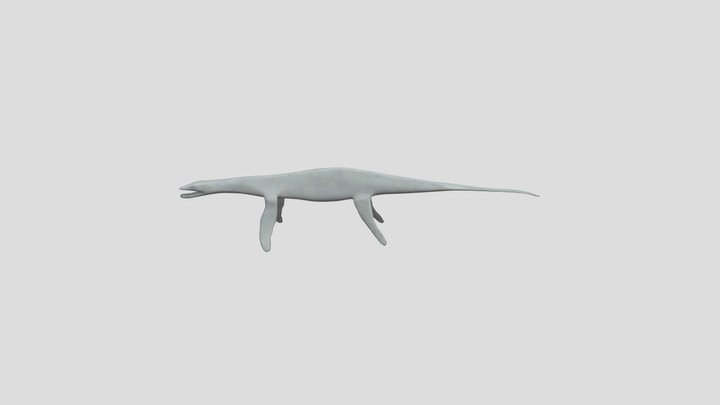
3D model
- Source
- Sketchfab
- Credit
- Rainbow Yoshi Gun
- Licence
- CC Attribution
- Commercial use
- cannot be read from the licence given — check the record
Smithsonian Open Access was not reached for this taxon, so this list is what the others held rather than everything there is.
The description on this site
- Licence
- CC BY-SA 4.0
This is what the site found, which is not the same as what exists.
Keep going
What may have been alongside itAristonectinae through timeFormations of the Late CretaceousThe world it lived on
Occurrence data from the Paleobiology Database, CC BY 4.0. Cabrera 1941