Bambusoideae
Bamboos are a diverse group of mostly evergreen perennial flowering plants making up the subfamily Bambusoideae of the grass family Poaceae. Giant bamboos are the largest members of the grass family, in the case of Dendrocalamus sinicus having individual stalks (culms) reaching a length of 46 meters (151 ft), up to 36 centimeters (14 in) in diameter and a weight of up to 450 kilograms (1,000 lb). It grows in tropical and subtropical regions, especially in Asia. The internodes of bamboos can also be of great length. Kinabaluchloa wrayi has internodes up to 2.5 meters (8 ft) in length, and Arthrostylidium schomburgkii has internodes up to 5 meters (16 ft) in length, exceeded in length only by papyrus. By contrast, the stalks of the tiny bamboo Raddiella vanessiae of the savannas of French Guiana measure only 10–20 millimeters (0.4–0.8 in) in length by about 2 millimeters (0.08 in) in width. The origin of the word "bamboo" is uncertain, but it most likely comes from the Dutch or Portuguese language, which originally borrowed it from Malay.

Kamakura · CC BY-SA 3.0 · via Wikipedia/Commons. May be a photograph of a specimen, or an artist’s reconstruction — an interpretation of a skeleton, since colour and soft tissue are almost never preserved.
On record
Recorded, not inferred- Also called
- bambooPBDB
- Sits inside
- PoaceaePBDB
- Diet
- "photoautotroph"PBDB, for Angiospermae
Time the record covers
At least 63 million years on record.
The record covers at least 66 Mya to 2.58 Mya. No occurrence read is dated outside 72.2 Mya to 11.7 ka.
63 occurrences of Bambusoideae on record, most of them in the Miocene. The Paleobiology Database records this as a living group. Bar height is expected occurrences, not a count: each fossil is spread across the span it is dated to, so a tall narrow bar means tight dating and a low wide one means loose.
When
63 occurrences- Late Cretaceous5%
- Paleocene1%
- Eocene23%
- Oligocene17%
- Miocene48%
- Pliocene4%
- Pleistocene2%
These are dates about fossils, not the animal: the record can only begin after it arose and end before it died out, so either end may reach further. Shares are expected occurrences: a fossil dated to a span is counted partly in each period it straddles. More on what this infers.
Found in
21 formations
- Chenque Formation6
- Monte León Formation4
- Dajie Formation4
- Shengxian Formation4
- Deccan Intertrappean Formation4
- Eifel Formation2
Loading coastlines…
The named rock units Bambusoideae has been recovered from, largest first. Drawn where the rock is now, not where it formed. 22 occurrences have no formation on record, which is common for older literature.
Bambusoideae and its relatives
MioceneWhere Bambusoideae and its relatives were recorded in the Miocene.
Found in the same rock
1,176 taxa- Graminidites20 sites
- Phyllocladidites mawsonii15 sites
- Proteacidites15 sites
- Tricolpites14 sites
- Podocarpidites13 sites
- Nothofagidites12 sites
- Laevigatosporites ovatus11 sites
- Myrtaceidites11 sites
- Nothofagidites flemingii9 sites
- Araucariacites australis8 sites
- Laevigatosporites8 sites
- Liliacidites8 sites
- Lygistepollenites florinii8 sites
- Nothofagidites asperus8 sites
- Rhoipites8 sites
- Stereisporites8 sites
- Arecipites7 sites
- Cyathidites7 sites
- Malvacipollis7 sites
- Myrtaceidites parvus7 sites
- Podosporites microsaccatus7 sites
- Polycolporopollenites esobalteus7 sites
- Polypodiisporites7 sites
- Araucariacites6 sites
The Paleobiology Database records 36 sites for Bambusoideae, and this reads all of them. The number is how many of those sites it was catalogued from too. The 24 sharing the most are listed.
This is not a list of everything alive at the time. It is only what has come out of the same ground as this animal and been written down.
Entered from
31 references- Palinología del Paleogeno tardío-Neógeno temprano, pozo Aries x-1, plataforma Continental Argentina, Tierra del Fuego8
- A Catalogue of Indian Fossil Plants8
- Bamboo leaf and pollen fossils from the late Miocene of eastern Zhejiang, China and their phytogeological significance4
- The earliest fossil bamboos of China (middle Miocene, Yunnan) and their biogeographical importance4
- Palinomorph assemblage of the Chenque Formation, Late Oligocene?- Miocene from Golfo San Jorge Basin, Patagonia, Argentina, Part 4: polycolporate and porate pollen4
- Persistent near-tropical warmth on the Antarctic continent during the early Eocene epoch3
- Palinomorfos continentales y marinos de la Formación Monte León en su área tipo, provincia de Santa Cruz, Argentina3
- Age and implications of the Forest Bed, Falkland Islands, southwest Atlantic Ocean: Evidence from fossil pollen and spores2
- Palinología de la Formación Chiquimil (Mioceno Superior), en Río Vallecito, provincia de Catamarca, Argentina. Parte 2. Polen2
- The Middle Eocene plant taphocoenosis from Eckfeld (Eifel, Germany)2
- The Oligo-Miocene coal floras of southeastern Australia2
- Palynologuie et stratigraphie du Crétacé des Bassin du Sénégal et Cote d'Ivoire2
Each of the 63 occurrences read was entered from one of these publications, ordered by how many each accounts for. This is not a search for papers mentioning the name. 19 further references are not listed. Entries link to doi.org where the Paleobiology Database holds an identifier, and to its own record where it does not. Relayed as the Paleobiology Database holds them, not checked against what they resolve to.
Media and terms
Media content1
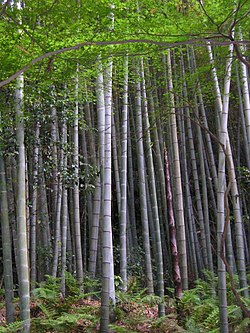
Picture of Bambusoideae
- Source
- Wikipedia/Commons
- Credit
- Kamakura
- Licence
- CC BY-SA 3.0
- Commercial use
- the licence allows it
No 3D scan of Bambusoideae was found in MorphoSource and Sketchfab.
Smithsonian Open Access was not reached for this taxon, so this list is what the others held rather than everything there is.
The description on this site
- Source
- Wikipedia, “Bamboo”
- Licence
- CC BY-SA 4.0
This is what the site found, which is not the same as what exists.
Keep going
What may have been alongside itPoaceae through timeFormations of the MioceneThe world it lived on
Occurrence data from the Paleobiology Database, CC BY 4.0. Luerssen 1893