Basommatophora
Basommatophora was a term that was previously used as a taxonomic informal group, a group of snails within the informal group Pulmonata, the air-breathing slugs and snails. According to the taxonomy of the Gastropoda, whenever monophyly has not been tested, or where a traditional taxon of gastropods has now been discovered to be paraphyletic or polyphyletic, the term "group" or "informal group" was used.

Dr. Lars Peters · CC BY-SA 3.0 · via Wikipedia/Commons. May be a photograph of a specimen, or an artist’s reconstruction — an interpretation of a skeleton, since colour and soft tissue are almost never preserved.
On record
Recorded, not inferred- Sits inside
- PulmonataPBDB
- Life habit
- epifaunalPBDB, for Gastropoda
- Motility
- actively mobilePBDB, for Pulmonata
- Vision
- limitedPBDB, for Gastropoda
- Environment
- terrestrialPBDB, for Pulmonata
Time the record covers
At least 6.8 million years on record.
The record covers at least 132.6 Mya to 125.77 Mya. No occurrence read is dated outside 139.1 Mya to 121.4 Mya.
2 occurrences of Basommatophora on record, most of them in the Early Cretaceous. The Paleobiology Database records this as a living group, and the chart stops with its fossils rather than at the present. Bar height is expected occurrences, not a count: each fossil is spread across the span it is dated to, so a tall narrow bar means tight dating and a low wide one means loose.
When
2 occurrences- Early Cretaceous100%
These are dates about fossils, not the animal: the record can only begin after it arose and end before it died out, so either end may reach further. Shares are expected occurrences: a fossil dated to a span is counted partly in each period it straddles. More on what this infers.
Found in
1 formation
Loading coastlines…
The named rock units Basommatophora has been recovered from, largest first. Drawn where the rock is now, not where it formed. 1 occurrence has no formation on record, which is common for older literature.
Basommatophora and its relatives
Early CretaceousWhere Basommatophora and its relatives were recorded in the Early Cretaceous.
Found in the same rock
116 taxa- Acroteuthis1 site
- Acteon1 site
- Aetostreon latissimum1 site
- Albanerpetontidae1 site
- Albionbaataridae1 site
- Ankylosauria1 site
- Anomia1 site
- Anomia laevigata1 site
- Anomia pseudoradiata1 site
- Astarte1 site
- Asteroidea1 site
- Atherfieldastacus rapax1 site
- Atopochara trivolvis1 site
- Avialae1 site
- Baryonychinae1 site
- Bernissartiidae1 site
- Buchia1 site
- Camptonectes (Boreionectes) cinctus1 site
- Camptonectes (Camptonectes) striatopunctatus1 site
- Cantalera abadi1 site
- Carcharodontosauridae1 site
- Cerithium1 site
- Chladocrinus1 site
- Chondrites1 site
The Paleobiology Database records 2 sites for Basommatophora, and this reads all of them. The number is how many of those sites it was catalogued from too. The 24 sharing the most are listed.
This is not a list of everything alive at the time. It is only what has come out of the same ground as this animal and been written down.
Entered from
2 references- Primera evidencia de un área de alimentación de dinosaurios herbívoros en el Cretácico Inferior de España (Teruel) [First evidence of a feeding area of herbivorous dinosaurs in the Lower Cretaceous of Spain (Teruel)]1
- Fossilien aus der Tongrube Sachsenhagen1
Each of the 2 occurrences read was entered from one of these publications, ordered by how many each accounts for. This is not a search for papers mentioning the name. Each entry links to the Paleobiology Database's own record for the work.
Media and terms
Media content1
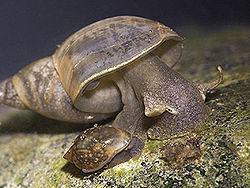
Picture of Basommatophora
- Source
- Wikipedia/Commons
- Credit
- Dr. Lars Peters
- Licence
- CC BY-SA 3.0
- Commercial use
- the licence allows it
No 3D scan was found. Smithsonian Open Access, MorphoSource and Sketchfab were all searched.
The description on this site
- Licence
- CC BY-SA 4.0
This is what the site found, which is not the same as what exists.
Keep going
What may have been alongside itPulmonata through timeFormations of the Early CretaceousThe world it lived on
Occurrence data from the Paleobiology Database, CC BY 4.0. (Keferstein 1864)