Bifida
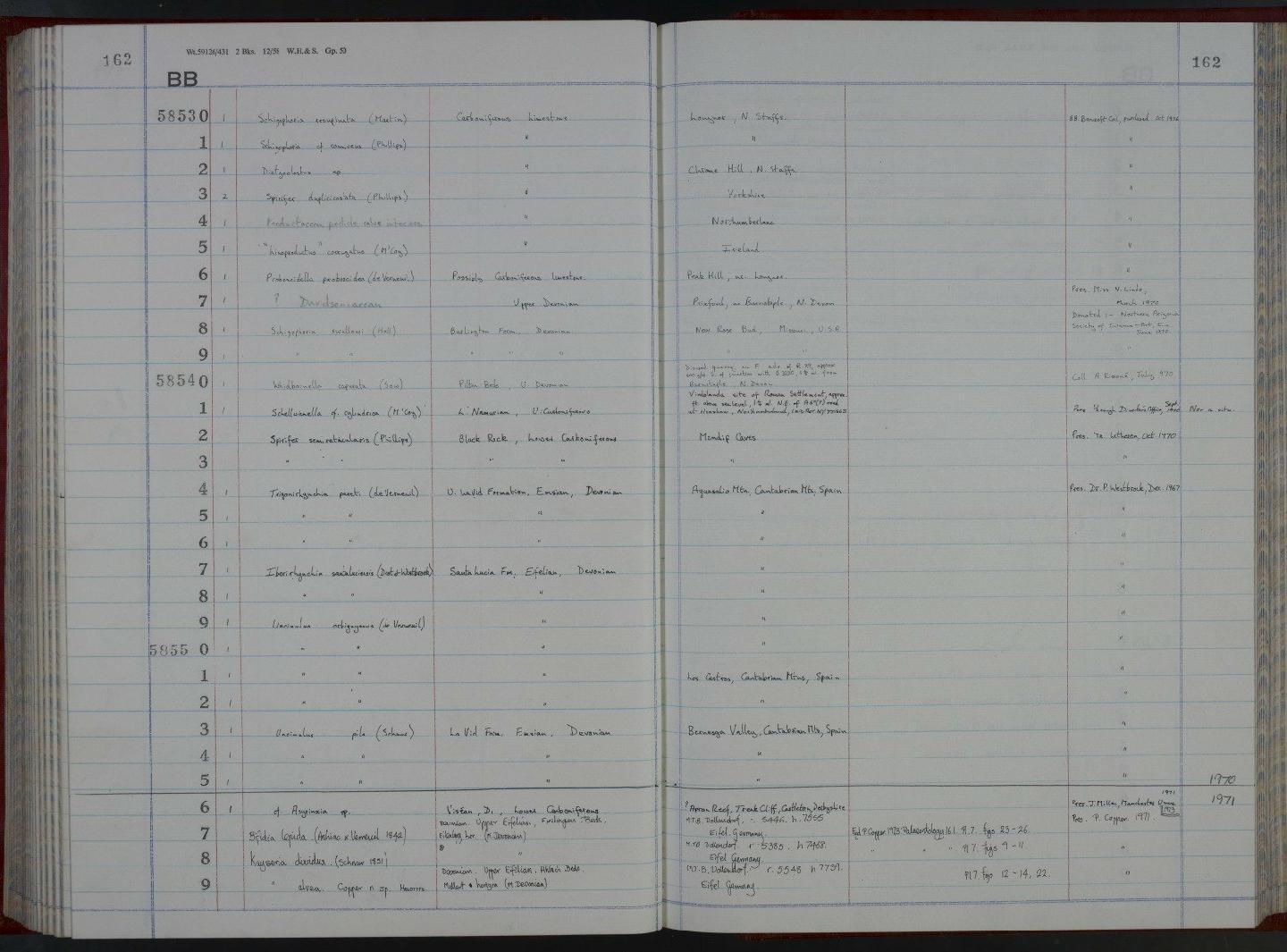
via iDigBio · CC BY · via iDigBio. May be a photograph of a specimen, or an artist’s reconstruction — an interpretation of a skeleton, since colour and soft tissue are almost never preserved.
On record
Recorded, not inferred- Sits inside
- AnoplothecinaePBDB
- Diet
- suspension feederPBDB, for Brachiopoda
- Life habit
- low-level epifaunalPBDB, for Brachiopoda
- Motility
- stationary, attachedPBDB, for Brachiopoda
- Vision
- blindPBDB, for Rhynchonellata
- Environment
- marinePBDB, for Lophophorata
Time the record covers
At least 24 million years on record.
The record covers at least 410.62 Mya to 385.9 Mya. No occurrence read is dated outside 419.62 Mya to 382.31 Mya.
21 occurrences of Bifida on record, most of them in the Devonian. Bar height is expected occurrences, not a count: each fossil is spread across the span it is dated to, so a tall narrow bar means tight dating and a low wide one means loose.
When
21 occurrences- Devonian100%
These are dates about fossils, not the animal: the record can only begin after it arose and end before it died out, so either end may reach further. Shares are expected occurrences: a fossil dated to a span is counted partly in each period it straddles. More on what this infers.
Found in
11 formations
- Kersadiou Formation · Troaon Group3
- Zlichov Limestone Formation2
- Selscheid Formation2
- Skaly Formation2
- Coils Creek Limestone Formation1
- Disappointment Bay Formation1
Loading coastlines…
The named rock units Bifida has been recovered from, largest first. Drawn where the rock is now, not where it formed. 5 occurrences have no formation on record, which is common for older literature.
Bifida and its relatives
DevonianWhere Bifida and its relatives were recorded in the Devonian.
Found in the same rock
397 taxa- Nucleospira7 sites
- Icriodus6 sites
- Nowakia6 sites
- Prokopia6 sites
- Rugoleptaena6 sites
- Atrypa5 sites
- Cingulodermis5 sites
- Cyrtina5 sites
- Plectodonta (Dalejodiscus)5 sites
- Polygnathus5 sites
- Rugosa5 sites
- Schizophoria5 sites
- Skenidioides5 sites
- Ambocoelia4 sites
- Caplinoplia4 sites
- Cyphaspides4 sites
- Cyphaspis convexum4 sites
- Eodictyonella4 sites
- Miniprokopia4 sites
- Pandorinellina4 sites
- Xenomartinia4 sites
- Bisinocoelia3 sites
- Bojodouvillina3 sites
- Chynistrophia3 sites
The Paleobiology Database records 17 sites for Bifida, and this reads all of them. The number is how many of those sites it was catalogued from too. The 24 sharing the most are listed.
This is not a list of everything alive at the time. It is only what has come out of the same ground as this animal and been written down.
Entered from
10 references- The Bohemian Lower Devonian Stages6
- Benthic paleoecology in the givetian: an example from the Kersadiou Formation (massif armoricain, NW France)3
- Cyclic ecological replacement of brachiopod assemblages in the top-Eifelian Dobruchna Brachiopod Shale Member (Skały Formation) of the Holy Cross Mountains (Poland)2
- Die Fossilführung des Mitteldevons im Raum Attendorn-Olpe (West-Sauerland; Rechtsrheinisches Schiefergebirge) [Middle Devonian fossils of the Attendorn-Olpe area (western Sauerland; Rhenish Massif]2
- Fauna und Alter der Erbslochgrauwacke (Brachiopoden und Trilobiten, Unter-Devon, Rheinisches Schiefergebirge und Harz2
- Geologie der Blankenheimer Mulde (Devon, Eifel)2
- Middle Devonian brachiopods from northern Maïder (eastern Anti-Atlas, Morocco)1
- Devonian Transgressive-Regressive Cycles and Biostratigraphy, Northern Antelope Range, Nevada: Establishment of Reference Horizons for Global Cycles1
- Silur und Devon im Arauz-Gebiet (Prov. Palencia, N-Spanien)1
- Late Early Devonian brachiopods from the Disappointment Bay Formation, Lowther Island, Arctic Canada1
Each of the 21 occurrences read was entered from one of these publications, ordered by how many each accounts for. This is not a search for papers mentioning the name. Entries link to doi.org where the Paleobiology Database holds an identifier, and to its own record where it does not. Relayed as the Paleobiology Database holds them, not checked against what they resolve to.
Media and terms
Media content2
Picture of Bifida
- Source
- iDigBio
- Credit
- via iDigBio
- Licence
- CC BY
- Commercial use
- the licence allows it
Smithsonian Open Access and MorphoSource were not reached for this taxon, so this list is what the others held rather than everything there is.
This is what the site found, which is not the same as what exists.
Keep going
What may have been alongside itAnoplothecinae through timeFormations of the DevonianThe world it lived on
Occurrence data from the Paleobiology Database, CC BY 4.0.