Biphyllidae
Biphyllidae, or false skin beetles, are a family of beetles, in the superfamily Cleroidea. They have a cosmopolitan distribution. About 195 species are known. They live under the bark of dead trees and in leaf litter, and are mycophagous, feeding on fungi.

Udo Schmidt from Deutschland · CC BY-SA 2.0 · via Wikipedia/Commons. May be a photograph of a specimen, or an artist’s reconstruction — an interpretation of a skeleton, since colour and soft tissue are almost never preserved.
On record
Recorded, not inferred- Also called
- false skin beetlePBDB
- Sits inside
- CleroideaPBDB
- Motility
- actively mobilePBDB, for Arthropoda
- Environment
- terrestrialPBDB, for Insecta
Time the record covers
At least 45 million years on record.
The record covers at least 83.6 Mya to 37.71 Mya. No occurrence read is dated outside 85.7 Mya to 33.9 Mya.
6 occurrences of Biphyllidae on record, most of them in the Eocene. The Paleobiology Database records this as a living group, and the chart stops with its fossils rather than at the present. Bar height is expected occurrences, not a count: each fossil is spread across the span it is dated to, so a tall narrow bar means tight dating and a low wide one means loose.
When
6 occurrences- Late Cretaceous17%
- Eocene83%
These are dates about fossils, not the animal: the record can only begin after it arose and end before it died out, so either end may reach further. Shares are expected occurrences: a fossil dated to a span is counted partly in each period it straddles. More on what this infers.
Found in
1 formation
Loading coastlines…
The named rock units Biphyllidae has been recovered from, largest first. Drawn where the rock is now, not where it formed. 5 occurrences have no formation on record, which is common for older literature.
Biphyllidae and its relatives
EoceneWhere Biphyllidae and its relatives were recorded in the Eocene.
Found in the same rock
299 taxa- Abdera (Abdera) hoffeinsorum2 sites
- Jiricateres storozhenkoi2 sites
- Omineus febribilis2 sites
- Protostomopsis pandema2 sites
- Sucinoptinus sucini2 sites
- Abdera (Abdera) rikojotensis1 site
- Agaphora iunior1 site
- Allocotidus melpomene1 site
- Amberpoemenia kirejtshuki1 site
- Ambraaltica baltica1 site
- Amelyris (Asymelyris) groehni1 site
- Amelyris (Asymelyris) lupatus1 site
- Amelyris (Asymelyris) paucidentatus1 site
- Aneurops daugpilensis1 site
- Anthobium alekseevi1 site
- Anthrenus1 site
- Anthrenus (Nathrenus) groehni1 site
- Antonaphis affinis1 site
- Aphidocallis caudatus1 site
- Aphytocerus communis1 site
- Aposerphites solox1 site
- Araneoidea1 site
- Araneomorphae1 site
- Archaelachesis granulosa1 site
The Paleobiology Database records 5 sites for Biphyllidae, and this reads all of them. The number is how many of those sites it was catalogued from too. The 24 sharing the most are listed.
This is not a list of everything alive at the time. It is only what has come out of the same ground as this animal and been written down.
Entered from
3 references- New data on Biphyllidae (Coleoptera: Cucujiformia: Cleroidea) from Baltic amber: more diverse assemblage than previously assumed and its climatic interpretation4
- Smallest and oldest false skin beetle: Paleobiphyllus ponomarenkoi gen. et sp. nov. (Coleoptera: Cleroidea: Biphyllidae) from Santonian Taimyr amber, northern Russia1
- Diplocoelus probiphyllus n. sp., the first known fossil false skin beetle (Coleoptera: Biphyllidae)1
Each of the 6 occurrences read was entered from one of these publications, ordered by how many each accounts for. This is not a search for papers mentioning the name. Each entry links to doi.org. Relayed as the Paleobiology Database holds them, not checked against what they resolve to.
Media and terms
Media content1
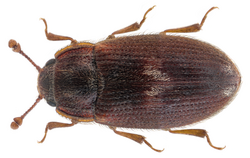
Picture of Biphyllidae
- Source
- Wikipedia/Commons
- Credit
- Udo Schmidt from Deutschland
- Licence
- CC BY-SA 2.0
- Commercial use
- the licence allows it
No 3D scan of Biphyllidae was found in Sketchfab.
Smithsonian Open Access and MorphoSource were not reached for this taxon, so this list is what the others held rather than everything there is.
The description on this site
- Source
- Wikipedia, “Biphyllidae”
- Licence
- CC BY-SA 4.0
This is what the site found, which is not the same as what exists.
Keep going
What may have been alongside itCleroidea through timeFormations of the EoceneThe world it lived on
Occurrence data from the Paleobiology Database, CC BY 4.0. Leconte 1861