Callinectes sapidus
Callinectes sapidus, commonly known as the blue crab, Atlantic blue crab, or, regionally, the Maryland blue crab, is a species of crab native to the waters of the western Atlantic Ocean and the Gulf of Mexico, and introduced internationally.

Uncredited · CC BY-SA 3.0 · via Wikipedia/Commons. May be a photograph of a specimen, or an artist’s reconstruction — an interpretation of a skeleton, since colour and soft tissue are almost never preserved.
On record
Recorded, not inferred- Sits inside
- CallinectesPBDB
- Diet
- carnivorePBDB, for Decapoda
- Life habit
- semi-infaunalPBDB, for Portunoidea
- Motility
- actively mobilePBDB, for Malacostraca
- Vision
- well-developedPBDB, for Malacostraca
Time the record covers
At least 15 million years on record.
The record covers at least 15.98 Mya to 129 ka. No occurrence read is dated outside 23.04 Mya to 11.7 ka.
21 occurrences of Callinectes sapidus on record, most of them in the Pleistocene. The Paleobiology Database records this as a living group. Bar height is expected occurrences, not a count: each fossil is spread across the span it is dated to, so a tall narrow bar means tight dating and a low wide one means loose.
When
21 occurrences- Miocene23%
- Pliocene6%
- Pleistocene71%
These are dates about fossils, not the animal: the record can only begin after it arose and end before it died out, so either end may reach further. Shares are expected occurrences: a fossil dated to a span is counted partly in each period it straddles. More on what this infers.
Found in
7 formations
- Talbot Formation5
- Cape May Formation4
- Chipola Formation · Alum Bluff Group2
- Yorktown Formation1
- Pamlico Formation1
- Bowden Formation · Lower Coastal Group1
Loading coastlines…
The named rock units Callinectes sapidus has been recovered from, largest first. Drawn where the rock is now, not where it formed. 6 occurrences have no formation on record, which is common for older literature.
Callinectes sapidus and its relatives
PleistoceneWhere Callinectes sapidus and its relatives were recorded in the Pleistocene.
Found in the same rock
106 taxa- Panopeus herbstii3 sites
- Balanus crenatus2 sites
- Acanthodesia1 site
- Anadara (Larkinia) transversa1 site
- Angulus agilis1 site
- Apalone ferox1 site
- Asterias1 site
- Astrangia danae1 site
- Astyris lunata1 site
- Biflustra savartii1 site
- Boonea impressa1 site
- Brevoortia1 site
- Calappa springeri1 site
- Calianassa atlantica1 site
- Calianassa cf. matsoni1 site
- Cancer1 site
- Cancer borealis1 site
- Cancer irroratus1 site
- Cancer nancei1 site
- Caryocorbula contracta1 site
- Chloridella empusa1 site
- Chlorilia sp.1 site
- Chrysemys isoni1 site
- Cliona1 site
The Paleobiology Database records 4 sites for Callinectes sapidus, and this reads all of them. The number is how many of those sites it was catalogued from too. The 24 sharing the most are listed.
This is not a list of everything alive at the time. It is only what has come out of the same ground as this animal and been written down.
Entered from
4 references- Fossil Crustacea of the Atlantic and Gulf Coastal Plain17
- The Pleistocene marine fauna of Wailes Bluff and Langley Bluff, Maryland2
- Systematics and paleoecology of Miocene brachyuran crabs (Decapoda: Brachyura: Cancroidea, Portunidae) from the St. Marys Formation, Maryland, USA1
- Decapod, stomatopod and cirripede Crustacea from the Pliocene Bowden shell bed, St Thomas parish, Jamaica1
Each of the 21 occurrences read was entered from one of these publications, ordered by how many each accounts for. This is not a search for papers mentioning the name. Entries link to doi.org where the Paleobiology Database holds an identifier, and to its own record where it does not. Relayed as the Paleobiology Database holds them, not checked against what they resolve to.
Media and terms
Media content2

Picture of Callinectes sapidus
- Source
- Wikipedia/Commons
- Credit
- nobody named on the record
- Licence
- CC BY-SA 3.0
- Commercial use
- the licence allows it
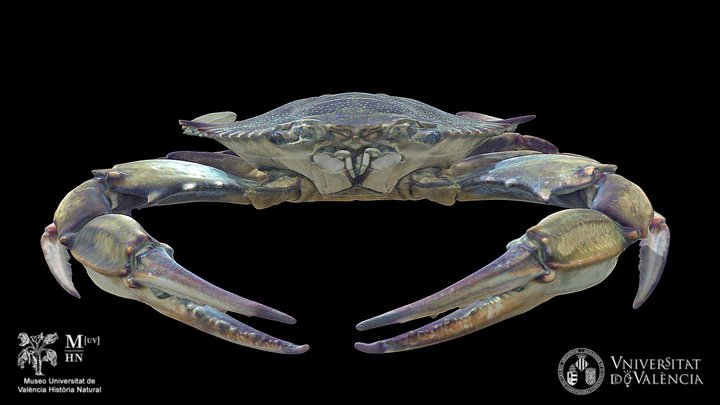
3D model
- Source
- Sketchfab
- Licence
- CC Attribution
- Commercial use
- cannot be read from the licence given — check the record
The description on this site
- Licence
- CC BY-SA 4.0
This is what the site found, which is not the same as what exists.
Keep going
What may have been alongside itCallinectes through timeFormations of the PleistoceneThe world it lived on
Occurrence data from the Paleobiology Database, CC BY 4.0. Rathbun 1896