Calycoceras
Calycoceras is an extinct genus of cephalopods belonging to the subclass Ammonoidea and family Acanthoceratidae that lived during the Cenomanian stage of the Late Cretaceous, 100-94 Mya. Their shells had ornate ribs.

Hectonichus · CC BY-SA 3.0 · via Wikipedia/Commons. May be a photograph of a specimen, or an artist’s reconstruction — an interpretation of a skeleton, since colour and soft tissue are almost never preserved.
On record
Recorded, not inferred- Sits inside
- AcanthoceratinaePBDB
- Diet
- carnivorePBDB, for Ammonoidea
- Life habit
- nektonicPBDB, for Ammonoidea
- Motility
- fast-movingPBDB, for Ammonoidea
- Vision
- well-developedPBDB, for Cephalopoda
- Environment
- marinePBDB, for Cephalopoda
Time the record covers
At least 6.6 million years on record.
The record covers at least 100.5 Mya to 93.9 Mya. No occurrence read is dated outside 106.3 Mya to 89.8 Mya.
206 occurrences of Calycoceras on record, most of them in the Late Cretaceous. Bar height is expected occurrences, not a count: each fossil is spread across the span it is dated to, so a tall narrow bar means tight dating and a low wide one means loose.
When
206 occurrences- Early Cretaceousunder 1%
- Late Cretaceous99%
These are dates about fossils, not the animal: the record can only begin after it arose and end before it died out, so either end may reach further. Shares are expected occurrences: a fossil dated to a span is counted partly in each period it straddles. More on what this infers.
Found in
57 formations
- Greenhorn Limestone Formation · Colorado Group22
- Craie de Rouen Formation13
- Lower Chalk Formation13
- Sanandinovo Formation12
- Mancos Shale Formation9
- Beer Head Limestone Formation · Grey Chalk Group8
Loading coastlines…
The named rock units Calycoceras has been recovered from, largest first. Drawn where the rock is now, not where it formed. 33 further formations hold fewer occurrences each and are not listed. 23 occurrences have no formation on record, which is common for older literature.
Calycoceras and its relatives
Late CretaceousWhere Calycoceras and its relatives were recorded in the Late Cretaceous.
Found in the same rock
574 taxa- Turrilites costatus17 sites
- Acanthoceras13 sites
- Schloenbachia12 sites
- Inoceramus11 sites
- Turrilites acutus11 sites
- Eucalycoceras pentagonum10 sites
- Sciponoceras10 sites
- Stomohamites10 sites
- Inoceramus (Inoceramus) pictus9 sites
- Plicatula9 sites
- Scaphites equalis9 sites
- Scaphites obliquus9 sites
- Schloenbachia varians9 sites
- Metoicoceras geslinianum8 sites
- Turrilites scheuchzerianus8 sites
- Acanthoceras rhotomagense7 sites
- Costagyra olisiponensis7 sites
- Holaster7 sites
- Moremanoceras scotti7 sites
- Neolobites vibrayeanus7 sites
- Pseudocalycoceras angolaense7 sites
- Scaphites7 sites
- Euomphaloceras septemseriatum6 sites
- Gyrodes6 sites
The Paleobiology Database records 144 sites for Calycoceras, and this reads all of them. The number is how many of those sites it was catalogued from too. The 24 sharing the most are listed.
This is not a list of everything alive at the time. It is only what has come out of the same ground as this animal and been written down.
Entered from
74 references- A correlation of the uppermost Albian and the Cenomanian of South-West England18
- New and little-known ammonites from the Upper Cretaceous (Cenomanian and Turonian) of the western interior of the United States14
- Middle Cenomanian ammonites from the type section of the Sanandinovo Formation of northern Bulgaria12
- Upper Cretaceous rocks and ammonite faunas of southwestern New Mexico10
- Faunes d’ammonites et biostratigraphie compareé du Cénomanien du nord-ouest de la France (Normandie) et du sud de l’Angleterre8
- Paleontology of the Greenhorn cylcothem (Cretaceous: late Cenomanian to middle Turonian) at Black Mesa, northeastern Arizona7
- Upper Cretaceous ammonites of California. Part III7
- New records of acanthoceratid ammonoids from the Upper Cenomanian of South Dakota6
- The Cenomanian-Turonian boundary in central Tunisia in the context of a sequence-stratigraphic interpretation6
- Upper Albian and Cenomanian ammonites from Djebel Mrhila, Central Tunisia5
- Ammonites of the Cretaceous Ieru Formation, western Papua New Guinea5
- Uppermost Cenomanian-basal Turonian ammonites from Salinas, Angola5
Each of the 206 occurrences read was entered from one of these publications, ordered by how many each accounts for. This is not a search for papers mentioning the name. 62 further references are not listed. Entries link to doi.org where the Paleobiology Database holds an identifier, and to its own record where it does not. Relayed as the Paleobiology Database holds them, not checked against what they resolve to.
Media and terms
Media content2

Picture of Calycoceras
- Source
- Wikipedia/Commons
- Credit
- Hectonichus
- Licence
- CC BY-SA 3.0
- Commercial use
- the licence allows it
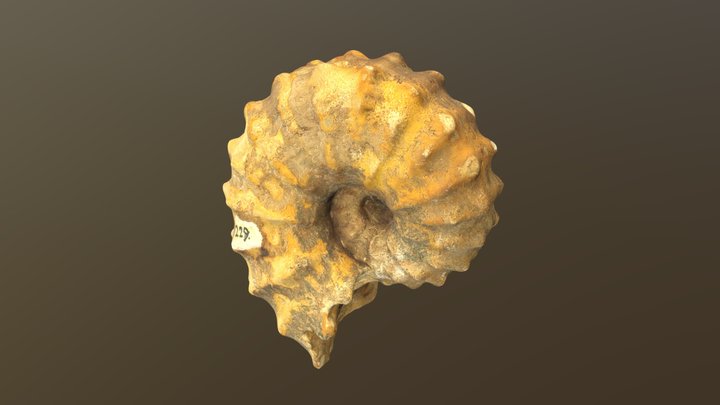
3D model
- Source
- Sketchfab
- Credit
- Shellie Luallin
- Licence
- CC Attribution
- Commercial use
- cannot be read from the licence given — check the record
The description on this site
- Source
- Wikipedia, “Calycoceras”
- Licence
- CC BY-SA 4.0
This is what the site found, which is not the same as what exists.
Keep going
What may have been alongside itAcanthoceratinae through timeFormations of the Late CretaceousThe world it lived on
Occurrence data from the Paleobiology Database, CC BY 4.0. Hyatt 1900