Carebara
Carebara is a genus of ants in the subfamily Myrmicinae. It is one of the largest myrmicine genera with more than 200 species distributed worldwide in the tropics and the Afrotropical region. Many of them are very tiny cryptic soil and leaf-litter inhabitants. They nest in rotten wood to which the bark is still adherent in the Afrotropical region, or may be lestobiotic, nesting near other ant species. Some species are known to exist parasitically within termite nests. Little is known about the biology of the genus, but they are notable for the vast difference in size between queens and workers. In Tanzania's Lake Victoria, Arusha, and Morogoro Regions, Carebara queens are hunted and consumed; they are locally known as wadudu mafuta, meaning "fat insects".

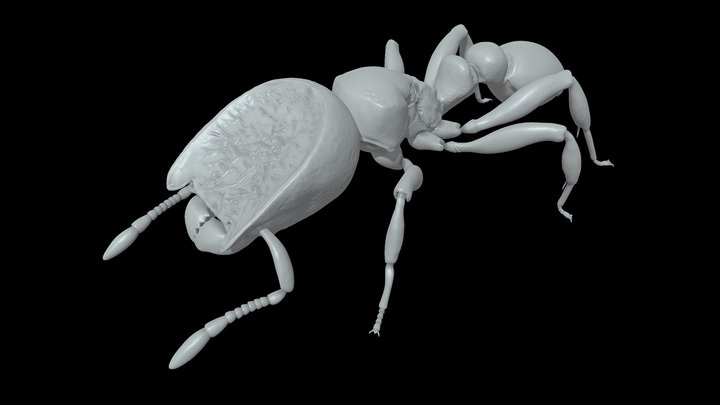
Uncredited · CC BY 4.0 · via Wikipedia/Commons. May be a photograph of a specimen, or an artist’s reconstruction — an interpretation of a skeleton, since colour and soft tissue are almost never preserved.
On record
Recorded, not inferred- Sits inside
- CrematogastriniPBDB
- Motility
- actively mobilePBDB, for Arthropoda
- Environment
- terrestrialPBDB, for Insecta
Time the record covers
At least 31 million years on record.
The record covers at least 33.9 Mya to 2.58 Mya. No occurrence read is dated outside 37.71 Mya to 1.8 Mya.
17 occurrences of Carebara on record. The Paleobiology Database records this as a living group, and the chart stops with its fossils rather than at the present. Bar height is expected occurrences, not a count: each fossil is spread across the span it is dated to, so a tall narrow bar means tight dating and a low wide one means loose.
When
17 occurrences- Eocene53%
- Oligocene6%
- Miocene35%
- Pleistocene6%
These are dates about fossils, not the animal: the record can only begin after it arose and end before it died out, so either end may reach further. Shares are expected occurrences: a fossil dated to a span is counted partly in each period it straddles. More on what this infers.
Found in
3 formations
Loading coastlines…
The named rock units Carebara has been recovered from, largest first. Drawn where the rock is now, not where it formed. 13 occurrences have no formation on record, which is common for older literature.
Found in the same rock
2,180 taxa- Lasius schiefferdeckeri6 sites
- Prenolepis henschei6 sites
- Tetraponera simplex6 sites
- Yantaromyrmex geinitzi6 sites
- Ctenobethylus goepperti5 sites
- Formica flori5 sites
- Gesomyrmex hoernesi5 sites
- Gnamptogenys europaea5 sites
- Lype sericea5 sites
- Nylanderia pygmaea5 sites
- Bradoponera meieri4 sites
- Eocamponotus mengei4 sites
- Eotemnothorax gracilis4 sites
- Holocentropus atratus4 sites
- Hypoponera atavia4 sites
- Monomorium mayrianum4 sites
- Pachycondyla succinea4 sites
- Plagiolepis klinsmanni4 sites
- Plagiolepis kuenowi4 sites
- Plectrocnemia lata4 sites
- Procerapachys annosus4 sites
- Stigmomyrmex venustus4 sites
- Tetraponera ocellata4 sites
- Yantaromyrmex constrictus4 sites
The Paleobiology Database records 15 sites for Carebara, and this reads all of them. The number is how many of those sites it was catalogued from too. The 24 sharing the most are listed.
This is not a list of everything alive at the time. It is only what has come out of the same ground as this animal and been written down.
Entered from
13 references- New extinct species of the ant genus Carebara (Hymenoptera: Formicidae) from the late Eocene European ambers3
- Murav'i (Hymenoptera, Formicidae) Rovenskogo yantarya2
- Die Ameisen des baltischen Bernsteins2
- First record of a soldier of the genus Carebara Westwood, 1840 (Hymenoptera: Formicidae: Myrmicinae) from Late Eocene Baltic amber1
- The mid-Miocene Zhangpu biota reveals an outstandingly rich rainforest biome in East Asia1
- Notes complémentaire sur les insectes fossiles oligocènes des gypses d'Aix-en-Provence1
- La faune entomologique des gisements Mio-Pliocènes du Massif Central1
- The Ants of the Baltic Amber1
- Le formiche dell'ambra Siciliana nel Museo Mineralogico dell'Università di Bologna1
- Fauna der Cyprisschiefer des Egerer Tertiärbeckens1
- Beiträge zur Insekten-Fauna der Vorwelt. I. Beitrag. Die fossilen Insekten des tertiären (miocenen) Thonlagers von Schossnitz bei Kanth1
- Beiträge zur Insektenfauna Oeningens: Coleoptera. Geodephagen, Hydrocanthariden, Gyriniden, Brachelytren, Clavicornen, Lamellicornen und Buprestiden1
Each of the 17 occurrences read was entered from one of these publications, ordered by how many each accounts for. This is not a search for papers mentioning the name. 1 further reference is not listed. Entries link to doi.org where the Paleobiology Database holds an identifier, and to its own record where it does not. Relayed as the Paleobiology Database holds them, not checked against what they resolve to.
Media and terms
Media content2

Picture of Carebara
- Source
- Wikipedia/Commons
- Credit
- nobody named on the record
- Licence
- CC BY 4.0
- Commercial use
- the licence allows it
The description on this site
- Source
- Wikipedia, “Carebara”
- Licence
- CC BY-SA 4.0
This is what the site found, which is not the same as what exists.
Keep going
What may have been alongside itCrematogastrini through timeThe world it lived on
Occurrence data from the Paleobiology Database, CC BY 4.0. Westwood 1840