Centrophorus squamosus
The leafscale gulper shark is a dogfish of the family Centrophoridae. C. squamosus is reported to have a lifespan of approximately 70 years, based on otolith ring counts. It was the first described species in the genus Centrophorus, which now contains 13 species.

Chris_huh · CC BY-SA 3.0 · via Wikipedia/Commons. May be a photograph of a specimen, or an artist’s reconstruction — an interpretation of a skeleton, since colour and soft tissue are almost never preserved.
On record
Recorded, not inferred- Also called
- leafscale gulper sharkPBDB
- Sits inside
- CentrophorusPBDB
- Diet
- carnivorePBDB, for Squaliformes
- Life habit
- nektonicPBDB, for Squaliformes
- Motility
- actively mobilePBDB, for Squaliformes
Time the record covers
At least 64 million years on record.
The record covers at least 66 Mya to 1.8 Mya. No occurrence read is dated outside 83.6 Mya to 774 ka.
11 occurrences of Centrophorus squamosus on record, most of them in the Pleistocene. The Paleobiology Database records this as a living group, and the chart stops with its fossils rather than at the present. Bar height is expected occurrences, not a count: each fossil is spread across the span it is dated to, so a tall narrow bar means tight dating and a low wide one means loose.
When
11 occurrences- Late Cretaceous9%
- Eocene9%
- Oligocene9%
- Miocene28%
- Pliocene9%
- Pleistocene36%
These are dates about fossils, not the animal: the record can only begin after it arose and end before it died out, so either end may reach further. Shares are expected occurrences: a fossil dated to a span is counted partly in each period it straddles. More on what this infers.
Found in
4 formations
- Rifle Butts Formation1
- Gee Greensand Formation1
- Otekaike Limestone Formation1
- Argille Azzurre Formation1
Loading coastlines…
The named rock units Centrophorus squamosus has been recovered from, largest first. Drawn where the rock is now, not where it formed. 7 occurrences have no formation on record, which is common for older literature.
Centrophorus squamosus and its relatives
PleistoceneWhere Centrophorus squamosus and its relatives were recorded in the Pleistocene.
Found in the same rock
17 taxa- Chlamydoselachus anguineus4 sites
- Elasmobranchii4 sites
- Galeus melastomus4 sites
- Megascyliorhinus cooperi3 sites
- Apristurus2 sites
- Centrophorus granulosus2 sites
- Trichiuridae2 sites
- Chlamydoselachus1 site
- Cyathoceras periallus1 site
- Dalatias licha1 site
- Deania1 site
- Pliokogia apenninica1 site
- Pristiophorus1 site
- Pristiophorus lanceolatus1 site
- Scymnodalatias garricki1 site
- Scymnodon ringens1 site
- Zameus squamulosus1 site
The Paleobiology Database records 11 sites for Centrophorus squamosus, and this reads all of them. The number is how many of those sites it was catalogued from too.
This is not a list of everything alive at the time. It is only what has come out of the same ground as this animal and been written down.
Entered from
3 references- New records of fossil elasmobranch genera Megascyliorhinus, Centrophorus, and Dalatias (Order Selachii) in New Zealand6
- A new bathyal shark fauna from the Pleistocene sediments of Fiumefreddo (Sicily, Italy)4
- A new kogiid sperm whale from northern Italy supports psychrospheric conditions in the early Pliocene Mediterranean Sea1
Each of the 11 occurrences read was entered from one of these publications, ordered by how many each accounts for. This is not a search for papers mentioning the name. Entries link to doi.org where the Paleobiology Database holds an identifier, and to its own record where it does not. Relayed as the Paleobiology Database holds them, not checked against what they resolve to.
Media and terms
Media content2
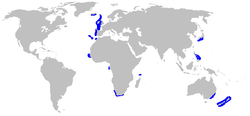
Picture of Centrophorus squamosus
- Source
- Wikipedia/Commons
- Credit
- Chris_huh
- Licence
- CC BY-SA 3.0
- Commercial use
- the licence allows it
CT scan
- Source
- MorphoSource
- Licence
- not stated by the source
- Commercial use
- cannot be read from the licence given — check the record
- Specimen
- Centrophorus squamosus · zmuc:p:4
Smithsonian Open Access was not reached for this taxon, so this list is what the others held rather than everything there is.
The description on this site
- Licence
- CC BY-SA 4.0
This is what the site found, which is not the same as what exists.
Keep going
What may have been alongside itCentrophorus through timeFormations of the PleistoceneThe world it lived on
Occurrence data from the Paleobiology Database, CC BY 4.0. (Bonnaterre 1788)