Ceractinomorpha
Demosponges or common sponges are sponges of the class Demospongiae, the most diverse group in the phylum Porifera which include greater than 90% of all extant sponges with nearly 8,800 species worldwide. Being siliceous sponges, they are predominantly leuconoid in structure with an endoskeleton made of a meshwork of spicules consisting of fibers of the protein spongin, the mineral silica, or both. Where spicules of silica are present, they have a different shape from those in the otherwise similar glass sponges. Some species, in particular from the Antarctic, obtain the silica for spicule-building from the ingestion of diatoms.

Twilight Zone Expedition Team 2007, NOAA-OE · Public Domain · via Wikipedia/Commons. May be a photograph of a specimen, or an artist’s reconstruction — an interpretation of a skeleton, since colour and soft tissue are almost never preserved.
On record
Recorded, not inferred- Sits inside
- DemospongiaePBDB
- Diet
- suspension feederPBDB
- Life habit
- epifaunalPBDB
- Motility
- stationary, attachedPBDB
- Vision
- blindPBDB, for Porifera
Time the record covers
At least 270 million years on record.
The record covers at least 470.3 Mya to 199.5 Mya. No occurrence read is dated outside 475.3 Mya to 192.9 Mya.
43 occurrences of Ceractinomorpha on record, most of them in the Ordovician. The Paleobiology Database records this as a living group, and the chart stops with its fossils rather than at the present. Bar height is expected occurrences, not a count: each fossil is spread across the span it is dated to, so a tall narrow bar means tight dating and a low wide one means loose.
When
43 occurrencesThese are dates about fossils, not the animal: the record can only begin after it arose and end before it died out, so either end may reach further. Shares are expected occurrences: a fossil dated to a span is counted partly in each period it straddles. More on what this infers.
Found in
16 formations
- Wardell Formation8
- Cliffield Formation7
- Benbolt Formation6
- Witten Limestone Formation3
- Whitewater Formation2
- Arnheim Formation2
Loading coastlines…
The named rock units Ceractinomorpha has been recovered from, largest first. Drawn where the rock is now, not where it formed. 4 occurrences have no formation on record, which is common for older literature.
Ceractinomorpha and its relatives
OrdovicianWhere Ceractinomorpha and its relatives were recorded in the Ordovician.
Found in the same rock
481 taxa- Dystactospongia31 sites
- Girvanella14 sites
- Tetradium13 sites
- Lophospira11 sites
- Batostoma10 sites
- Solenopora10 sites
- Columnaria9 sites
- Lichenaria9 sites
- Rafinesquina9 sites
- Carabocrinus8 sites
- Cleiocrinus8 sites
- Coronocystis angulatus8 sites
- Diabolocrinus8 sites
- Leperditia8 sites
- Pachydictya8 sites
- Pachydictya robusta8 sites
- Receptaculites8 sites
- Stromatocerium rugosum8 sites
- Dermatostroma7 sites
- Eospongia7 sites
- Gonioceras7 sites
- Anolotichia6 sites
- Apatomorpha pulchella6 sites
- Bumastus lioderma6 sites
The Paleobiology Database records 38 sites for Ceractinomorpha, and this reads all of them. The number is how many of those sites it was catalogued from too. The 24 sharing the most are listed.
This is not a list of everything alive at the time. It is only what has come out of the same ground as this animal and been written down.
Entered from
13 references- Stratigraphy of the Lower Middle Ordovician of Tazewell County, Virginia24
- Pre-Chattanooga stratigraphy in Central Tennessee5
- The fossil fauna of the Ordovician in the Cincinnati Region3
- Paleoecology of some Leonardian patch reefs in the Glass Mountains, Texas2
- Hypercalcified sponges from the Upper Triassic (Norian-Rhaetian) reefs of Sicily1
- Emsian (Early Late Devonian) sponges from west-central and south-central Alaska1
- Boiko et al., 19911
- Communità a Poriferi nei Calcari Grigi delle Vette Feltrine (Giurassico Inferiore, Prealpi Bellunesi)1
- The occurrence of pelecypods in early Paleozoic epeiric-sea environments, Late Ordovician of the Cincinnati, Ohio area1
- Occurrence and distribution of fossils within and adjacent to Middle Ordovician bioherms in the southern Appalachians of Alabama1
- The Ordovician-Silurian boundary in the Garth area of southwest Powys, Wales1
- A new fossil sponge from the Ordovician Garden City Limestone od southeastern Idaho1
Each of the 43 occurrences read was entered from one of these publications, ordered by how many each accounts for. This is not a search for papers mentioning the name. 1 further reference is not listed. Entries link to doi.org where the Paleobiology Database holds an identifier, and to its own record where it does not. Relayed as the Paleobiology Database holds them, not checked against what they resolve to.
Media and terms
Media content1
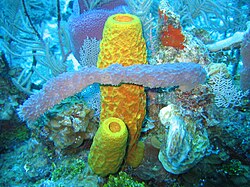
Picture of Ceractinomorpha
- Source
- Wikipedia/Commons
- Credit
- Twilight Zone Expedition Team 2007, NOAA-OE
- Licence
- Public Domain
- Commercial use
- the licence allows it
No 3D scan was found. Smithsonian Open Access, MorphoSource and Sketchfab were all searched.
The description on this site
- Source
- Wikipedia, “Demosponge”
- Licence
- CC BY-SA 4.0
This is what the site found, which is not the same as what exists.
Keep going
What may have been alongside itDemospongiae through timeFormations of the OrdovicianThe world it lived on
Occurrence data from the Paleobiology Database, CC BY 4.0. Levi 1953