Ceratopygidae
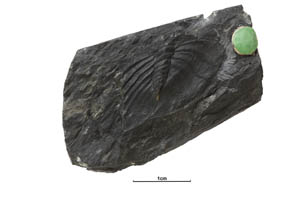
Not Ceratopygidae. This is Cermatops Shergold, 1980, a relative — both are Ceratopygidae.
via GBIF · CC BY-NC 4.0 · via GBIF. May be a photograph of a specimen, or an artist’s reconstruction — an interpretation of a skeleton, since colour and soft tissue are almost never preserved.
On record
Recorded, not inferred- Sits inside
- AsaphoideaPBDB
- Diet
- carnivorePBDB, for Trilobita
- Life habit
- low-level epifaunalPBDB, for Asaphida
- Motility
- fast-movingPBDB, for Asaphida
- Vision
- well-developedPBDB
- Environment
- marinePBDB, for Trilobita
Time the record covers
At least 46 million years on record.
The record covers at least 504.5 Mya to 458.2 Mya. No occurrence read is dated outside 538.8 Mya to 454 Mya.
759 occurrences of Ceratopygidae on record, most of them in the Cambrian. Bar height is expected occurrences, not a count: each fossil is spread across the span it is dated to, so a tall narrow bar means tight dating and a low wide one means loose.
When
759 occurrences- Cambrian86%
- Ordovician14%
These are dates about fossils, not the animal: the record can only begin after it arose and end before it died out, so either end may reach further. Shares are expected occurrences: a fossil dated to a span is counted partly in each period it straddles. More on what this infers.
Found in
62 formations
- Zhumabai Formation115
- Huaqiao Formation76
- Machari Formation · Yeongwol Group71
- Bestogai Formation62
- Shenjiawan Formation60
- Siyangshan Formation58
Loading coastlines…
The named rock units Ceratopygidae has been recovered from, largest first. Drawn where the rock is now, not where it formed. 38 further formations hold fewer occurrences each and are not listed. 25 occurrences have no formation on record, which is common for older literature.
Ceratopygidae and its relatives
CambrianWhere Ceratopygidae and its relatives were recorded in the Cambrian.
Found in the same rock
704 taxa- Pseudagnostus26 sites
- Euloma25 sites
- Brachiopoda21 sites
- Maladioidella doylei21 sites
- Haniwoides varia18 sites
- Onychopyge18 sites
- Taenicephalites plerus17 sites
- Geragnostus16 sites
- Parabolinella16 sites
- Wentsuia iota16 sites
- Macropyge15 sites
- Ceratopyge14 sites
- Apatokephalus serratus13 sites
- Cermatops vieta13 sites
- Niobe (Niobella)13 sites
- Shumardia13 sites
- Hysterolenus12 sites
- Angelina hyeronimi11 sites
- Micragnostus11 sites
- Niobe11 sites
- Proceratopyge11 sites
- Symphysurus11 sites
- Apatokephalus10 sites
- Asaphellus catamarcensis10 sites
The Paleobiology Database records 173 sites for Ceratopygidae, and this reads all of them. The number is how many of those sites it was catalogued from too. The 24 sharing the most are listed.
This is not a list of everything alive at the time. It is only what has come out of the same ground as this animal and been written down.
Entered from
83 references- Cambrian Malyy Karatau Range, Kazakhstan177
- Upper Cambrian polymerid trilobites from the Machari Formation, Yongwol, Korea70
- The Cambrian trilobites of western Zhejiang61
- Corynexochida, Lichida and Asaphida43
- Proposed GSSP for the base of Cambrian Stage 9, coinciding with the first appearance of Agnostotes orientalis, at Duibian, Zhejiang, China42
- Cambrian of the Hunan-Guizhou region, south China42
- Upper Cambrian biostratigraphy and trilobite faunas of the Cili-Taoyuan area, northwestern Hunan, China41
- Late Cambrian trilobites from the Chatsworth Limestone, western Queensland41
- Ordovician trilobites of Argentina26
- Cambro-Ordovician boundary in western Zhejiang and the trilobites contained therein17
- The Khos-Nelege section of the Ogon'or Formation: a potential candidate for the GSSP of stage 10, Cambrian System14
- Early Ordovician trilobites from the Iruya area (Cordillera Oriental, northwestern Argentina) and their stratigraphic significance10
Each of the 759 occurrences read was entered from one of these publications, ordered by how many each accounts for. This is not a search for papers mentioning the name. 71 further references are not listed. Entries link to doi.org where the Paleobiology Database holds an identifier, and to its own record where it does not. Relayed as the Paleobiology Database holds them, not checked against what they resolve to.
Media and terms
Media content1
Picture of Cermatops Shergold, 1980
- Source
- GBIF
- Credit
- via GBIF
- Licence
- CC BY-NC 4.0
- Commercial use
- the licence does not allow it
No 3D scan of Ceratopygidae was found in MorphoSource and Sketchfab.
Smithsonian Open Access was not reached for this taxon, so this list is what the others held rather than everything there is.
This is what the site found, which is not the same as what exists.
Keep going
What may have been alongside itAsaphoidea through timeFormations of the CambrianThe world it lived on
Occurrence data from the Paleobiology Database, CC BY 4.0. Raymond 1913