Charonia variegata
Charonia variegata, the Atlantic triton or Atlantic triton's trumpet, is a species of predatory sea snail, a marine gastropod mollusc in the family Charoniidae, the triton snails, triton shells, or tritons.

NOAA · Public Domain · via Wikipedia/Commons. May be a photograph of a specimen, or an artist’s reconstruction — an interpretation of a skeleton, since colour and soft tissue are almost never preserved.
On record
Recorded, not inferred- Sits inside
- CharoniaPBDB
- Diet
- carnivorePBDB, for Charonia
- Life habit
- epifaunalPBDB, for Charonia
- Motility
- actively mobilePBDB, for Charonia
- Vision
- limitedPBDB, for Gastropoda
- Environment
- marinePBDB, for Charonia
Time the record covers
At least 7.2 million years on record.
The record covers at least 7.246 Mya to 11.7 ka. No occurrence read is dated outside 11.63 Mya to 0 Mya.
14 occurrences of Charonia variegata on record, most of them in the Pliocene. The Paleobiology Database records this as a living group. Bar height is expected occurrences, not a count: each fossil is spread across the span it is dated to, so a tall narrow bar means tight dating and a low wide one means loose.
When
14 occurrences- Miocene36%
- Pliocene50%
- Pleistocene7%
- Holocene7%
These are dates about fossils, not the animal: the record can only begin after it arose and end before it died out, so either end may reach further. Shares are expected occurrences: a fossil dated to a span is counted partly in each period it straddles. More on what this infers.
Found in
3 formations
- Gurabo Formation8
- Moin Formation · Limon Group4
- Cercado Formation1
Loading coastlines…
The named rock units Charonia variegata has been recovered from, largest first. Drawn where the rock is now, not where it formed. 1 occurrence has no formation on record, which is common for older literature.
Charonia variegata and its relatives
PlioceneWhere Charonia variegata and its relatives were recorded in the Pliocene.
Found in the same rock
209 taxa- Distorsio mcgintyi3 sites
- Antillophos (Antillophos) moorei2 sites
- Argopecten thetidis2 sites
- Bivetiella epistomifera2 sites
- Cassis sulcifera2 sites
- Chicoreus (Triplex) cornurectus2 sites
- Conus (Pyruconus) haytensis2 sites
- Conus (Stephanoconus) sewalli2 sites
- Conus catenatus2 sites
- Cymatium (Gutturnium)2 sites
- Cymatium praefemorale2 sites
- Distorsio simillima2 sites
- Erosaria spurca2 sites
- Lacazella caribbeanensis2 sites
- Lindapecten paramuscosus2 sites
- Luria isabella2 sites
- Macrocypraea zebra2 sites
- Marginella2 sites
- Metulella2 sites
- Metulella venusta2 sites
- Monoplex gurabonicus2 sites
- Monoplex krebsii2 sites
- Niso2 sites
- Orbicella limbata2 sites
The Paleobiology Database records 5 sites for Charonia variegata, and this reads all of them. The number is how many of those sites it was catalogued from too. The 24 sharing the most are listed.
This is not a list of everything alive at the time. It is only what has come out of the same ground as this animal and been written down.
Entered from
2 references- Neogene Tonnoidean Gastropods of Tropical and South America; contributions to the Dominican Republic and Panama Paleontology Projects and Uplift of the Central American Isthmus13
- Late Prehistoric Lucayan occupation and subsistence on Middle Caicos Island, northern West Indies1
Each of the 14 occurrences read was entered from one of these publications, ordered by how many each accounts for. This is not a search for papers mentioning the name. Each entry links to the Paleobiology Database's own record for the work.
Media and terms
Media content2

Picture of Charonia variegata
- Source
- Wikipedia/Commons
- Credit
- NOAA
- Licence
- Public Domain
- Commercial use
- the licence allows it
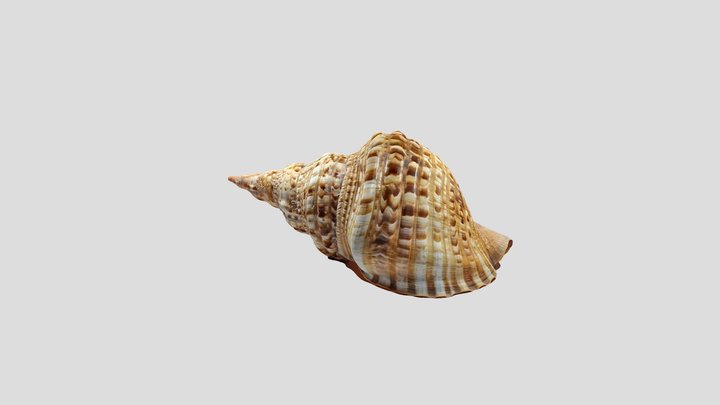
3D model
- Source
- Sketchfab
- Credit
- Do real ao digital
- Licence
- CC Attribution
- Commercial use
- cannot be read from the licence given — check the record
Smithsonian Open Access and MorphoSource were not reached for this taxon, so this list is what the others held rather than everything there is.
The description on this site
- Licence
- CC BY-SA 4.0
This is what the site found, which is not the same as what exists.
Keep going
What may have been alongside itCharonia through timeFormations of the PlioceneThe world it lived on
Occurrence data from the Paleobiology Database, CC BY 4.0. (Lamarck 1816)