Chimaeridae
The Chimaeridae, or short-nosed chimaeras, are a family of cartilaginous fish.

SEFSC Pascagoula Laboratory; Collection of Brandi Noble, NOAA/NMFS/SEFSC · Public Domain · via Wikipedia/Commons. May be a photograph of a specimen, or an artist’s reconstruction — an interpretation of a skeleton, since colour and soft tissue are almost never preserved.
On record
Recorded, not inferred- Sits inside
- ChimaeroideiPBDB
- Diet
- carnivorePBDB, for Chimaeriformes
- Life habit
- nektobenthicPBDB, for Chimaeriformes
- Motility
- actively mobilePBDB, for Chimaeriformes
Time the record covers
At least 301 million years on record.
The record covers at least 307 Mya to 5.333 Mya. No occurrence read is dated outside 315.2 Mya to 3.6 Mya.
40 occurrences of Chimaeridae on record, most of them in the Late Cretaceous. The Paleobiology Database records this as a living group, and the chart stops with its fossils rather than at the present. Bar height is expected occurrences, not a count: each fossil is spread across the span it is dated to, so a tall narrow bar means tight dating and a low wide one means loose.
When
40 occurrences- Carboniferous3%
- Early Jurassic3%
- Late Jurassic3%
- Early Cretaceous8%
- Late Cretaceous46%
- Paleocene11%
- Eocene5%
- Oligocene18%
- Miocene2%
- Pliocene3%
These are dates about fossils, not the animal: the record can only begin after it arose and end before it died out, so either end may reach further. Shares are expected occurrences: a fossil dated to a span is counted partly in each period it straddles. More on what this infers.
Found in
19 formations
- Masuk Formation12
- Sables de Bracheux Formation3
- Melovatka Formation2
- San Mateo Formation1
- Rupel Formation1
- Bohlen Formation1
Loading coastlines…
The named rock units Chimaeridae has been recovered from, largest first. Drawn where the rock is now, not where it formed. 7 occurrences have no formation on record, which is common for older literature.
Chimaeridae and its relatives
Late CretaceousWhere Chimaeridae and its relatives were recorded in the Late Cretaceous.
Found in the same rock
856 taxa- Saurischia8 sites
- Hadrosauridae7 sites
- Carcharias hopei5 sites
- Chimaera5 sites
- Chondrichthyes5 sites
- Palaeohypotodus rutoti5 sites
- Squalus minor5 sites
- Squatina prima5 sites
- Aetomylaeus dixoni4 sites
- Dugongidae4 sites
- Hybodus4 sites
- Jaekelotodus robustus4 sites
- Keasius parvus4 sites
- Pachygaleus lefevrei4 sites
- Palaeogaleus vincenti4 sites
- Physogaleus latus4 sites
- Rhinoptera4 sites
- Scyliorhinus4 sites
- Squalus alsaticus4 sites
- Squalus orpiensis4 sites
- Squatina4 sites
- Striatolamia striata4 sites
- Abdounia minutissima3 sites
- Anomotodon novus3 sites
The Paleobiology Database records 38 sites for Chimaeridae, and this reads all of them. The number is how many of those sites it was catalogued from too. The 24 sharing the most are listed.
This is not a list of everything alive at the time. It is only what has come out of the same ground as this animal and been written down.
Entered from
26 references- Stratigraphic revision of Campanian (Upper Cretaceous) rocks in the Henry Basin, Utah12
- Contribution à l'étude des élasmobranches du Thanétien (Paléocène) du Bassin de Paris. 1. Découverte d'une faune d'elasmobranches dans la partie supérieure des Sables de Bracheux (Thanétien, Paléocène du Bassin de Paris) des régions de Compiègne (Oise) et de Montdidier (Somme)3
- Fauna und Palokologie des marinen Mitteloligozans der Leipziger Tieflansbucht (Bohlener Schichten)2
- A new genus of chimaerid fish (Holocephali, Chimaeridae) from the upper Oligocene Sooke Formation of British Columbia, Canada1
- The Rauenberg fossil Lagerstätte (Baden-Württemberg, Germany): A window into early Oligocene marine and coastal ecosystems of Central Europe1
- Im Reich der Meerengel. Der Nusplinger Plattenkalk und seine Fossilien1
- Additional fish record from the Uscari Formation, Upper Miocene-Lower Pliocene of Costa Rica: A Chimaeroidei tooth plate (Pisces, Chondrichthyes, Holocephali)1
- On the brain of a primitive bird from the Upper Cretaceous of European Russia1
- First record of the Late Cretaceous durophagous mosaasaur Carinodens belgicus (Squamata, Mosasauridae) from Volgogradskaya Oblast (Russia) and Crimea (Ukraine)1
- Two bone fragments of ornithocheiroid pterosaurs from the Cenomanian of Volgograd Region, southern Russia1
- New data on Cretaceous flying reptiles (Pterosauria) from Russia, Kazakhstan, and Kyrgyzstan1
- Découverte d'une faune de vertébrés dans l'Oligocène inférieur de Vayres-sur-Essone (bassin de Paris, France): biodiversité et paléoenvironnement1
Each of the 40 occurrences read was entered from one of these publications, ordered by how many each accounts for. This is not a search for papers mentioning the name. 14 further references are not listed. Entries link to doi.org where the Paleobiology Database holds an identifier, and to its own record where it does not. Relayed as the Paleobiology Database holds them, not checked against what they resolve to.
Media and terms
Media content1
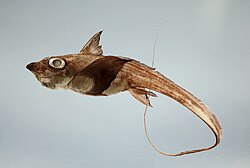
Picture of Chimaeridae
- Source
- Wikipedia/Commons
- Credit
- SEFSC Pascagoula Laboratory; Collection of Brandi Noble, NOAA/NMFS/SEFSC
- Licence
- Public Domain
- Commercial use
- the licence allows it
No 3D scan of Chimaeridae was found in Sketchfab.
Smithsonian Open Access and MorphoSource were not reached for this taxon, so this list is what the others held rather than everything there is.
The description on this site
- Source
- Wikipedia, “Chimaeridae”
- Licence
- CC BY-SA 4.0
This is what the site found, which is not the same as what exists.
Keep going
What may have been alongside itChimaeroidei through timeFormations of the Late CretaceousThe world it lived on
Occurrence data from the Paleobiology Database, CC BY 4.0.