Chriacus gallinae
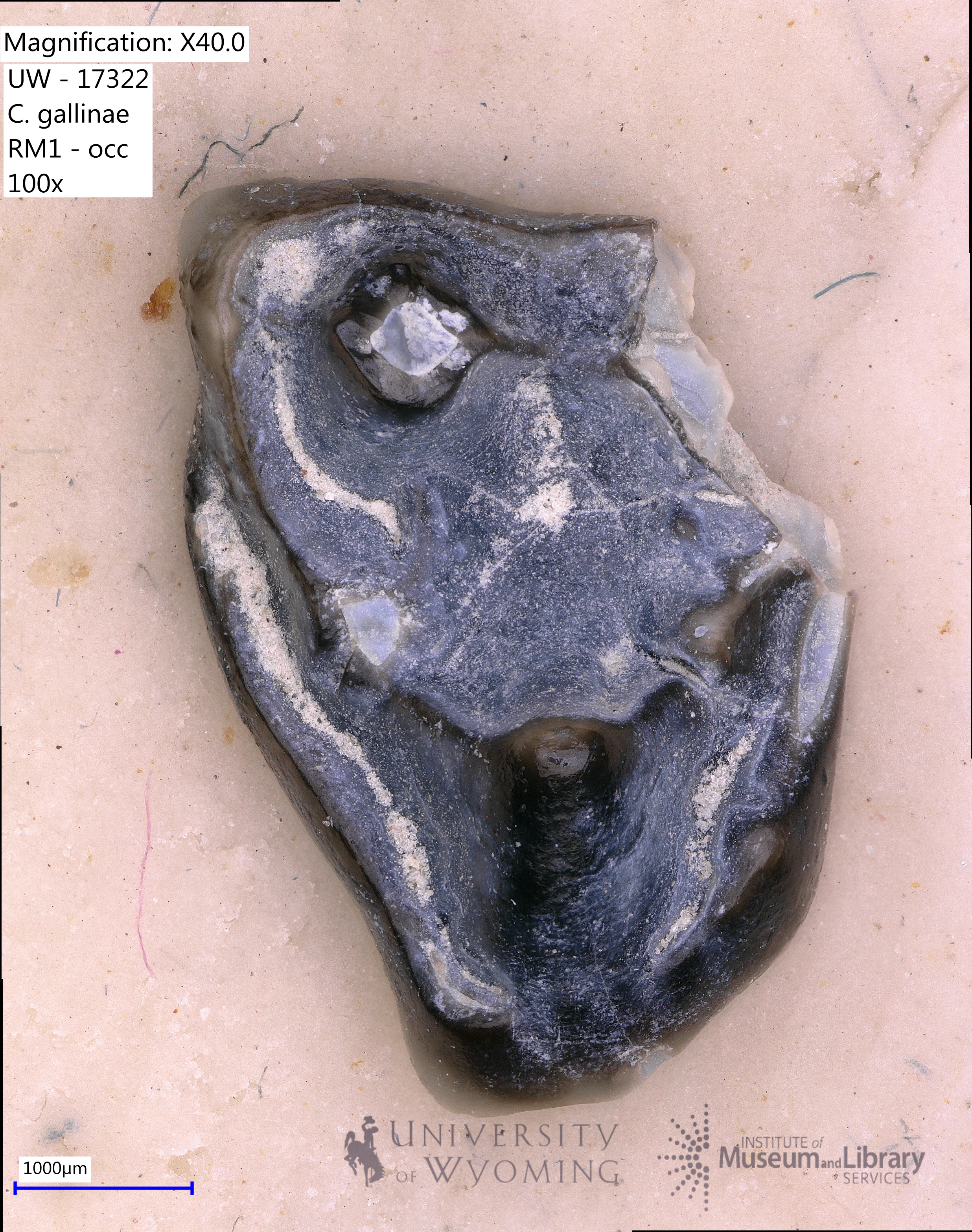
via iDigBio · via iDigBio. May be a photograph of a specimen, or an artist’s reconstruction — an interpretation of a skeleton, since colour and soft tissue are almost never preserved.
On record
Recorded, not inferred- Sits inside
- ChriacusPBDB
- Diet
- omnivorePBDB, for Chriacus
- Life habit
- scansorialPBDB, for Chriacus
- Motility
- actively mobilePBDB, for Osteichthyes
- Environment
- terrestrialPBDB, for Eutheria
Time the record covers
At most 9.5 million years on record.
Every occurrence read is dated to somewhere between 57.5 Mya and 48.07 Mya, and nothing in the dating separates them, so that window is what the record shows rather than a span.
25 occurrences of Chriacus gallinae on record, most of them in the Eocene. Bar height is expected occurrences, not a count: each fossil is spread across the span it is dated to, so a tall narrow bar means tight dating and a low wide one means loose.
When
25 occurrencesThese are dates about fossils, not the animal: the record can only begin after it arose and end before it died out, so either end may reach further. Shares are expected occurrences: a fossil dated to a span is counted partly in each period it straddles. More on what this infers.
Found in
5 formations
- Willwood Formation14
- Wasatch Formation6
- DeBeque Formation2
- "Wasatch" Formation2
- Indian Meadows Formation1
Loading coastlines…
The named rock units Chriacus gallinae has been recovered from, largest first. Drawn where the rock is now, not where it formed.
Chriacus gallinae and its relatives
EoceneWhere Chriacus gallinae and its relatives were recorded in the Eocene.
Found in the same rock
171 taxa- Phenacodus vortmani15 sites
- Cantius abditus13 sites
- Esthonyx bisulcatus13 sites
- Coryphodon12 sites
- Arenahippus pernix10 sites
- Diacodexis metsiacus10 sites
- Hyopsodus simplex9 sites
- Apheliscus8 sites
- Bunophorus8 sites
- Bunophorus etsagicus8 sites
- Didelphodus absarokae8 sites
- Haplomylus speirianus8 sites
- Heptodon calciculus8 sites
- Miacis exiguus8 sites
- Paramys copei8 sites
- Sifrhippus grangeri8 sites
- Absarokius metoecus7 sites
- Homogalax protapirinus7 sites
- Hyopsodus7 sites
- Palaeictops bicuspis7 sites
- Paramys7 sites
- Viverravus acutus7 sites
- Vulpavus australis7 sites
- Absarokius abbotti6 sites
The Paleobiology Database records 25 sites for Chriacus gallinae, and this reads all of them. The number is how many of those sites it was catalogued from too. The 24 sharing the most are listed.
This is not a list of everything alive at the time. It is only what has come out of the same ground as this animal and been written down.
Entered from
6 references- Stratigraphy and mammalian paleontology of the McCullough Peaks, northern Bighorn Basin, Wyoming: Implications for biochronology, basin development, and community reorganization across the Paleocene-Eocene boundary10
- Fossil Mammalia from the early Wasatchian Four Mile fauna, Eocene of northwest Colorado6
- Faunal Zonation of the Willwood Formation in the Central Bighorn Basin, Wyoming4
- Early Eocene Mammalian Fauna of the Piceance Creek Basin. Northwestern Colorado2
- Fossil mammals of the early Wasatchian Powder River local fauna, Eocene of northeast2
- Laramide tectonics and deposition, Washakie Range and northwestern Wind River Basin, Wyoming1
Each of the 25 occurrences read was entered from one of these publications, ordered by how many each accounts for. This is not a search for papers mentioning the name. Each entry links to the Paleobiology Database's own record for the work.
Media and terms
Media content2
Picture of Chriacus gallinae
- Source
- iDigBio
- Credit
- via iDigBio
- Licence
- not stated by the source
- Commercial use
- cannot be read from the licence given — check the record
Laser scan
- Source
- MorphoSource
- Licence
- In Copyright
- Commercial use
- cannot be read from the licence given — check the record
- Specimen
- Chriacus gallinae · AMNH:FM:105121
Smithsonian Open Access was not reached for this taxon, so this list is what the others held rather than everything there is.
This is what the site found, which is not the same as what exists.
Keep going
What may have been alongside itChriacus through timeFormations of the EoceneThe world it lived on
Occurrence data from the Paleobiology Database, CC BY 4.0. Matthew and Granger 1915