Collyrites

via iDigBio · CC BY-SA · via iDigBio. May be a photograph of a specimen, or an artist’s reconstruction — an interpretation of a skeleton, since colour and soft tissue are almost never preserved.
On record
Recorded, not inferred- Sits inside
- PygorhytinaePBDB
- Diet
- grazer, deposit feederPBDB, for Echinoidea
- Life habit
- epifaunalPBDB, for Echinoidea
- Motility
- actively mobilePBDB, for Echinoidea
- Vision
- limitedPBDB, for Echinoidea
- Environment
- marinePBDB, for Echinodermata
Time the record covers
At least 32 million years on record.
The record covers at least 165.3 Mya to 132.6 Mya. No occurrence read is dated outside 168.2 Mya to 125.77 Mya.
27 occurrences of Collyrites on record, most of them in the Late Jurassic. Bar height is expected occurrences, not a count: each fossil is spread across the span it is dated to, so a tall narrow bar means tight dating and a low wide one means loose.
When
27 occurrencesThese are dates about fossils, not the animal: the record can only begin after it arose and end before it died out, so either end may reach further. Shares are expected occurrences: a fossil dated to a span is counted partly in each period it straddles. More on what this infers.
Found in
5 formations
- Marnes de Latrecey Formation4
- Hajar Formation2
- Baghamshah Formation2
- Aground Ouadar Formation1
- Chari Formation1
Loading coastlines…
The named rock units Collyrites has been recovered from, largest first. Drawn where the rock is now, not where it formed. 17 occurrences have no formation on record, which is common for older literature.
Collyrites and its relatives
Late JurassicWhere Collyrites and its relatives were recorded in the Late Jurassic.
Found in the same rock
288 taxa- Holectypus7 sites
- Pecten7 sites
- Pholadomya6 sites
- Pleurotomaria6 sites
- Serpula5 sites
- Toxaster5 sites
- Arca4 sites
- Astarte4 sites
- Cardium4 sites
- Cymatoceras pseudoelegans4 sites
- Dorsoplicathyris4 sites
- Eurotrigonia caudata4 sites
- Exogyra4 sites
- Hastites4 sites
- Janita4 sites
- Lamellaerhynchia rostriformis4 sites
- Lima4 sites
- Nucula4 sites
- Ostrea4 sites
- Pholadomya elongata4 sites
- Serpulidae4 sites
- Terebratula4 sites
- Trimarginites4 sites
- Venus4 sites
The Paleobiology Database records 25 sites for Collyrites, and this reads all of them. The number is how many of those sites it was catalogued from too. The 24 sharing the most are listed.
This is not a list of everything alive at the time. It is only what has come out of the same ground as this animal and been written down.
Entered from
14 references- Jura Vaudois et Neuchatelois5
- L'Oxfordien moyen et supérieur de l'Est du Bassin Parisien (France). L'exemple de Latrecey (Haute-Marne): aspects fauniques, paléoenvironnementaux et stratigraphiques4
- Les Terebratulidés de l'Oxfordien du Jura et de la bordure sud du Bassin de Paris4
- A Late Jurassic carbonate ramp colonized by sponges and benthic microbial communities (External Prebetic, Southern Spain)2
- Explanatory text of the Naybandan Quadrangle Map 1:250,0002
- Échinides irréguliers du Dogger de Pologne2
- Unpublished data from Kachchh1
- Ammonites and nautiloids from the Jurassic and Lower Cretaceous of Wadi Hajar, southern Yemen1
- The Jurassic and Lower Cretaceous of Wadi Hajar, southern Yemen1
- Les echinides du Kimméridgien inférieur des Monts de Chellala (ouest Algérien); révision, paléoenvironnement, et eustatisme1
- Lithostratigraphy, biostratigraphy and sedimentary dynamics of the Lower Cretaceous deposits on the northern side of the western High Atlas (Morocco)1
- O yurskikh morskikh ezhakh Armyanskoy SSR1
Each of the 27 occurrences read was entered from one of these publications, ordered by how many each accounts for. This is not a search for papers mentioning the name. 2 further references are not listed. Entries link to doi.org where the Paleobiology Database holds an identifier, and to its own record where it does not. Relayed as the Paleobiology Database holds them, not checked against what they resolve to.
Media and terms
Media content2
Picture of Collyrites
- Source
- iDigBio
- Credit
- via iDigBio
- Licence
- CC BY-SA
- Commercial use
- the licence allows it
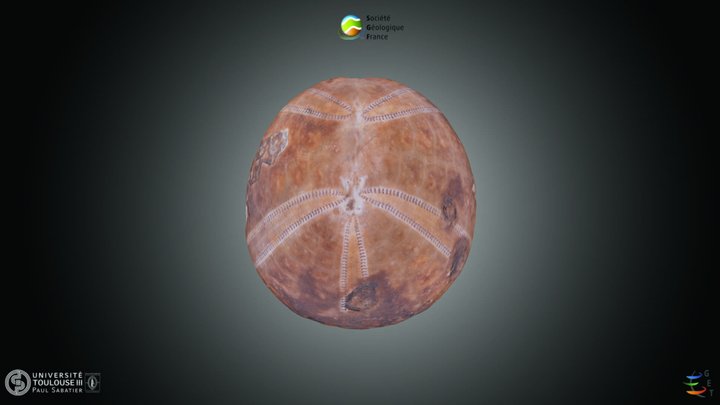
3D model
- Source
- Sketchfab
- Licence
- CC Attribution-NonCommercial-ShareAlike
- Commercial use
- the licence does not allow it
This is what the site found, which is not the same as what exists.
Keep going
What may have been alongside itPygorhytinae through timeFormations of the Late JurassicThe world it lived on
Occurrence data from the Paleobiology Database, CC BY 4.0.