Comatulida
Comatulida is an order of crinoids. Members of this order are known as feather stars and mostly do not have a stalk as adults. The oral surface with the mouth is facing upwards and is surrounded by five, often divided rays with feathery pinnules. Comatulids live on the seabed and on reefs in tropical and temperate waters.

albert kok · CC BY-SA 3.0 · via Wikipedia/Commons. May be a photograph of a specimen, or an artist’s reconstruction — an interpretation of a skeleton, since colour and soft tissue are almost never preserved.
On record
Recorded, not inferred- Also called
- Feather starPBDB
- Sits inside
- ArticulataPBDB
- Diet
- suspension feederPBDB
- Life habit
- intermediate-level epifaunalPBDB
- Motility
- facultatively mobile, attachedPBDB
- Vision
- blindPBDB, for Crinoidea
- Environment
- marinePBDB
Time the record covers
At least 201 million years on record.
The record covers at least 201.4 Mya to 129 ka. No occurrence read is dated outside 205.7 Mya to 11.7 ka.
322 occurrences of Comatulida on record, most of them in the Late Cretaceous. The Paleobiology Database records this as a living group. Bar height is expected occurrences, not a count: each fossil is spread across the span it is dated to, so a tall narrow bar means tight dating and a low wide one means loose.
When
322 occurrences- Late Triassicunder 1%
- Early Jurassicunder 1%
- Middle Jurassic2%
- Late Jurassic4%
- Early Cretaceous15%
- Late Cretaceous54%
- Paleocene4%
- Eocene9%
- Oligocene5%
- Miocene5%
- Pleistoceneunder 1%
These are dates about fossils, not the animal: the record can only begin after it arose and end before it died out, so either end may reach further. Shares are expected occurrences: a fossil dated to a span is counted partly in each period it straddles. More on what this infers.
Found in
44 formations
- Otekaike Limestone Formation27
- Maastricht Formation26
- Haslam Formation21
- Gulpen Formation20
- Maastricht Formation16
- White Chalk Formation11
Loading coastlines…
The named rock units Comatulida has been recovered from, largest first. Drawn where the rock is now, not where it formed. 20 further formations hold fewer occurrences each and are not listed. 137 occurrences have no formation on record, which is common for older literature.
Comatulida and its relatives
Late CretaceousWhere Comatulida and its relatives were recorded in the Late Cretaceous.
Found in the same rock
1,869 taxa- Bourgueticrinus ellipticus23 sites
- Chomataster acules16 sites
- Ophiomusium granulosum15 sites
- Goniasteridae14 sites
- Hemiaster14 sites
- Hemipneustes striatoradiatus14 sites
- Applinocrinus cretaceus13 sites
- Gauthieria pseudoradiata13 sites
- Marsupites testudinarius13 sites
- Oolopygus13 sites
- Metopaster12 sites
- Nucleopygus12 sites
- Dunnicrinus aequalis11 sites
- Ophiura serrata11 sites
- Temnocidaris11 sites
- Trichaster ornatus11 sites
- Hemiaster (Bolbaster) prunella10 sites
- Lophidiaster pygmaeus10 sites
- Bourgueticrinus9 sites
- Cardiaster granulosus9 sites
- Diplodetus9 sites
- Procassidulus lapiscancri9 sites
- Trochalosoma9 sites
- Astropectinidae8 sites
The Paleobiology Database records 172 sites for Comatulida, and this reads all of them. The number is how many of those sites it was catalogued from too. The 24 sharing the most are listed.
This is not a list of everything alive at the time. It is only what has come out of the same ground as this animal and been written down.
Entered from
74 references- Late Cretaceous-Early Paleocene echinoderms and the K/T boundary in the southeast Netherlands and the northeast Belgium. - part 2: Crinoids64
- Campanian-Maastrichtian crinoids (Echinodermata) from Tercis les Bains (Landes)34
- Thiolliericrinid crinoids from the Lower Cretaceous of Crimea31
- The crinoid Marsupites in the Upper Cretaceous Nanaimo Group, British Columbia: resolution of the Santonian-Campanian boundary in the North Pacific Province21
- New Comatulid Crinoids From the Meyers Pass Limestone Member (Waitakian (Chattian)) of the Pentland Hills and Hurstlea, South Canterbury, New Zealand16
- Late Cretaceous crinoids (Echinodermata) from the southwestern margin of the Holy Cross Mts. (southern Poland) and phylogenetic relationships among bourgueticrinids15
- New fossil crinoids (Articulata: Comatulida) from the Late Oligocene of the Pentland Hills and Hurstlea, South Canterbury, New Zealand11
- The echinoderms of the Rügen White Chalk (Maastrichtian, Germany)11
- Les paléoenvironnements éocènes à crinoïdes pédonculés des marnes de Miretrain (Angoumé, SW France): interprétations paléobathymétriques10
- New comatulid crinoids from the Early Cretaceous Glen Rose Formation (Texas, USA): paleobiology and evolutionary relationships of an endemic, ephemeral giant8
- Cretaceous Crinoidea (Comatulida and Roveacrinida) from England and France7
- Late Cretaceous nautilid beaks from near-shore/shallow water deposits of the Bohemian Cretaceous Basin (Czech Republic)5
Each of the 322 occurrences read was entered from one of these publications, ordered by how many each accounts for. This is not a search for papers mentioning the name. 62 further references are not listed. Entries link to doi.org where the Paleobiology Database holds an identifier, and to its own record where it does not. Relayed as the Paleobiology Database holds them, not checked against what they resolve to.
Media and terms
Media content1
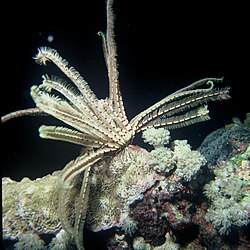
Picture of Comatulida
- Source
- Wikipedia/Commons
- Credit
- albert kok
- Licence
- CC BY-SA 3.0
- Commercial use
- the licence allows it
No 3D scan was found. Smithsonian Open Access, MorphoSource and Sketchfab were all searched.
The description on this site
- Source
- Wikipedia, “Comatulida”
- Licence
- CC BY-SA 4.0
This is what the site found, which is not the same as what exists.
Keep going
What may have been alongside itArticulata through timeFormations of the Late CretaceousThe world it lived on
Occurrence data from the Paleobiology Database, CC BY 4.0. Clark 1908