Conodonta
Searched as Conodonta indet.. The Paleobiology Database treats Conodonta as the accepted name.
Conodonts are an extinct group of marine jawless vertebrates belonging to the class Conodonta. They are primarily known from their hard, mineralised tooth-like structures called "conodont elements" that in life were present in the oral cavity and used to process food. Rare soft tissue remains suggest that they had elongate eel-like bodies with large eyes. Conodonts were a long-lasting group with over 300 million years of existence from the Cambrian to the beginning of the Jurassic. Conodont elements are highly distinctive to particular species and are widely used in biostratigraphy as indicative of particular periods of geological time.

Rexroad, Carl Buckner, 1925- · No restrictions · via Wikipedia/Commons. May be a photograph of a specimen, or an artist’s reconstruction — an interpretation of a skeleton, since colour and soft tissue are almost never preserved.
On record
Recorded, not inferred- Also called
- conodontPBDB
- Sits inside
- ConodontophoridaPBDB
- Diet
- carnivorePBDB
- Life habit
- nektonicPBDB
- Motility
- actively mobilePBDB
- Vision
- well-developedPBDB
Time the record covers
At least 300 million years on record.
The record covers at least 499.5 Mya to 199.5 Mya. No occurrence read is dated outside 504.5 Mya to 184.2 Mya.
313 occurrences of Conodonta on record, most of them in the Ordovician. Bar height is expected occurrences, not a count: each fossil is spread across the span it is dated to, so a tall narrow bar means tight dating and a low wide one means loose.
When
313 occurrences- Cambrian2%
- Ordovician30%
- Silurian9%
- Devonian23%
- Carboniferous18%
- Permianunder 1%
- Early Triassic4%
- Middle Triassic11%
- Late Triassic3%
- Early Jurassicunder 1%
These are dates about fossils, not the animal: the record can only begin after it arose and end before it died out, so either end may reach further. Shares are expected occurrences: a fossil dated to a span is counted partly in each period it straddles. More on what this infers.
Found in
104 formations
- Antelope Valley Formation · Pogonip Group26
- Salmontrout Limestone Formation15
- Kopanina Formation14
- New Albany Shale Formation11
- Gull River Formation10
- Bac Thuy Formation9
Loading coastlines…
The named rock units Conodonta has been recovered from, largest first. Drawn where the rock is now, not where it formed. 80 further formations hold fewer occurrences each and are not listed. 58 occurrences have no formation on record, which is common for older literature.
Conodonta and its relatives
OrdovicianWhere Conodonta and its relatives were recorded in the Ordovician.
Found in the same rock
903 taxa- Panderodus unicostatus68 sites
- Wurmiella excavata48 sites
- Polygnathus41 sites
- Ozarkodina35 sites
- Pseudooneotodus bicornis35 sites
- Belodella34 sites
- Oulodus29 sites
- Pelekysgnathus26 sites
- Ozarkodina sagitta25 sites
- Walliserodus sancticlairi23 sites
- Warrenella23 sites
- Palmatolepis22 sites
- Panderodus21 sites
- Icriodus18 sites
- Oulodus equirectus17 sites
- Rugosa17 sites
- Tortodus14 sites
- Brachiopoda13 sites
- Nicollidina remscheidensis13 sites
- Ozarkodina confluens13 sites
- Polygnathus costatus13 sites
- Wurmiella polinclinata12 sites
- Carniodus carnulus11 sites
- Conodontophorida11 sites
The Paleobiology Database records at least 469 sites for Conodonta, and this reads 240 of them. The number is how many of those sites it was catalogued from too. The 24 sharing the most are listed.
This is not a list of everything alive at the time. It is only what has come out of the same ground as this animal and been written down.
Entered from
117 references- Early Anisian (Middle Triassic) Conodonts from Romania and China, with Comments on Their Role in the Recognition and Correlation of the Base of the Anisian.17
- The Middle Triassic magnetostratigraphy from the Peri-Tethys basin in Poland16
- Devonian tentaculitids of east-central Alaska; systematics and biostratigraphic significance16
- Aspects of Middle and Upper Ordovician Conodont Biostratigraphy of Carbonate Facies in Nevada and Southeast California and Comparison with Some Appalachian Successions15
- A jawed polychaete fauna from the Late Ludlow Kozlowskii event interval in the Prague Basin (Czech Republic)13
- Lower Devonian (Lochkovian) biostratigraphy and brachiopod faunas, Canadian arctic islands12
- The early vertebrate Astraspis, habitat based on a lithologic association10
- Fossils from the Ordovician bioherm at Meiklejohn Peak, Nevada10
- Olenekian (Early Triassic) stratigraphy and fossil assemblages in northeastern Vietnam9
- Biostratigraphy and paleobiogeography of Middle and Late Ordovician conodonts from the Langkawi Islands, northwestern peninsular Malaysia7
- Organic buildups in the Lower Ordovician (Canadian) of Texas and Oklahoma7
- Taxonomy, Evolution, and Biostratigraphy of Conodonts: from the Kechika Formation, Skoki Formation, and Road River Group (Upper Cambrian to Lower Silurian)6
Each of the 313 occurrences read was entered from one of these publications, ordered by how many each accounts for. This is not a search for papers mentioning the name. 105 further references are not listed. Entries link to doi.org where the Paleobiology Database holds an identifier, and to its own record where it does not. Relayed as the Paleobiology Database holds them, not checked against what they resolve to.
Media and terms
Media content2

Picture of Conodonta
- Source
- Wikipedia/Commons
- Credit
- Rexroad, Carl Buckner, 1925-
- Licence
- No restrictions
- Commercial use
- cannot be read from the licence given — check the record
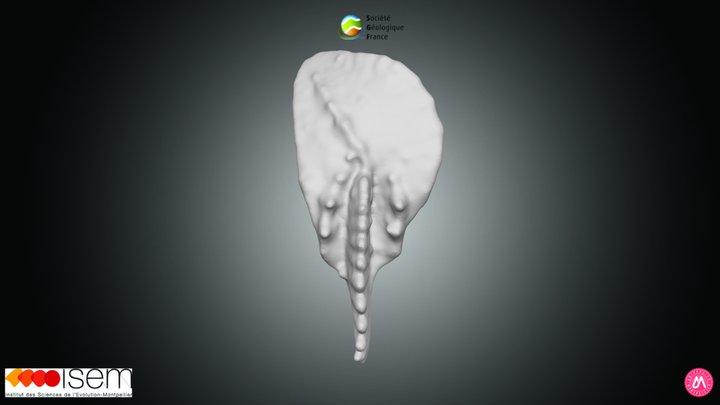
3D model
- Source
- Sketchfab
- Licence
- CC Attribution-NonCommercial-ShareAlike
- Commercial use
- the licence does not allow it
Smithsonian Open Access and MorphoSource were not reached for this taxon, so this list is what the others held rather than everything there is.
The description on this site
- Source
- Wikipedia, “Conodont”
- Licence
- CC BY-SA 4.0
This is what the site found, which is not the same as what exists.
Keep going
What may have been alongside itConodontophorida through timeFormations of the OrdovicianThe world it lived on
Occurrence data from the Paleobiology Database, CC BY 4.0. (Pander 1856)