Coturnix japonica
The Japanese quail, also known as the coturnix quail, is a species of Old World quail found in East Asia. First considered a subspecies of the common quail, it is now considered as a separate species. The Japanese quail has played an active role in the lives of humanity since the 12th century, and continues to play major roles in industry and scientific research. Where it is found, the species is abundant across most of its range. Currently, there are a few true breeding mutations of the Japanese quail. The varieties currently found in the United States include Pharaoh, Italian, Manchurian, Tibetan, Rosetta, along with the following mutations: sex-linked brown, fee, roux, silver, andalusian, blue/blau, white winged pied, progressive pied, albino, calico, sparkly, as well as non-color mutations such as celadon, which lay blue-tinted eggs.

Ingrid Taylar · CC BY 2.0 · via Wikipedia/Commons. May be a photograph of a specimen, or an artist’s reconstruction — an interpretation of a skeleton, since colour and soft tissue are almost never preserved.
On record
Recorded, not inferred- Also called
- Japanese quailPBDB
- Sits inside
- CoturnixPBDB
- Diet
- granivorePBDB, for Phasianidae
- Life habit
- volantPBDB, for Phasianidae
- Motility
- actively mobilePBDB, for Theropoda
- Environment
- terrestrialPBDB, for Phasianidae
- Mass
- 8 gWikidata
Time the record covers
At most 118 thousand years on record.
The one occurrence read is dated to somewhere between 129 ka and 11.7 ka, which is a dating window rather than a span.
1 occurrence of Coturnix japonica on record, most of them in the Pleistocene. The Paleobiology Database records this as a living group. Bar height is expected occurrences, not a count: each fossil is spread across the span it is dated to, so a tall narrow bar means tight dating and a low wide one means loose.
When
1 occurrences- Pleistocene100%
These are dates about fossils, not the animal: the record can only begin after it arose and end before it died out, so either end may reach further. Shares are expected occurrences: a fossil dated to a span is counted partly in each period it straddles. More on what this infers.
Coturnix japonica and its relatives
PleistoceneWhere Coturnix japonica and its relatives were recorded in the Pleistocene.
Found in the same rock
23 taxa- Aix galericulata1 site
- Anser anser1 site
- Butastur indicus1 site
- Buteo buteo1 site
- Columba janthina1 site
- Corvus macrorhynchos1 site
- Emberizidae1 site
- Gallirallus1 site
- Grus1 site
- Haliaeetus pelagicus1 site
- Hypsipetes amaurotis1 site
- Phalacrocorax capillatus1 site
- Rallus1 site
- Scolopacidae1 site
- Scolopax mira1 site
- Streptopelia orientalis1 site
- Strigidae1 site
- Sylviidae1 site
- Synoicus chinensis1 site
- Turdus pallidus1 site
- Turnix suscitator1 site
- Zapornia fusca1 site
- Zoothera dauma major1 site
The Paleobiology Database records 1 site for Coturnix japonica, and this reads all of them. The number is how many of those sites it was catalogued from too.
This is not a list of everything alive at the time. It is only what has come out of the same ground as this animal and been written down.
Entered from
1 referenceEach of the 1 occurrence read was entered from one of these publications, ordered by how many each accounts for. This is not a search for papers mentioning the name. Each entry links to doi.org. Relayed as the Paleobiology Database holds them, not checked against what they resolve to.
Media and terms
Media content1
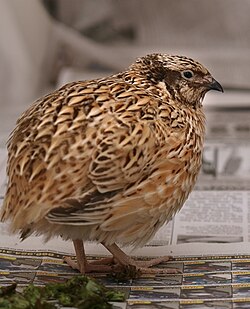
Picture of Coturnix japonica
- Source
- Wikipedia/Commons
- Credit
- Ingrid Taylar
- Licence
- CC BY 2.0
- Commercial use
- the licence allows it
No 3D scan of Coturnix japonica was found in Sketchfab.
Smithsonian Open Access and MorphoSource were not reached for this taxon, so this list is what the others held rather than everything there is.
The description on this site
- Licence
- CC BY-SA 4.0
This is what the site found, which is not the same as what exists.
Keep going
What may have been alongside itCoturnix through timeFormations of the PleistoceneThe world it lived on
Occurrence data from the Paleobiology Database, CC BY 4.0. Temminck and Schlegel 1849