Criocerinae
The Criocerinae are a subfamily of the leaf beetles, or Chrysomelidae.

Uncredited · CC BY-SA 3.0 · via Wikipedia/Commons. May be a photograph of a specimen, or an artist’s reconstruction — an interpretation of a skeleton, since colour and soft tissue are almost never preserved.
On record
Recorded, not inferred- Sits inside
- ChrysomelidaePBDB
- Motility
- actively mobilePBDB, for Arthropoda
- Environment
- terrestrialPBDB, for Insecta
Time the record covers
At least 33 million years on record.
The record covers at least 33.9 Mya to 129 ka. No occurrence read is dated outside 37.71 Mya to 11.7 ka.
14 occurrences of Criocerinae on record. The Paleobiology Database records this as a living group. Bar height is expected occurrences, not a count: each fossil is spread across the span it is dated to, so a tall narrow bar means tight dating and a low wide one means loose.
When
14 occurrences- Eocene64%
- Oligocene7%
- Miocene14%
- Pleistocene14%
These are dates about fossils, not the animal: the record can only begin after it arose and end before it died out, so either end may reach further. Shares are expected occurrences: a fossil dated to a span is counted partly in each period it straddles. More on what this infers.
Found in
4 formations
- Florissant Formation8
- Niveau du gypse d'Aix Formation1
- Upper Freshwater-Molasse Formation1
- Mizozono Formation1
Loading coastlines…
The named rock units Criocerinae has been recovered from, largest first. Drawn where the rock is now, not where it formed. 3 occurrences have no formation on record, which is common for older literature.
Found in the same rock
999 taxa- Coleoptera4 sites
- Curculionidae4 sites
- Acrididae2 sites
- Anthophorites mellona2 sites
- Aphaenogaster mayri2 sites
- Apidae2 sites
- Chironomidae2 sites
- Dolichoderus antiquus2 sites
- Entiminae2 sites
- Entimini2 sites
- Formica robusta2 sites
- Lema evanescens2 sites
- Liometopum miocenicum2 sites
- Miomyrmex impactus2 sites
- Protazteca capitata2 sites
- Protazteca elongata2 sites
- Protazteca quadrata2 sites
- Scarabaeidae2 sites
- Abelater succineus1 site
- Ablator triguttatus1 site
- Acalles exhumatus1 site
- Acanthoderes1 site
- Achenium ingens1 site
- Acidota1 site
The Paleobiology Database records 8 sites for Criocerinae, and this reads all of them. The number is how many of those sites it was catalogued from too. The 24 sharing the most are listed.
This is not a list of everything alive at the time. It is only what has come out of the same ground as this animal and been written down.
Entered from
11 references- New Miocene Coleoptera from Florissant3
- Fossil Coleoptera from the Wilson Ranch near Florissant, Colorado2
- Lilioceris groehni sp. n.: the first authentic species of Criocerinae (Coleoptera, Chrysomelidae) from Baltic amber1
- Late Cenozoic insects of northern Eurasia1
- Late Pleistocene insects from the Mizozono Formation in Yoshimatsu-cho, Kagoshima Prefecture, Japan1
- Twenty new Coleoptera from the Florissant Shales1
- A report on some recent collections of fossil Coleoptera from the Miocene shales of Florissant1
- New fossil Coleoptera from Florissant, with notes on some already described1
- Recherches sur les insectes fossiles des terrains Tertiaires de la France, deuxième partie, insectes fossiles d'Aix en Provence1
- Fossile Insekten aus der Braunkohle von Salzhausen1
- Heer, 18641
Each of the 14 occurrences read was entered from one of these publications, ordered by how many each accounts for. This is not a search for papers mentioning the name. Entries link to doi.org where the Paleobiology Database holds an identifier, and to its own record where it does not. Relayed as the Paleobiology Database holds them, not checked against what they resolve to.
Media and terms
Media content1
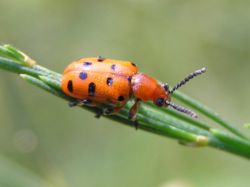
Picture of Criocerinae
- Source
- Wikipedia/Commons
- Credit
- nobody named on the record
- Licence
- CC BY-SA 3.0
- Commercial use
- the licence allows it
No 3D scan of Criocerinae was found in Sketchfab.
Smithsonian Open Access and MorphoSource were not reached for this taxon, so this list is what the others held rather than everything there is.
The description on this site
- Source
- Wikipedia, “Criocerinae”
- Licence
- CC BY-SA 4.0
This is what the site found, which is not the same as what exists.
Keep going
What may have been alongside itChrysomelidae through timeThe world it lived on
Occurrence data from the Paleobiology Database, CC BY 4.0. Latreille 1804