Cromyocrinidae
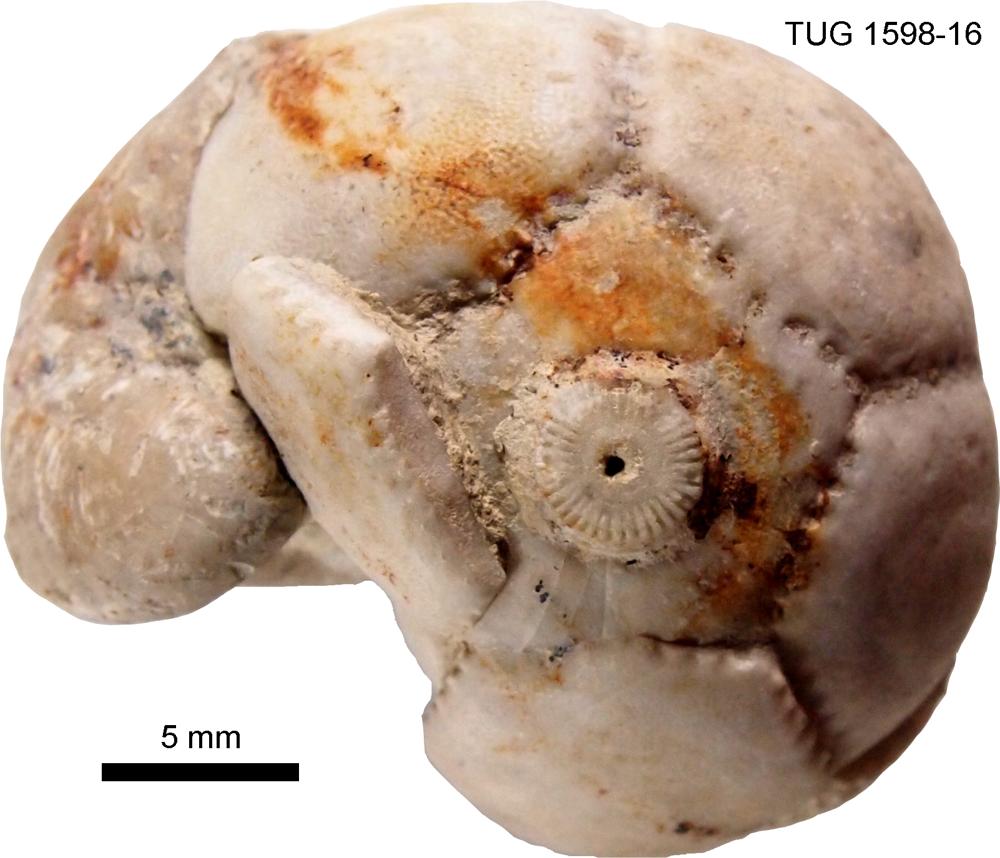
Not Cromyocrinidae. This is Cromyocrinus Trautschold, 1867, a relative — both are Cromyocrinidae.
via GBIF · CC BY-NC 4.0 · via GBIF. May be a photograph of a specimen, or an artist’s reconstruction — an interpretation of a skeleton, since colour and soft tissue are almost never preserved.
On record
Recorded, not inferred- Sits inside
- CromyocrinoideaPBDB
- Diet
- suspension feederPBDB, for Cladida
- Life habit
- intermediate-level epifaunalPBDB, for Cladida
- Motility
- stationary, attachedPBDB, for Cladida
- Vision
- blindPBDB, for Crinoidea
- Environment
- marinePBDB, for Echinodermata
Time the record covers
At least 63 million years on record.
The record covers at least 323.4 Mya to 259.857 Mya. No occurrence read is dated outside 330.3 Mya to 254.14 Mya.
103 occurrences of Cromyocrinidae on record, most of them in the Carboniferous. Bar height is expected occurrences, not a count: each fossil is spread across the span it is dated to, so a tall narrow bar means tight dating and a low wide one means loose.
When
103 occurrences- Carboniferous74%
- Permian26%
These are dates about fossils, not the animal: the record can only begin after it arose and end before it died out, so either end may reach further. Shares are expected occurrences: a fossil dated to a span is counted partly in each period it straddles. More on what this infers.
Found in
33 formations
- Barnsdall Formation · Lansing Group11
- Stanton Formation · Lansing Group10
- Bloyd Formation10
- Bird Spring Formation8
- Naco Formation7
- Atoka Formation5
Loading coastlines…
The named rock units Cromyocrinidae has been recovered from, largest first. Drawn where the rock is now, not where it formed. 9 further formations hold fewer occurrences each and are not listed. 2 occurrences have no formation on record, which is common for older literature.
Cromyocrinidae and its relatives
CarboniferousWhere Cromyocrinidae and its relatives were recorded in the Carboniferous.
Found in the same rock
551 taxa- Pirasocrinidae17 sites
- Delocrinus16 sites
- Erisocrinus15 sites
- Stellarocrinus15 sites
- Apographiocrinus14 sites
- Elibatocrinus14 sites
- Exoriocrinus14 sites
- Cymbiocrinidae13 sites
- Scytalocrinidae13 sites
- Cibolocrinus12 sites
- Ulocrinus12 sites
- Ampelocrinidae11 sites
- Stenopecrinidae indet.11 sites
- Exocrinus9 sites
- Graffhamicrinus9 sites
- Kallimorphocrinus9 sites
- Glaukosocrinus8 sites
- Laudonocrinidae8 sites
- Paramphicrinus8 sites
- Plummericrinus8 sites
- Endelocrinus matheri7 sites
- Galateacrinus7 sites
- Dicromyocrinus optimus6 sites
- Euonychocrinus6 sites
The Paleobiology Database records 69 sites for Cromyocrinidae, and this reads all of them. The number is how many of those sites it was catalogued from too. The 24 sharing the most are listed.
This is not a list of everything alive at the time. It is only what has come out of the same ground as this animal and been written down.
Entered from
29 references- Filtration models, guilds, and biofacies: crinoid paleoecology of the Stanton Formation (Upper Pennsylvanian), Midcontinent, North America21
- Lower Pennsylvanian (Morrowan) crinoids from Arkansas, Oklahoma, and Texas18
- Taphonomic Analysis and Systematic Descriptions of Some Late Pennsylvanian and Early Permian Crinoids from Southeastern Nebraska, Eastern Kansas and Southwestern Iowa9
- New crinoids from the Naco Formation (Middle Pennsylvanian) of Arizona and a revision of the Family Cromyocrinidae7
- Middle Pennsylvanian (Atokan) crinoids from Oklahoma and Missouri6
- New Permian crinoids from the Battleship Wash patch reef in southern Nevada5
- The first Pennsylvanian batocrinid and other new echinoderms from the Minturn Formation of central Colorado5
- Crinoids of the LaSalle Limestone (Pennsylvanian) of Illinois4
- Trekhrukie morskie lilii3
- Permian crinoids from the Saiwan and Khuff Formations, southeastern Oman2
- New Pennsylvanian (Moscovian) echinoderms from Xinjiang Uyghur Autonomous Region, western China2
- Globally significant Early Permian crinoids from the Mount Mark Formation in Strathcona Provincial Park, Vancouver Island, British Columbia - preliminary analysis of a disappearing fauna2
Each of the 103 occurrences read was entered from one of these publications, ordered by how many each accounts for. This is not a search for papers mentioning the name. 17 further references are not listed. Entries link to doi.org where the Paleobiology Database holds an identifier, and to its own record where it does not. Relayed as the Paleobiology Database holds them, not checked against what they resolve to.
Media and terms
Media content1
Picture of Cromyocrinus Trautschold, 1867
- Source
- GBIF
- Credit
- via GBIF
- Licence
- CC BY-NC 4.0
- Commercial use
- the licence does not allow it
No 3D scan was found. Smithsonian Open Access, MorphoSource and Sketchfab were all searched.
This is what the site found, which is not the same as what exists.
Keep going
What may have been alongside itCromyocrinoidea through timeFormations of the CarboniferousThe world it lived on
Occurrence data from the Paleobiology Database, CC BY 4.0. Bather 1890