Cuneolina
Searched as Cuneolina pavonia parva. The Paleobiology Database treats Cuneolina as the accepted name.
Cuneolina is an extinct genus of prehistoric foraminifera in the family Cuneolinidae with species from the Jurassic and Cretaceous.Name brought to synonymyCuneolina angusta Cushman, 1919, a synonym for Textulariella angusta

Unknown author Unknown author · Public Domain · via Wikipedia/Commons. May be a photograph of a specimen, or an artist’s reconstruction — an interpretation of a skeleton, since colour and soft tissue are almost never preserved.
On record
Recorded, not inferred- Sits inside
- CuneolininaePBDB
- Diet
- detritivorePBDB, for Textulariina
- Life habit
- infaunalPBDB, for Textulariina
- Motility
- stationaryPBDB, for Foraminifera
Time the record covers
At least 4.1 million years on record.
The record covers at least 89.8 Mya to 85.7 Mya. No occurrence read is dated outside 93.9 Mya to 72.2 Mya.
3 occurrences of Cuneolina on record, most of them in the Late Cretaceous. Bar height is expected occurrences, not a count: each fossil is spread across the span it is dated to, so a tall narrow bar means tight dating and a low wide one means loose.
When
3 occurrences- Late Cretaceous100%
These are dates about fossils, not the animal: the record can only begin after it arose and end before it died out, so either end may reach further. Shares are expected occurrences: a fossil dated to a span is counted partly in each period it straddles. More on what this infers.
Cuneolina and its relatives
Late CretaceousWhere Cuneolina and its relatives were recorded in the Late Cretaceous.
Found in the same rock
503 taxa- Miliolidae10 sites
- Pseudocyclammina8 sites
- Radiolites8 sites
- Orbitolina7 sites
- Dicyclina schlumbergeri6 sites
- Nezzazata6 sites
- Ophthalmidiidae6 sites
- Textulariidae6 sites
- Acicularia5 sites
- Dictyopsella5 sites
- Hippurites5 sites
- Thaumatoporella parvovesiculifera5 sites
- Vaccinites5 sites
- Vidalina5 sites
- Ammobaculites4 sites
- Biconcava4 sites
- Biplanata4 sites
- Echinoidea4 sites
- Haplophragmoides4 sites
- Lenticulina4 sites
- Moncharmontia4 sites
- Naticidae4 sites
- Nautiloculina4 sites
- Polystrata alba4 sites
The Paleobiology Database records 41 sites for Cuneolina, and this reads all of them. The number is how many of those sites it was catalogued from too. The 24 sharing the most are listed.
This is not a list of everything alive at the time. It is only what has come out of the same ground as this animal and been written down.
Entered from
2 references- Alcune facies a Rudiste dei Monti Carseolani: descrizione e correlazione dal bordo occidentale all'interno della piattaforma laziale-abruzzese [Some rudist facies in the Carseolani Mountains; description and correlation on the western border of the Latium-Abruzzi internal platform]2
- Apricardia manuelae n. sp. in the lower Turonian of northeastern Matese (south Apennines), Italy1
Each of the 3 occurrences read was entered from one of these publications, ordered by how many each accounts for. This is not a search for papers mentioning the name. Each entry links to the Paleobiology Database's own record for the work.
Media and terms
Media content1
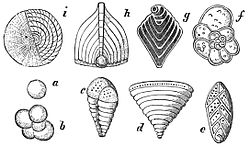
Picture of Cuneolina
- Source
- Wikipedia/Commons
- Credit
- Unknown author Unknown author
- Licence
- Public Domain
- Commercial use
- the licence allows it
No 3D scan of Cuneolina was found in Sketchfab.
Smithsonian Open Access and MorphoSource were not reached for this taxon, so this list is what the others held rather than everything there is.
The description on this site
- Source
- Wikipedia, “Cuneolina”
- Licence
- CC BY-SA 4.0
This is what the site found, which is not the same as what exists.
Keep going
What may have been alongside itCuneolininae through timeFormations of the Late CretaceousThe world it lived on
Occurrence data from the Paleobiology Database, CC BY 4.0.