Diceras
Diceras is an extinct genus of fossil saltwater clams, marine heterodont bivalve molluscs. These bivalves were stationary epifaunal suspension feeders.

Hectonichus · CC BY-SA 3.0 · via Wikipedia/Commons. May be a photograph of a specimen, or an artist’s reconstruction — an interpretation of a skeleton, since colour and soft tissue are almost never preserved.
On record
Recorded, not inferred- Sits inside
- DiceratidaePBDB
- Diet
- suspension feederPBDB, for Hippuritida
- Life habit
- epifaunalPBDB, for Diceratidae
- Motility
- stationaryPBDB, for Diceratidae
- Vision
- blindPBDB, for Bivalvia
- Environment
- marinePBDB, for Hippuritida
Time the record covers
At least 51 million years on record.
The record covers at least 157.9 Mya to 106.3 Mya. No occurrence read is dated outside 161.5 Mya to 100.5 Mya.
41 occurrences of Diceras on record, most of them in the Late Jurassic. Bar height is expected occurrences, not a count: each fossil is spread across the span it is dated to, so a tall narrow bar means tight dating and a low wide one means loose.
When
41 occurrencesThese are dates about fossils, not the animal: the record can only begin after it arose and end before it died out, so either end may reach further. Shares are expected occurrences: a fossil dated to a span is counted partly in each period it straddles. More on what this infers.
Found in
2 formations
Loading coastlines…
The named rock units Diceras has been recovered from, largest first. Drawn where the rock is now, not where it formed. 39 occurrences have no formation on record, which is common for older literature.
Diceras and its relatives
Late JurassicWhere Diceras and its relatives were recorded in the Late Jurassic.
Found in the same rock
373 taxa- Nerinea7 sites
- Adelocoenia limbata5 sites
- Trichites5 sites
- Comoseris minima4 sites
- Eodiceras4 sites
- Isastrea helianthoides4 sites
- Microsolena agariciformis4 sites
- Ptygmatis4 sites
- Solenocoenia sexradiata4 sites
- Thamnasteria concinna4 sites
- Actinaraea3 sites
- Adelocoenia radisensis3 sites
- Aequipecten3 sites
- Bryozoa3 sites
- Calamophylliopsis stockesi3 sites
- Chlamys3 sites
- Heliocoenia (Decaheliocoenia) variabilis3 sites
- Mitrodendron3 sites
- Montlivaltia3 sites
- Opisoma3 sites
- Plesiodiceras yailense3 sites
- Shuqraia heybroeki3 sites
- Solenoporaceae3 sites
- Stylina3 sites
The Paleobiology Database records 22 sites for Diceras, and this reads all of them. The number is how many of those sites it was catalogued from too. The 24 sharing the most are listed.
This is not a list of everything alive at the time. It is only what has come out of the same ground as this animal and been written down.
Entered from
11 references- Upper Jurassic Rudistae of the margin of the Holy Cross Mountains, Poland24
- Considérations stratigraphiques concernant les formations coralligènes néojurassiques de la Dobrogea centrale (Roumanie)6
- Les Madreporaires du Jurassic superieur de la bordure des Monts de Sainte-Croix, Pologne [Upper Jurassic Scleractinia from the Holy Cross Mountains, Poland]3
- Role des microbialites et des "micro-encroutants" dans la lithification recifale: exemples du Jurassique superieur de l'Atlas maghrebin (Maroc et Tunisie) [The role of microbialites and micro-encrusters in the reef lithification: examples from the Upper Jurassic of the Maghrebian Atlas (Morocco and Tunisia)]1
- Late Jurassic coral/microbial reefs from the northern Paris Basin - facies, paleoecology and paleobiogeography1
- Les grès verts helvétiques (Aptien moyen-Albien supérieur) de Haute-Savoie, Valais et Vaud (Alpes occidentales franco-suisses)1
- The Tithonian reef of Stramberk Limestone (Czechoslovakia, West Carpathians)1
- An Upper Jurassic reef complex from Slovenia, Yugoslavia1
- A study of the reef complex of Belleme (Normandy, France)1
- Facijelni odnosi i hidrozoa malma - primorskog dijela sjevernog Velebita i Velike Kapele1
- Die oberjurassische Korallenfauna von Württemberg1
Each of the 41 occurrences read was entered from one of these publications, ordered by how many each accounts for. This is not a search for papers mentioning the name. Entries link to doi.org where the Paleobiology Database holds an identifier, and to its own record where it does not. Relayed as the Paleobiology Database holds them, not checked against what they resolve to.
Media and terms
Media content2

Picture of Diceras
- Source
- Wikipedia/Commons
- Credit
- Hectonichus
- Licence
- CC BY-SA 3.0
- Commercial use
- the licence allows it
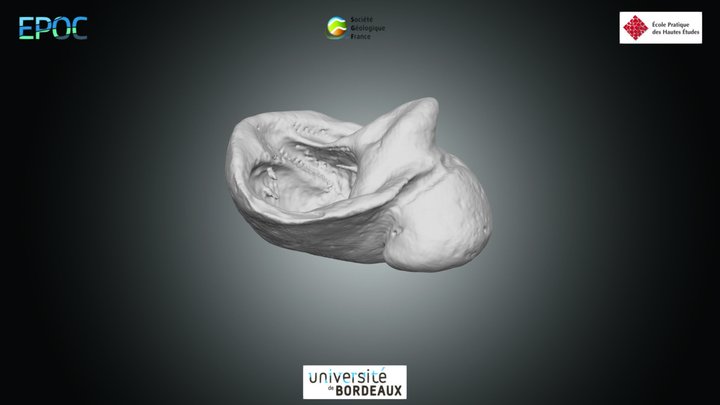
3D model
- Source
- Sketchfab
- Licence
- CC Attribution-NonCommercial-ShareAlike
- Commercial use
- the licence does not allow it
Smithsonian Open Access was not reached for this taxon, so this list is what the others held rather than everything there is.
The description on this site
- Source
- Wikipedia, “Diceras”
- Licence
- CC BY-SA 4.0
This is what the site found, which is not the same as what exists.
Keep going
What may have been alongside itDiceratidae through timeFormations of the Late JurassicThe world it lived on
Occurrence data from the Paleobiology Database, CC BY 4.0. Lamarck 1805