Dicynodontoides
Dicynodontoides is a genus of small to medium-bodied, herbivorous, emydopoid dicynodonts from the Late Permian. The name Dicynodontoides references its “dicynodont-like” appearance due to the caniniform tusks featured by most members of this infraorder. Kingoria, a junior synonym, has been used more widely in the literature than the more obscure Dicynodontoides, which is similar-sounding to another distantly related genus of dicynodont, Dicynodon. Three species are recognized: D. recurvidens from South Africa, and D. nowacki and D. kubwa from Tanzania.

Dmitry Bogdanov · CC BY-SA 3.0 · via Wikipedia/Commons. May be a photograph of a specimen, or an artist’s reconstruction — an interpretation of a skeleton, since colour and soft tissue are almost never preserved.
On record
Recorded, not inferred- Sits inside
- KingoriidaePBDB
- Diet
- herbivorePBDB, for Dicynodontia
- Motility
- actively mobilePBDB, for Osteichthyes
- Environment
- terrestrialPBDB, for Amniota
Time the record covers
At least 2.2 million years on record.
The record covers at least 254.14 Mya to 251.902 Mya. No occurrence read is dated outside 298.9 Mya to 247 Mya.
14 occurrences of Dicynodontoides on record, most of them in the Permian. Bar height is expected occurrences, not a count: each fossil is spread across the span it is dated to, so a tall narrow bar means tight dating and a low wide one means loose.
When
14 occurrencesThese are dates about fossils, not the animal: the record can only begin after it arose and end before it died out, so either end may reach further. Shares are expected occurrences: a fossil dated to a span is counted partly in each period it straddles. More on what this infers.
Found in
5 formations
- Madumabisa Mudstone Formation3
- Usili Formation · Songea Group2
- Kundaram Formation · Gondwana Group1
- Middelton Formation · Beaufort Group1
- Katberg Formation · Beaufort Group1
Loading coastlines…
The named rock units Dicynodontoides has been recovered from, largest first. Drawn where the rock is now, not where it formed. 6 occurrences have no formation on record, which is common for older literature.
Dicynodontoides and its relatives
PermianWhere Dicynodontoides and its relatives were recorded in the Permian.
Found in the same rock
34 taxa- Platypodosaurus huenei2 sites
- Rhachiocephalus magnus2 sites
- Aloposaurus1 site
- Arctognathus nasuta1 site
- Burnetiidae1 site
- Cistecephalus microrhinus1 site
- Daptocephalus huenei1 site
- Dinanomodon gilli1 site
- Dinogorgon rubidgei1 site
- Endothiodon1 site
- Euptychognathus bathyrhynchus1 site
- Geikia locusticeps1 site
- Gorgonopidae1 site
- Ictidosuchops rubidgei1 site
- Inostrancevia1 site
- Katumbia parringtoni1 site
- Kawingasaurus fossilis1 site
- Lystrosaurus curvatus1 site
- Lystrosaurus declivis1 site
- Lystrosaurus maccaigi1 site
- Lystrosaurus murrayi1 site
- Moschorhinus kitchingi1 site
- Peltobatrachus pustulatus1 site
- Procynosuchus1 site
The Paleobiology Database records 5 sites for Dicynodontoides, and this reads all of them. The number is how many of those sites it was catalogued from too. The 24 sharing the most are listed.
This is not a list of everything alive at the time. It is only what has come out of the same ground as this animal and been written down.
Entered from
11 references- Permian and Triassic Dicynodont (Therapsida: Anomodontia) Faunas of the Luangwa Basin, Zambia: Taxonomic Update and Implications for Dicynodont Biogeography and Biostratigraphy3
- A Contribution to our Knowledge of the Vertebrates of the Karroo Beds of South Africa2
- Dicynodontoides kubwa, sp. nov. (Synapsida: Anomodontia), a new large emydopoid from the base of the Usili Formation (Ruhuhu Basin, Tanzania)1
- Vertebrate Paleontology of Nooitgedacht 68: A Lystrosaurus maccaigi-Rich Permo-Triassic Boundary Locality in South Africa1
- Do extraordinarily high growth rates in Permo-Triassic dicynodonts (Therapsida, Anomodontia) explain their success before and after the end-Permian extinction?1
- Late Permian vertebrate community of the Pranhita–Godavari valley, India1
- Three new species of anomodonts from the Rubidge Collection1
- Die Anomodontier des Ruhuhu-Gebietes in der Tübinger Sammlung [Anomodontia of Ruhuhu valley in the collection of Tübingen]1
- On some new genera and species of fossil reptiles from the Karroo Beds of Graaff-Reinet1
- On the structure and affinities of Udenodon1
- Descriptive and Illustrated catalogue of the Fossil Reptilia of South Africa in the Collection of the British Museum of Natural History1
Each of the 14 occurrences read was entered from one of these publications, ordered by how many each accounts for. This is not a search for papers mentioning the name. Entries link to doi.org where the Paleobiology Database holds an identifier, and to its own record where it does not. Relayed as the Paleobiology Database holds them, not checked against what they resolve to.
Media and terms
Media content1
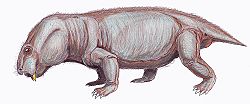
Picture of Dicynodontoides
- Source
- Wikipedia/Commons
- Credit
- Dmitry Bogdanov
- Licence
- CC BY-SA 3.0
- Commercial use
- the licence allows it
No 3D scan of Dicynodontoides was found in MorphoSource and Sketchfab.
Smithsonian Open Access was not reached for this taxon, so this list is what the others held rather than everything there is.
The description on this site
- Licence
- CC BY-SA 4.0
This is what the site found, which is not the same as what exists.
Keep going
What may have been alongside itKingoriidae through timeFormations of the PermianThe world it lived on
Occurrence data from the Paleobiology Database, CC BY 4.0. Broom 1940