Didymoceras nebrascense
Didymoceras nebrascense was an extinct species of heteromorph ammonite from the upper Campanian age. It was sexually dimorphic, with two adult sizes averaging at 270 mm (11 in) and 180 mm (7.1 in) high for females and males respectively. It exhibited three distinct growth stages. The first growth stage was composed of one or two straight sharply bending sections and a gently curved third. The second growth stage is composed of around three and a half loosely coiling whorls. The last (adult) growth stage is composed of a U-shaped bend facing upwards.

Ghedoghedo · CC BY-SA 3.0 · via Wikipedia/Commons. May be a photograph of a specimen, or an artist’s reconstruction — an interpretation of a skeleton, since colour and soft tissue are almost never preserved.
On record
Recorded, not inferred- Sits inside
- DidymocerasPBDB
- Diet
- carnivorePBDB, for Ammonoidea
- Life habit
- nektonicPBDB, for Ammonoidea
- Motility
- fast-movingPBDB, for Ammonoidea
- Vision
- well-developedPBDB, for Cephalopoda
- Environment
- marinePBDB, for Cephalopoda
Time the record covers
At most 12 million years on record.
Every occurrence read is dated to somewhere between 83.6 Mya and 72.2 Mya, and nothing in the dating separates them, so that window is what the record shows rather than a span.
10 occurrences of Didymoceras nebrascense on record, most of them in the Late Cretaceous. Bar height is expected occurrences, not a count: each fossil is spread across the span it is dated to, so a tall narrow bar means tight dating and a low wide one means loose.
When
10 occurrences- Late Cretaceous100%
These are dates about fossils, not the animal: the record can only begin after it arose and end before it died out, so either end may reach further. Shares are expected occurrences: a fossil dated to a span is counted partly in each period it straddles. More on what this infers.
Found in
4 formations
Loading coastlines…
The named rock units Didymoceras nebrascense has been recovered from, largest first. Drawn where the rock is now, not where it formed. 1 occurrence has no formation on record, which is common for older literature.
Didymoceras nebrascense and its relatives
Late CretaceousWhere Didymoceras nebrascense and its relatives were recorded in the Late Cretaceous.
Found in the same rock
16 taxa- Inoceramus turgidus3 sites
- Baculites2 sites
- Anisomyon sexsulcatus1 site
- Atira1 site
- Baculites pseudovatus1 site
- Drepanocheilus1 site
- Heus foersteri1 site
- Hoploscaphites1 site
- Notopocorystes eichhorni1 site
- Nymphalucina occidentalis1 site
- Phelopteria linguaeformis1 site
- Polinices1 site
- Solenoceras bearpawense1 site
- Tenea1 site
- Trachytriton1 site
- Zygastrocarcinus griesi1 site
The Paleobiology Database records 10 sites for Didymoceras nebrascense, and this reads all of them. The number is how many of those sites it was catalogued from too.
This is not a list of everything alive at the time. It is only what has come out of the same ground as this animal and been written down.
Entered from
6 references- The Red Bird Section of the Upper Cretaceous Pierre Shale in Wyoming3
- Late Campanian (Cretaceous) heteromorph ammonites2
- Geology of the Fort Peck area, Garfield, McCone and Valley counties, Montana2
- Fossil crabs from Tepee Buttes, submarine seeps of the Late Cretaceous Pierre Shale, South Dakota and Colorado, U.S.A.1
- Two new species of crabs, Notopocorystes (Eucorystes) eichhorni and Zygastrocarcinus griesi (Decapoda: Brachyura) from the Bearpaw Shale (Campanian) of north-central Montana1
- Age relations of upper part of Lewis Shale on east side of San Juan Basin, New Mexico1
Each of the 10 occurrences read was entered from one of these publications, ordered by how many each accounts for. This is not a search for papers mentioning the name. Entries link to doi.org where the Paleobiology Database holds an identifier, and to its own record where it does not. Relayed as the Paleobiology Database holds them, not checked against what they resolve to.
Media and terms
Media content2

Picture of Didymoceras nebrascense
- Source
- Wikipedia/Commons
- Credit
- Ghedoghedo
- Licence
- CC BY-SA 3.0
- Commercial use
- the licence allows it
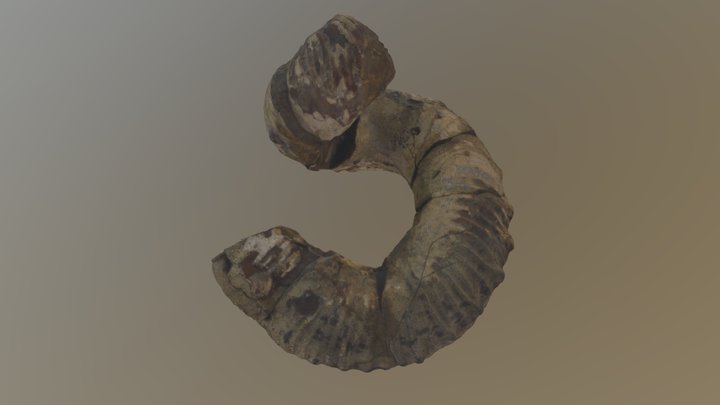
3D model
- Source
- Sketchfab
- Credit
- Shellie Luallin
- Licence
- CC Attribution
- Commercial use
- cannot be read from the licence given — check the record
MorphoSource was not reached for this taxon, so this list is what the others held rather than everything there is.
The description on this site
- Licence
- CC BY-SA 4.0
This is what the site found, which is not the same as what exists.
Keep going
What may have been alongside itDidymoceras through timeFormations of the Late CretaceousThe world it lived on
Occurrence data from the Paleobiology Database, CC BY 4.0. (Meek and Hayden 1856)