Discoscaphites conradi

via iDigBio · CC0 · via iDigBio. May be a photograph of a specimen, or an artist’s reconstruction — an interpretation of a skeleton, since colour and soft tissue are almost never preserved.
On record
Recorded, not inferred- Sits inside
- DiscoscaphitesPBDB
- Diet
- carnivorePBDB, for Ammonoidea
- Life habit
- nektonicPBDB, for Ammonoidea
- Motility
- fast-movingPBDB, for Ammonoidea
- Vision
- well-developedPBDB, for Cephalopoda
- Environment
- marinePBDB, for Cephalopoda
Time the record covers
At most 78 million years on record.
Every occurrence read is dated to somewhere between 143.1 Mya and 66 Mya, and nothing in the dating separates them, so that window is what the record shows rather than a span.
75 occurrences of Discoscaphites conradi on record, most of them in the Late Cretaceous. Bar height is expected occurrences, not a count: each fossil is spread across the span it is dated to, so a tall narrow bar means tight dating and a low wide one means loose.
When
75 occurrences- Early Cretaceousunder 1%
- Late Cretaceous99%
These are dates about fossils, not the animal: the record can only begin after it arose and end before it died out, so either end may reach further. Shares are expected occurrences: a fossil dated to a span is counted partly in each period it straddles. More on what this infers.
Found in
11 formations
- Prairie Bluff Formation · Selma Group30
- Fox Hills Formation20
- Severn Formation11
- Corsicana Marl Formation5
- Pierre Shale Formation · Montana Group2
- Prairie Bluff Chalk Formation2
Loading coastlines…
The named rock units Discoscaphites conradi has been recovered from, largest first. Drawn where the rock is now, not where it formed.
Discoscaphites conradi and its relatives
Late CretaceousWhere Discoscaphites conradi and its relatives were recorded in the Late Cretaceous.
Found in the same rock
555 taxa- Exogyra (Exogyra) costata36 sites
- Turritella34 sites
- Baculites32 sites
- Crassatella vadosa32 sites
- Anomia argentaria29 sites
- Eutrephoceras dekayi29 sites
- Serpula29 sites
- Veniella conradi29 sites
- Idonearca capax28 sites
- Nucula percrassa26 sites
- Bellifusus25 sites
- Gryphaeostrea vomer25 sites
- Cubitostrea tecticosta24 sites
- Drilluta24 sites
- Gyrodes petrosus24 sites
- Liopistha protexta24 sites
- Turritella vertebroides24 sites
- Crenella serica23 sites
- Eubaculites carinatus23 sites
- Gyrodes abyssinus23 sites
- Pyropsis23 sites
- Vertebrata23 sites
- Nuculana22 sites
- Graphidula21 sites
The Paleobiology Database records 75 sites for Discoscaphites conradi, and this reads all of them. The number is how many of those sites it was catalogued from too. The 24 sharing the most are listed.
This is not a list of everything alive at the time. It is only what has come out of the same ground as this animal and been written down.
Entered from
11 references- Upper Cretaceous (Maestrichtian) Mollusca from the Haustator bilira Assemblage Zone in the East Gulf Coastal Plain23
- Scaphitid ammonites of the Upper Cretaceous (Maastrichtian) Fox Hills Formation in South Dakota and Wyoming21
- Upper Cretaceous (Maestrichtian) larger invertebrates from the Haustator bilira Assemblage Zone in the Atlantic Coastal Plain with further data for the East Gulf10
- Cretaceous deposits of the eastern gulf region and species of Exogyra from the eastern gulf region and the Carolinas8
- Upper Cretaceous (Maestrichtian) larger invertebrate Fossils from the Haustator bilira Assemblage Zone in the west gulf Coastal Plain6
- Upper Maastrichtian ammonite biostratigraphy of the Gulf Coastal Plain (Mississippi Embayment, southern USA)2
- Trans-Atlantic correlations of Upper Cretaceous marine sediments; the Mid-Atlantic (USA) and Maastricht (Netherlands) regions1
- Faunal changes across the Cretaceous-Tertiary (K-T) boundary in the Atlantic coastal plain of New Jersey: restructuring the marine community after the K-T mass-extinction event1
- Fabric of the Cretaceous-Tertiary Marine Macrofaunal Transition at Braggs, Alabama1
- A new Severn formation (Early Middle Maastrichtian, Late Cretaceous) locality in Prince Georges County, Maryland1
- Cephalopods of the Pierre Formation of Wallace County, Kansas, and adjacent area1
Each of the 75 occurrences read was entered from one of these publications, ordered by how many each accounts for. This is not a search for papers mentioning the name. Entries link to doi.org where the Paleobiology Database holds an identifier, and to its own record where it does not. Relayed as the Paleobiology Database holds them, not checked against what they resolve to.
Media and terms
Media content2
Picture of Discoscaphites conradi
- Source
- iDigBio
- Credit
- via iDigBio
- Licence
- CC0
- Commercial use
- the licence allows it
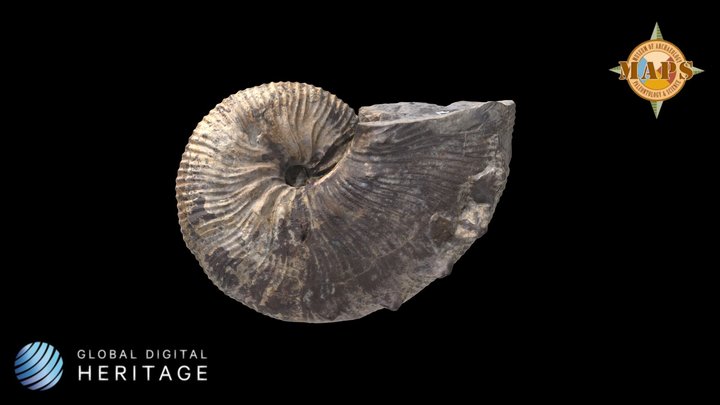
3D model
- Source
- Sketchfab
- Licence
- CC Attribution-NonCommercial
- Commercial use
- the licence does not allow it
This is what the site found, which is not the same as what exists.
Keep going
What may have been alongside itDiscoscaphites through timeFormations of the Late CretaceousThe world it lived on
Occurrence data from the Paleobiology Database, CC BY 4.0. (Morton 1834)