Dryptosaurus
Dryptosaurus is a genus of theropod dinosaur that lived in the present-day East Coast of the United States during the Late Cretaceous period. The type, and only, species, D. aquilunguis was described by Edward Drinker Cope in 1866 as Laelaps aquilunguis, however the genus name was preoccupied by a mite. As a result, Cope's rival in the Bone Wars, Othniel Marsh, replaced the genus name with Dryptosaurus. Dryptosaurus is known from a single, fragmentary skeleton including parts of the mandible, limbs, and vertebrae. These fossils were unearthed by fertilizer miners in New Jersey in rock layers of the New Egypt Formation. This formation dates to the late Maastrichtian stage of the Late Cretaceous, around 67 to 66 million years ago. Several other fragmentary remains have been assigned to Dryptosaurus, however their referral is uncertain.

Skye McDavid · CC BY 4.0 · via Wikipedia/Commons. May be a photograph of a specimen, or an artist’s reconstruction — an interpretation of a skeleton, since colour and soft tissue are almost never preserved.
On record
Recorded, not inferred- Sits inside
- TyrannosauroideaPBDB
- Diet
- carnivorePBDB, for Coelurosauria
- Life habit
- ground dwelling, solitaryPBDB, for Theropoda
- Motility
- actively mobilePBDB, for Theropoda
- Environment
- terrestrialPBDB, for Theropoda
- Length
- 6.4 mWikidata
Time the record covers
At least 28 million years on record.
The record covers at least 100.5 Mya to 72.2 Mya. No occurrence read is dated outside 113.2 Mya to 66 Mya.
13 occurrences of Dryptosaurus on record, most of them in the Late Cretaceous. Bar height is expected occurrences, not a count: each fossil is spread across the span it is dated to, so a tall narrow bar means tight dating and a low wide one means loose.
When
13 occurrencesThese are dates about fossils, not the animal: the record can only begin after it arose and end before it died out, so either end may reach further. Shares are expected occurrences: a fossil dated to a span is counted partly in each period it straddles. More on what this infers.
Found in
7 formations
- Lance Formation6
- Marshalltown Formation · Matawan Group2
- New Egypt Formation · Monmouth Group1
- Paluxy Formation · Trinity Group1
- Navesink Formation · Monmouth Group1
- Mount Laurel Formation · Monmouth Group1
Loading coastlines…
The named rock units Dryptosaurus has been recovered from, largest first. Drawn where the rock is now, not where it formed.
Dryptosaurus and its relatives
Late CretaceousWhere Dryptosaurus and its relatives were recorded in the Late Cretaceous.
Found in the same rock
258 taxa- Lepisosteus occidentalis5 sites
- Trionychidae5 sites
- Borealosuchus sternbergii4 sites
- Brachychampsa montana4 sites
- Cimolodon nitidus3 sites
- Didelphodon vorax3 sites
- Edmontosaurus3 sites
- Gypsonictops hypoconus3 sites
- Habrosaurus dilatus3 sites
- Hadrosauridae3 sites
- Myledaphus bipartitus3 sites
- Paronychodon3 sites
- Protalphadon lulli3 sites
- Squalicorax kaupi3 sites
- Acipenser eruciferus2 sites
- Albanerpetontidae2 sites
- Alphadon marshi2 sites
- Anomoeodus phaseolus2 sites
- Archaeolamna kopingensis2 sites
- Baenidae2 sites
- Belemnitella americana2 sites
- Belonostomus longirostris2 sites
- Brachychampsa2 sites
- Brachyrhizodus wichitaensis2 sites
The Paleobiology Database records 12 sites for Dryptosaurus, and this reads all of them. The number is how many of those sites it was catalogued from too. The 24 sharing the most are listed.
This is not a list of everything alive at the time. It is only what has come out of the same ground as this animal and been written down.
Entered from
6 references- Fossil vertebrates from the Late Cretaceous Lance Formation, eastern Wyoming6
- The Cretaceous/Tertiary mass extinction event in the North Atlantic coastal plain3
- The distinctive theropod assemblage of the Ellisdale site of New Jersey and its implications for North American dinosaur ecology and evolution during the Cretaceous1
- Paleontology, biostratigraphy, and depositional environments of the Cretaceous-Tertiary transition in the New Jersey coastal plain1
- The Mesozoic systems in Texas1
- [On the remains of a gigantic extinct dinosaur, from the Cretaceous Green Sand of New Jersey]1
Each of the 13 occurrences read was entered from one of these publications, ordered by how many each accounts for. This is not a search for papers mentioning the name. Entries link to doi.org where the Paleobiology Database holds an identifier, and to its own record where it does not. Relayed as the Paleobiology Database holds them, not checked against what they resolve to.
Media and terms
Media content3
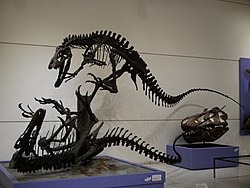
Picture of Dryptosaurus
- Source
- Wikipedia/Commons
- Credit
- Skye McDavid
- Licence
- CC BY 4.0
- Commercial use
- the licence allows it
Laser scan
- Source
- MorphoSource
- Licence
- In Copyright
- Commercial use
- cannot be read from the licence given — check the record
- Specimen
- Dryptosaurus aquilungus · NHMUK:PAL:PV OR 50100
3D model
- Source
- Sketchfab
- Credit
- brandonptw12345
- Licence
- CC Attribution
- Commercial use
- cannot be read from the licence given — check the record
Smithsonian Open Access was not reached for this taxon, so this list is what the others held rather than everything there is.
The description on this site
- Licence
- CC BY-SA 4.0
This is what the site found, which is not the same as what exists.
Keep going
What may have been alongside itTyrannosauroidea through timeFormations of the Late CretaceousThe world it lived on
Occurrence data from the Paleobiology Database, CC BY 4.0. Marsh 1877