Elasipodida
Elasipodida is an order of sea cucumbers. They have numerous appendages, including conical papillae and leaf-like tentacles. Although many species are benthic, a number are pelagic, and may have their appendages modified to form sails or fins. Most members of the order inhabit deep-sea environments, such as the species of the genus Enypniastes.

Image courtesy of Expedition to the Deep Slope 2007. · Public Domain · via Wikipedia/Commons. May be a photograph of a specimen, or an artist’s reconstruction — an interpretation of a skeleton, since colour and soft tissue are almost never preserved.
On record
Recorded, not inferred- Sits inside
- HolothuroideaPBDB
- Diet
- deposit feeder, detritivorePBDB
- Life habit
- epifaunalPBDB
- Motility
- actively mobilePBDB
- Vision
- blindPBDB, for Holothuroidea
- Environment
- marinePBDB
Time the record covers
At least 173 million years on record.
The record covers at least 413.02 Mya to 239.48 Mya. No occurrence read is dated outside 419.62 Mya to 237 Mya.
12 occurrences of Elasipodida on record, most of them in the Carboniferous. The Paleobiology Database records this as a living group, and the chart stops with its fossils rather than at the present. Bar height is expected occurrences, not a count: each fossil is spread across the span it is dated to, so a tall narrow bar means tight dating and a low wide one means loose.
When
12 occurrences- Devonian33%
- Carboniferous42%
- Permian17%
- Middle Triassic8%
These are dates about fossils, not the animal: the record can only begin after it arose and end before it died out, so either end may reach further. Shares are expected occurrences: a fossil dated to a span is counted partly in each period it straddles. More on what this infers.
Found in
9 formations
- Wabaunsee Formation2
- Lochkov Formation2
- Grzegorzowice Formation2
- Chase Formation1
- Mineral Wells Formation1
- Breathitt Formation1
Loading coastlines…
The named rock units Elasipodida has been recovered from, largest first. Drawn where the rock is now, not where it formed.
Elasipodida and its relatives
CarboniferousWhere Elasipodida and its relatives were recorded in the Carboniferous.
Found in the same rock
187 taxa- Palaeocaudina kansasensis7 sites
- Achistrum monochordata2 sites
- Albertechinus devonicus2 sites
- Apiastrum sp.2 sites
- Asteroidea2 sites
- Bactrocrinites2 sites
- Devonothyonites polymorphus2 sites
- Echinoidea2 sites
- Eocaudina gutschicki2 sites
- Eohalysiocrinus2 sites
- Glyphidocrinus2 sites
- Hexacrinites2 sites
- Kongielechinus magnituberculatus2 sites
- Lecanocrinus2 sites
- Lepidechinoides2 sites
- Lepidocentrus rhenanus2 sites
- Leptoschisma pentagonum2 sites
- Microantyx praedulcis2 sites
- Ophiuroidea2 sites
- Palaeocaudina regia2 sites
- Palaeocucumaria ancile2 sites
- Parisocrinus2 sites
- Platycrinitidae2 sites
- Pleurocystitidae2 sites
The Paleobiology Database records 12 sites for Elasipodida, and this reads all of them. The number is how many of those sites it was catalogued from too. The 24 sharing the most are listed.
This is not a list of everything alive at the time. It is only what has come out of the same ground as this animal and been written down.
Entered from
8 references- Remains of Holothuroidea from the Carboniferous of Kansas3
- Survey of echinoderms and a new ophiocistioid Branzoviella talpa gen. et sp. n. (Echinodermata, Ophiocistioidea) in the Lower Devonian, Lochkov Formation of the Barrandian area, Czech Republic2
- Isolated sclerites of Devonian non−pelmatozoan echinoderms2
- Paleontologia y paleoecolgia de los yacimientos fosiliferos del Muschelkalk superior entre Alcover y Mont-Ral (Montañas de Prades, Provincia de Tarragona)1
- Neue Holothuriensklerite aus dem Oberperm von Julfa in Nordiran1
- The Biota of the Pennsylvanian (Virgilian) Leavenworth Limestone, Midcontinent Region Part 5: Distribution of miscellaneous microfossils1
- Holothurian Sclerites from the Kendrick Shale of Eastern Kentucky1
- Fossil Holothuroidea1
Each of the 12 occurrences read was entered from one of these publications, ordered by how many each accounts for. This is not a search for papers mentioning the name. Each entry links to the Paleobiology Database's own record for the work.
Media and terms
Media content1
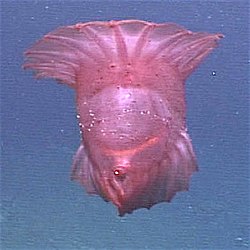
Picture of Elasipodida
- Source
- Wikipedia/Commons
- Credit
- Image courtesy of Expedition to the Deep Slope 2007.
- Licence
- Public Domain
- Commercial use
- the licence allows it
No 3D scan of Elasipodida was found in Sketchfab.
Smithsonian Open Access and MorphoSource were not reached for this taxon, so this list is what the others held rather than everything there is.
The description on this site
- Source
- Wikipedia, “Elasipodida”
- Licence
- CC BY-SA 4.0
This is what the site found, which is not the same as what exists.
Keep going
What may have been alongside itHolothuroidea through timeFormations of the CarboniferousThe world it lived on
Occurrence data from the Paleobiology Database, CC BY 4.0. Théel 1882