Epitoniidae
Wentletraps are small, often white, very high-spired, predatory or ectoparasitic sea snails, marine gastropod mollusks in the family Epitoniidae. The family Epitoniidae belongs to the superfamily Epitonioidea. Since 2017 this family also includes the former families Janthinidae and Nystiellidae, all part of the informal group Ptenoglossa. Epitoniidae is a rather large family, with an estimated number of species about 630.

Steve Jurvetson · CC BY 2.0 · via Wikipedia/Commons. May be a photograph of a specimen, or an artist’s reconstruction — an interpretation of a skeleton, since colour and soft tissue are almost never preserved.
On record
Recorded, not inferred- Also called
- wentletrapPBDB
- Sits inside
- EpitonioideaPBDB
- Diet
- carnivorePBDB
- Life habit
- low-level epifaunalPBDB
- Motility
- slow-movingPBDB
- Vision
- limitedPBDB, for Gastropoda
Time the record covers
At least 236 million years on record.
The record covers at least 237 Mya to 11.7 ka. No occurrence read is dated outside 247 Mya to 0 Mya.
2,177 occurrences of Epitoniidae on record, most of them in the Eocene. The Paleobiology Database records this as a living group. Bar height is expected occurrences, not a count: each fossil is spread across the span it is dated to, so a tall narrow bar means tight dating and a low wide one means loose.
When
2,177 occurrences- Middle Triassicunder 1%
- Late Triassicunder 1%
- Middle Jurassicunder 1%
- Early Cretaceous3%
- Late Cretaceous13%
- Paleocene6%
- Eocene22%
- Oligocene5%
- Miocene19%
- Pliocene12%
- Pleistocene18%
- Holocene1%
These are dates about fossils, not the animal: the record can only begin after it arose and end before it died out, so either end may reach further. Shares are expected occurrences: a fossil dated to a span is counted partly in each period it straddles. More on what this infers.
Found in
373 formations
- Palos Verdes Sand Formation77
- Cook Mountain Formation · Claiborne Group66
- Keasey Formation48
- Prairie Bluff Formation · Selma Group44
- Moodys Branch Formation · Jackson Group28
- Ripley Formation · Selma Group28
Loading coastlines…
The named rock units Epitoniidae has been recovered from, largest first. Drawn where the rock is now, not where it formed. 349 further formations hold fewer occurrences each and are not listed. 379 occurrences have no formation on record, which is common for older literature.
Epitoniidae and its relatives
EoceneWhere Epitoniidae and its relatives were recorded in the Eocene.
Found in the same rock
3,284 taxa- Turritella67 sites
- Serpula41 sites
- Anomia argentaria39 sites
- Turritella trilira39 sites
- Turritella vertebroides39 sites
- Exogyra (Exogyra) costata37 sites
- Bryozoa36 sites
- Euspira rectilabrum36 sites
- Cubitostrea tecticosta34 sites
- Acteon31 sites
- Drilluta31 sites
- Cardium30 sites
- Idonearca capax30 sites
- Vertebrata30 sites
- Crassatella vadosa29 sites
- Cyprimeria29 sites
- Arca28 sites
- Cliona28 sites
- Tellina28 sites
- Cadulus27 sites
- Corbula27 sites
- Crenella serica27 sites
- Nuculana27 sites
- Veniella conradi27 sites
The Paleobiology Database records 994 sites for Epitoniidae, and this reads 240 of them. Of that, one read hit the database's own return limit, so every count below is a floor rather than a total. The number is how many of those sites it was catalogued from too. The 24 sharing the most are listed.
This is not a list of everything alive at the time. It is only what has come out of the same ground as this animal and been written down.
Entered from
451 references- Die Fauna des marinen Miozäns von Kevelaer (Niederrhein)126
- Resilience of marine invertebrate communities during the early Cenozoic hyperthermals118
- The family Epitoniidae (Mollusca: Gastropoda) in the northeastern Pacific102
- Catalogue of the Paleocene and Eocene mollusca of the southern and eastern United States. Part 1. Pelecypoda, Amphineura, Pteropoda, Scaphopoda and Cephalopoda61
- Upper Cretaceous (Maestrichtian) Mollusca from the Haustator bilira Assemblage Zone in the East Gulf Coastal Plain54
- Paleogene Marine Gastropods of the Keasey Formation in Oregon43
- Miocene Gastropods and Biostratigraphy of the Kern River Area, California30
- Les Mesogastropoda Fossiles du Cenozoïque étranger des Collections de L'Institute Royale des Sciences Naturelles de Belgique: Cyclophoridae à Stilifetidae30
- A paleobiotic survey of Caribbean faunas from the Neogene of the Isthmus of Panama29
- Upper Cretaceous (Maestrichtian) larger invertebrates from the Haustator bilira Assemblage Zone in the Atlantic Coastal Plain with further data for the East Gulf29
- New Late Cretaceous epitoniid and zygopleurid gastropods from the Pacific Slope of North America27
- The Selandian (Paleocene) mollusc fauna from Copenhagen, Denmark: the Poul Harder 1920 collection27
Each of the 2,177 occurrences read was entered from one of these publications, ordered by how many each accounts for. This is not a search for papers mentioning the name. 439 further references are not listed. Entries link to doi.org where the Paleobiology Database holds an identifier, and to its own record where it does not. Relayed as the Paleobiology Database holds them, not checked against what they resolve to.
Media and terms
Media content1
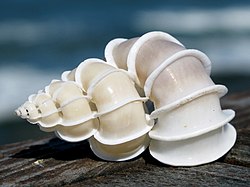
Picture of Epitoniidae
- Source
- Wikipedia/Commons
- Credit
- Steve Jurvetson
- Licence
- CC BY 2.0
- Commercial use
- the licence allows it
No 3D scan of Epitoniidae was found in Sketchfab.
Smithsonian Open Access and MorphoSource were not reached for this taxon, so this list is what the others held rather than everything there is.
The description on this site
- Source
- Wikipedia, “Wentletrap”
- Licence
- CC BY-SA 4.0
This is what the site found, which is not the same as what exists.
Keep going
What may have been alongside itEpitonioidea through timeFormations of the EoceneThe world it lived on
Occurrence data from the Paleobiology Database, CC BY 4.0. Berry 1910