Eurhomalea

Manuel Caballer · CC BY 4.0 · via Wikidata/Commons. May be a photograph of a specimen, or an artist’s reconstruction — an interpretation of a skeleton, since colour and soft tissue are almost never preserved.
On record
Recorded, not inferred- Sits inside
- VeneridaePBDB
- Diet
- suspension feederPBDB, for Veneridae
- Life habit
- infaunalPBDB, for Veneridae
- Motility
- facultatively mobilePBDB, for Veneridae
- Vision
- blindPBDB, for Bivalvia
Time the record covers
At least 41 million years on record.
The record covers at least 41.03 Mya to 11.7 ka. No occurrence read is dated outside 161.5 Mya to 0 Mya.
136 occurrences of Eurhomalea on record, most of them in the Eocene. The Paleobiology Database records this as a living group. Bar height is expected occurrences, not a count: each fossil is spread across the span it is dated to, so a tall narrow bar means tight dating and a low wide one means loose.
When
136 occurrences- Late Jurassicunder 1%
- Early Cretaceousunder 1%
- Late Cretaceousunder 1%
- Paleoceneunder 1%
- Eocene77%
- Oligocene1%
- Miocene5%
- Pliocene6%
- Pleistocene7%
- Holocene3%
These are dates about fossils, not the animal: the record can only begin after it arose and end before it died out, so either end may reach further. Shares are expected occurrences: a fossil dated to a span is counted partly in each period it straddles. More on what this infers.
Found in
14 formations
- La Meseta Formation73
- Submeseta Formation31
- Pampa del Palo Terrace Formation4
- Estratos de Caldera Formation4
- Polonez Cove Formation3
- Guadal Formation2
Loading coastlines…
The named rock units Eurhomalea has been recovered from, largest first. Drawn where the rock is now, not where it formed. 8 occurrences have no formation on record, which is common for older literature.
Eurhomalea and its relatives
EoceneWhere Eurhomalea and its relatives were recorded in the Eocene.
Found in the same rock
283 taxa- Polinices (Polinices) subtenuis51 sites
- Saxolucina sharmani43 sites
- Colposigma euthenia26 sites
- Sudonassarius antarctohimaleos26 sites
- Periploma topei23 sites
- Mactra irizari22 sites
- Lahillia wilckensi21 sites
- Cucullaea raea20 sites
- Austroficopsis wimani18 sites
- Cyclorismina marwicki18 sites
- Modiolus thomsoni18 sites
- Struthioptera camachoi18 sites
- Austrobuccinum tuberosum17 sites
- Eucrassatella wilckensi17 sites
- Antarctodarwinella ellioti15 sites
- Antarctodarwinella nordenskjoldi15 sites
- Austrotoma oliveroi14 sites
- Austroficopsis seymourensis12 sites
- Ostrea antarctica12 sites
- Australoneilo rossi11 sites
- Hiatella tenuis11 sites
- Mya (Arenomya) nucleoides11 sites
- Perissodonta laevis11 sites
- Struthiolarella variabilis11 sites
The Paleobiology Database records 94 sites for Eurhomalea, and this reads all of them. The number is how many of those sites it was catalogued from too. The 24 sharing the most are listed.
This is not a list of everything alive at the time. It is only what has come out of the same ground as this animal and been written down.
Entered from
17 references- Molluscan Systematics and Biostratigraphy103
- Carta Caldera, Región de Atacama. Servicio Nacional de Geología y Minería, Carta Geológica de Chile, Serie Geología Básica, No. 76, 38 p. 1 mapa escala 1:100.0004
- Paleoecologia de moluscos marinos del Holoceno medio de Isla Gable, Canal Beagle, Tierra del Fuego, Argentina4
- Pampa del Palo: an anomalous composite marine terrace on the uprising coast of southern Peru3
- Occurrence de Chione broggi (Pilsbry & Olsson, 1943) (Pelecypoda) en depositos litorales cuaternarios del sur del Peru: implicaciones paleoceanograficas3
- Biota of the "Pecten Conglomerate" (Polenez Cove Formation, Pliocene) of King George Island (South Shetland Islands, Antarctica)3
- Lithostratigraphy and Biostratigraphy of Pliocene and Pleistocene Marine Deposits and Age of the highest Marine Terrace from the Sacaco Basin and its Environs (southern Peru)2
- Range extensions and biogeographic implications of Chilean Neogene mollusks found in Peru2
- Invertibrados fósiles marinos de la Formación Guadal (Oligoceno superio-Mioceno inferior) en Pampa, Castillo region, región de Aisén, Chile2
- A new species of genus Panopea (Bivalvia) from King George Island, Antarctica2
- Molluscos del Terciario Inferior ("Magallanense") de la Isla Grande de Tierra del Fuego (Republica Argentina)2
- The Late Cenozoic history of Xanthochorus Fischer, 1884 (GastropodaL Muricidae) in western South America1
Each of the 136 occurrences read was entered from one of these publications, ordered by how many each accounts for. This is not a search for papers mentioning the name. 5 further references are not listed. Entries link to doi.org where the Paleobiology Database holds an identifier, and to its own record where it does not. Relayed as the Paleobiology Database holds them, not checked against what they resolve to.
Media and terms
Media content2
Picture of Eurhomalea
- Source
- Wikidata/Commons
- Credit
- Manuel Caballer
- Licence
- CC BY 4.0
- Commercial use
- the licence allows it
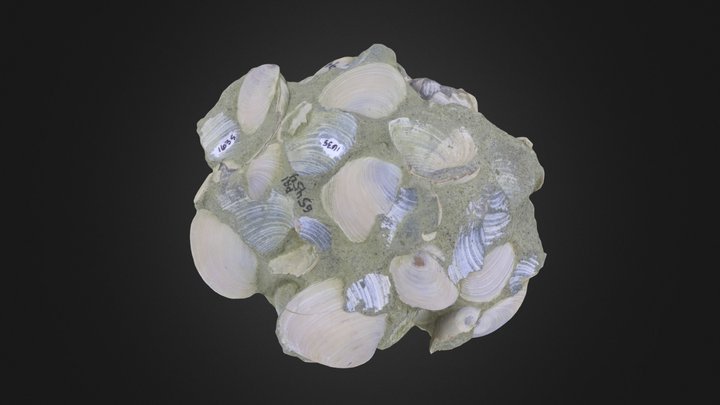
3D model
- Source
- Sketchfab
- Licence
- CC0 Public Domain
- Commercial use
- the licence allows it
Smithsonian Open Access and MorphoSource were not reached for this taxon, so this list is what the others held rather than everything there is.
This is what the site found, which is not the same as what exists.
Keep going
What may have been alongside itVeneridae through timeFormations of the EoceneThe world it lived on
Occurrence data from the Paleobiology Database, CC BY 4.0. Cossmann 1920