Fabaceae
Fabaceae or Leguminosae, commonly known as the legume, pea, or bean family, is a large and agriculturally important family of flowering plants. It includes trees, shrubs, and perennial or annual herbaceous plants, which are easily recognized by their fruit (legume) and their compound, stipulate leaves. The family is widely distributed, and is the third-largest land plant family in number of species, behind only the Orchidaceae and Asteraceae, with about 765 genera and nearly 20,000 known species.

Photo by Peggy Greb. · Public Domain · via Wikipedia/Commons. May be a photograph of a specimen, or an artist’s reconstruction — an interpretation of a skeleton, since colour and soft tissue are almost never preserved.
On record
Recorded, not inferred- Also called
- legumePBDB
- Sits inside
- FabalesPBDB
- Diet
- "photoautotroph"PBDB, for Angiospermae
Time the record covers
At least 100 million years on record.
The record covers at least 100.5 Mya to 11.7 ka. No occurrence read is dated outside 143.1 Mya to 0 Mya.
1,254 occurrences of Fabaceae on record, most of them in the Miocene. The Paleobiology Database records this as a living group. Bar height is expected occurrences, not a count: each fossil is spread across the span it is dated to, so a tall narrow bar means tight dating and a low wide one means loose.
When
1,254 occurrences- Early Cretaceousunder 1%
- Late Cretaceous3%
- Paleocene5%
- Eocene29%
- Oligocene5%
- Miocene34%
- Pliocene8%
- Pleistocene14%
- Holocene2%
These are dates about fossils, not the animal: the record can only begin after it arose and end before it died out, so either end may reach further. Shares are expected occurrences: a fossil dated to a span is counted partly in each period it straddles. More on what this infers.
Found in
144 formations
- London Clay Formation86
- Yaw Formation59
- Cerrejón Formation31
- Nkondo Formation · Albertine Group27
- Lower Formation · Siwalik Group25
- Itahana Formation · Tomioka Group23
Loading coastlines…
The named rock units Fabaceae has been recovered from, largest first. Drawn where the rock is now, not where it formed. 120 further formations hold fewer occurrences each and are not listed. 512 occurrences have no formation on record, which is common for older literature.
Fabaceae and its relatives
MioceneWhere Fabaceae and its relatives were recorded in the Miocene.
Found in the same rock
1,798 taxa- Cicatricosisporites dorogensis53 sites
- Margocolporites44 sites
- Laevigatosporites43 sites
- Taxodium42 sites
- Triporopollenites42 sites
- Caryapollenites40 sites
- Thompsonipollis magnificus40 sites
- Casurinidites pulcher39 sites
- Coniferales39 sites
- Liliacidites39 sites
- Pediastrum39 sites
- Microreticulatisporites38 sites
- Momipites38 sites
- Pinuspollenites38 sites
- Gleicheniidites37 sites
- Tricolpites37 sites
- Tricolpopollenites37 sites
- Leiotriletes36 sites
- Deltoidospora35 sites
- Divisisporites35 sites
- Ovoidites35 sites
- Nudopollis terminalis34 sites
- Pleuricellaesporites spp.34 sites
- Verrucatosporites34 sites
The Paleobiology Database records 566 sites for Fabaceae, and this reads 240 of them. The number is how many of those sites it was catalogued from too. The 24 sharing the most are listed.
This is not a list of everything alive at the time. It is only what has come out of the same ground as this animal and been written down.
Entered from
181 references- A Catalogue of Fossil Plants from India Part 4: Cenozoic (Tertiary) Megafossils66
- Angiospermous fossil leaves from the Siwalik foreland basins and their palaeoclimatic implications61
- A proto-monsoonal climate in the late Eocene of Southeast Asia: evidence from a sedimentary record in central Myanmar59
- A catalogue of Cenozoic megafossil plants in China58
- A Catalogue of Indian Fossil Plants56
- A Catalogue of Fossil Plants from India Part 6: Cenozoic (Quaternary) Palynology and Palaeobotany53
- Late Miocene and Pliocene Floras in Central Honshu, Japan53
- Report on Phyto-Palaeontological Investigations of the Fossil Flora of Sheppey43
- Distribution of pollen and spores in a subsurface marine Wilcox (Paleocene-Eocene) section in southwest Louisiana41
- A History of the Fossil Fruits & Seeds of the London Clay41
- Early Pleistocene vegetation change in upland south-eastern Australia40
- Late Paleocene fossils from the Cerrejón Formation, Colombia, are the earliest record of Neotropical rainforest31
Each of the 1,254 occurrences read was entered from one of these publications, ordered by how many each accounts for. This is not a search for papers mentioning the name. 169 further references are not listed. Entries link to doi.org where the Paleobiology Database holds an identifier, and to its own record where it does not. Relayed as the Paleobiology Database holds them, not checked against what they resolve to.
Media and terms
Media content1
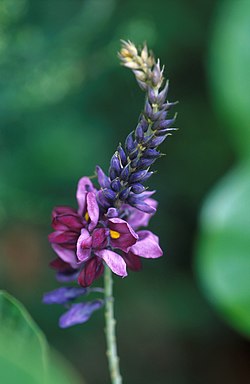
Picture of Fabaceae
- Source
- Wikipedia/Commons
- Credit
- Photo by Peggy Greb.
- Licence
- Public Domain
- Commercial use
- the licence allows it
No 3D scan of Fabaceae was found in MorphoSource and Sketchfab.
Smithsonian Open Access was not reached for this taxon, so this list is what the others held rather than everything there is.
The description on this site
- Source
- Wikipedia, “Fabaceae”
- Licence
- CC BY-SA 4.0
This is what the site found, which is not the same as what exists.
Keep going
What may have been alongside itFabales through timeFormations of the MioceneThe world it lived on
Occurrence data from the Paleobiology Database, CC BY 4.0. Lindley 1836