Festuca
Festuca (fescue) is a genus of flowering plants belonging to the grass family Poaceae. They are evergreen, herbaceous, or perennial, tufted grasses with a height range of 10–200 cm (4–79 in) and a cosmopolitan distribution, occurring on every continent except Antarctica. The genus is closely related to ryegrass (Lolium), and recent evidence from phylogenetic studies using DNA sequencing of plant mitochondrial DNA shows that the genus lacks monophyly. As a result, plant taxonomists have moved several species, including the forage grasses tall fescue and meadow fescue, from the genus Festuca into the genus Lolium or alternatively into the segregated genus Schedonorus.

Uncredited · Public Domain · via Wikipedia/Commons. May be a photograph of a specimen, or an artist’s reconstruction — an interpretation of a skeleton, since colour and soft tissue are almost never preserved.
On record
Recorded, not inferred- Also called
- fescuePBDB
- Sits inside
- PoaceaePBDB
- Diet
- "photoautotroph"PBDB, for Angiospermae
Time the record covers
At most 5.4 million years on record.
Every occurrence read is dated to somewhere between 5.333 Mya and 11.7 ka, and nothing in the dating separates them, so that window is what the record shows rather than a span.
2 occurrences of Festuca on record, most of them in the Pliocene. The Paleobiology Database records this as a living group. Bar height is expected occurrences, not a count: each fossil is spread across the span it is dated to, so a tall narrow bar means tight dating and a low wide one means loose.
When
2 occurrences- Pliocene50%
- Pleistocene50%
These are dates about fossils, not the animal: the record can only begin after it arose and end before it died out, so either end may reach further. Shares are expected occurrences: a fossil dated to a span is counted partly in each period it straddles. More on what this infers.
Festuca and its relatives
PlioceneWhere Festuca and its relatives were recorded in the Pliocene.
Found in the same rock
61 taxa- ? Pyrenomycetidae indet.1 site
- Acacia1 site
- Acrostichum1 site
- Apocynophyllum1 site
- Bauhinia1 site
- Bryophyta1 site
- Caesalpinia1 site
- Caesalpinites1 site
- Calliandra obliqua1 site
- Capparis1 site
- Carex1 site
- Carpolithus1 site
- Cassia1 site
- Cenococcum geophilum1 site
- Cerastium1 site
- Chronomidae indet.1 site
- Cladocera1 site
- Copaifera1 site
- Cypselites1 site
- Dalbergia1 site
- Daphnia1 site
- Dicrostonyx torquatus1 site
- Draba1 site
- Drepanocarpus franckei1 site
The Paleobiology Database records 2 sites for Festuca, and this reads all of them. The number is how many of those sites it was catalogued from too. The 24 sharing the most are listed.
This is not a list of everything alive at the time. It is only what has come out of the same ground as this animal and been written down.
Entered from
2 references- Interglacial remains of caribou (Rangifer tarandus) and lemming (Dicrostonyx torquatus (?)) from North Greenland1
- Fossil plants from Bolivia and their bearing upon the age of the uplift of the Eastern Andes1
Each of the 2 occurrences read was entered from one of these publications, ordered by how many each accounts for. This is not a search for papers mentioning the name. Each entry links to doi.org. Relayed as the Paleobiology Database holds them, not checked against what they resolve to.
Media and terms
Media content1
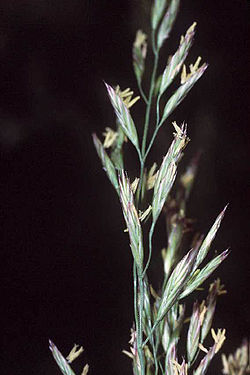
Picture of Festuca
- Source
- Wikipedia/Commons
- Credit
- nobody named on the record
- Licence
- Public Domain
- Commercial use
- the licence allows it
No 3D scan of Festuca was found in Sketchfab.
Smithsonian Open Access and MorphoSource were not reached for this taxon, so this list is what the others held rather than everything there is.
The description on this site
- Source
- Wikipedia, “Festuca”
- Licence
- CC BY-SA 4.0
This is what the site found, which is not the same as what exists.
Keep going
What may have been alongside itPoaceae through timeFormations of the PlioceneThe world it lived on
Occurrence data from the Paleobiology Database, CC BY 4.0. Linnaeus 1753