Gabriceraurus dentatus
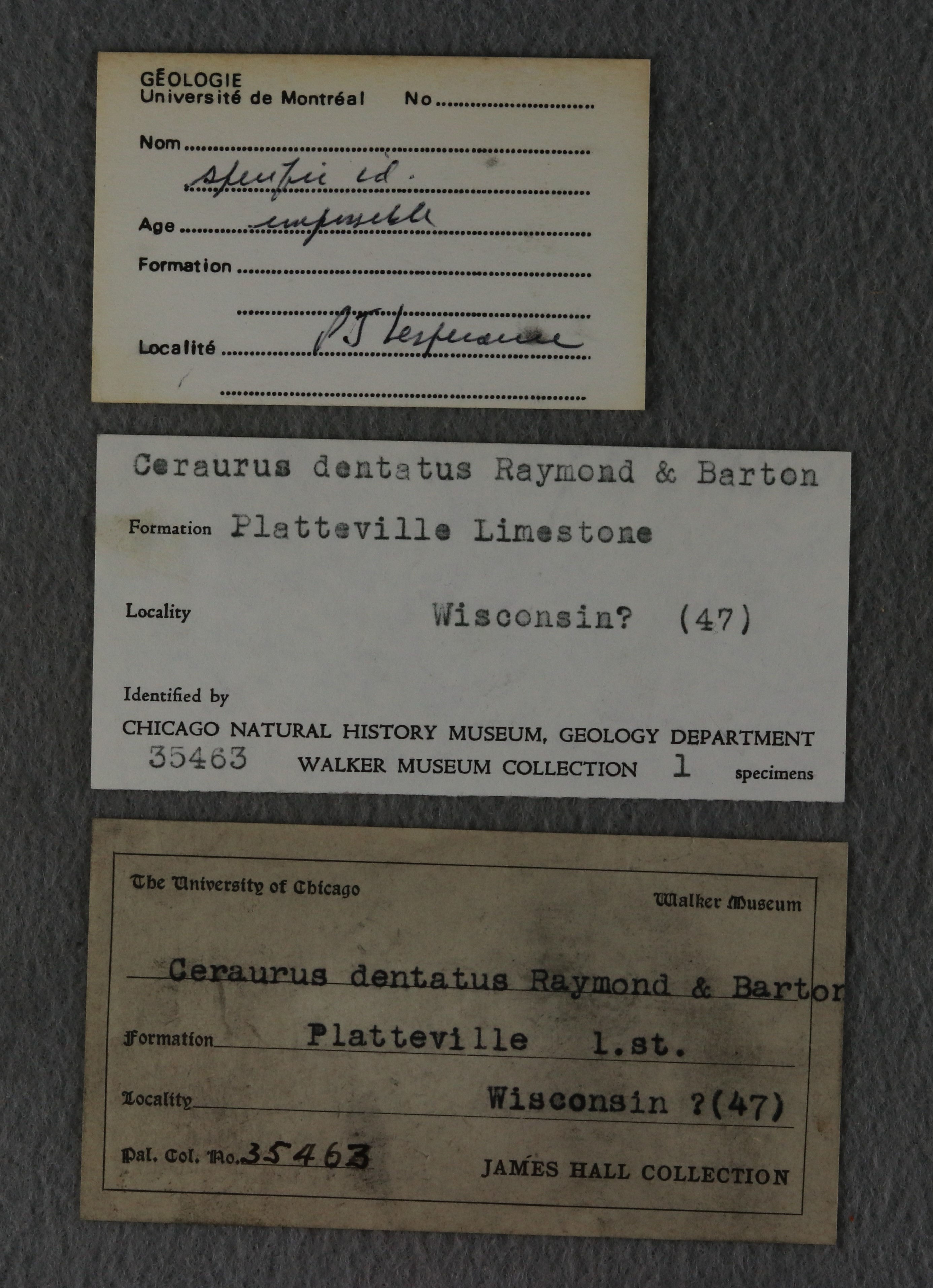
The Field Museum of Natural History · CC0 · via GBIF. May be a photograph of a specimen, or an artist’s reconstruction — an interpretation of a skeleton, since colour and soft tissue are almost never preserved.
On record
Recorded, not inferred- Sits inside
- GabriceraurusPBDB
- Diet
- carnivorePBDB, for Cheiruridae
- Life habit
- low-level epifaunalPBDB, for Trilobita
- Motility
- fast-movingPBDB, for Trilobita
- Vision
- well-developedPBDB, for Gabriceraurus
- Environment
- marinePBDB, for Trilobita
Time the record covers
At least 2.8 million years on record.
The record covers at least 453.8 Mya to 451 Mya. No occurrence read is dated outside 458.2 Mya to 449.5 Mya.
13 occurrences of Gabriceraurus dentatus on record, most of them in the Ordovician. Bar height is expected occurrences, not a count: each fossil is spread across the span it is dated to, so a tall narrow bar means tight dating and a low wide one means loose.
When
13 occurrences- Ordovician100%
These are dates about fossils, not the animal: the record can only begin after it arose and end before it died out, so either end may reach further. Shares are expected occurrences: a fossil dated to a span is counted partly in each period it straddles. More on what this infers.
Found in
8 formations
- Verulam Formation · Simcoe Group4
- Bobcaygeon Formation · Simcoe Group3
- Guttenberg Formation · Galena Group1
- Esbataottine Formation1
- Lindsay Formation · Simcoe Group1
- Whitby Formation · Nottawasaga Group1
Loading coastlines…
The named rock units Gabriceraurus dentatus has been recovered from, largest first. Drawn where the rock is now, not where it formed.
Gabriceraurus dentatus and its relatives
OrdovicianWhere Gabriceraurus dentatus and its relatives were recorded in the Ordovician.
Found in the same rock
342 taxa- Anazyga recurvirostra8 sites
- Hormotoma gracilis8 sites
- Paucicrura rogata8 sites
- Rafinesquina8 sites
- Rhynchotrema increbescens8 sites
- Sowerbyella (Sowerbyella) sericea8 sites
- Ceraurus pleurexanthemus7 sites
- Ctenodonta7 sites
- Cyrtostropha salteri7 sites
- Isotelus gigas7 sites
- Rafinesquina trentonensis7 sites
- Sinuites cancellatus7 sites
- Sowerbyella curdsvillensis7 sites
- Trochonema umbilicata7 sites
- Bathyurus (Raymondites) ingalli6 sites
- Conularia6 sites
- Hesperorthis tricenaria6 sites
- Mesotrypa6 sites
- Prasopora6 sites
- Rafinesquina alternata alata6 sites
- Sowerbyella subovalis6 sites
- Strophomena incurvata6 sites
- Endoceras proteiforme5 sites
- Flexicalymene (Flexicalymene) senaria5 sites
The Paleobiology Database records 13 sites for Gabriceraurus dentatus, and this reads all of them. The number is how many of those sites it was catalogued from too. The 24 sharing the most are listed.
This is not a list of everything alive at the time. It is only what has come out of the same ground as this animal and been written down.
Entered from
5 references- Palaeozoic geology of the Lake Simcoe Area, Ontario9
- Platteville and Decorah Trilobites from Illinois and Wisconsin1
- Trilobites from the Long Point Group (Ordovician), Port au Port Peninsula, southwestern Newfoundland1
- Ordovician formations and faunas, southern Mackenzie Mountains1
- The Palaeozoic Outlier of Lake Timiskaming, Ontario and Quebec1
Each of the 13 occurrences read was entered from one of these publications, ordered by how many each accounts for. This is not a search for papers mentioning the name. Entries link to doi.org where the Paleobiology Database holds an identifier, and to its own record where it does not. Relayed as the Paleobiology Database holds them, not checked against what they resolve to.
Media and terms
Media content1
Picture of Gabriceraurus dentatus
- Source
- GBIF
- Credit
- The Field Museum of Natural History
- Licence
- CC0
- Commercial use
- the licence allows it
No 3D scan of Gabriceraurus dentatus was found in MorphoSource and Sketchfab.
Smithsonian Open Access was not reached for this taxon, so this list is what the others held rather than everything there is.
This is what the site found, which is not the same as what exists.
Keep going
What may have been alongside itGabriceraurus through timeFormations of the OrdovicianThe world it lived on
Occurrence data from the Paleobiology Database, CC BY 4.0. (Raymond and Barton 1913)