Gerastos granulosus
No picture of Gerastos granulosus was found. Wikipedia, Wikidata, iDigBio and Smithsonian Open Access were searched and had none. GBIF was asked, and what came back is not recorded: nothing, or a picture this site could not tie to Gerastos granulosus, or no answer at all. This entry cannot say which.
On record
Recorded, not inferred- Sits inside
- GerastosPBDB
- Diet
- deposit feederPBDB, for Proetida
- Life habit
- low-level epifaunalPBDB, for Trilobita
- Motility
- fast-movingPBDB, for Trilobita
- Vision
- well-developedPBDB, for Proetidae
- Environment
- marinePBDB, for Trilobita
Time the record covers
At most 5.6 million years on record.
Every occurrence read is dated to somewhere between 393.47 Mya and 387.95 Mya, and nothing in the dating separates them, so that window is what the record shows rather than a span.
3 occurrences of Gerastos granulosus on record, most of them in the Devonian. Bar height is expected occurrences, not a count: each fossil is spread across the span it is dated to, so a tall narrow bar means tight dating and a low wide one means loose.
When
3 occurrences- Devonian100%
These are dates about fossils, not the animal: the record can only begin after it arose and end before it died out, so either end may reach further. Shares are expected occurrences: a fossil dated to a span is counted partly in each period it straddles. More on what this infers.
Found in
3 formations
Loading coastlines…
The named rock units Gerastos granulosus has been recovered from, largest first. Drawn where the rock is now, not where it formed.
Gerastos granulosus and its relatives
DevonianWhere Gerastos granulosus and its relatives were recorded in the Devonian.
Found in the same rock
41 taxa- Ceratarges armatus2 sites
- Charybdaspis2 sites
- Cyphaspis2 sites
- Gerastos cuvieri2 sites
- Goldius2 sites
- Harpes macrocephalus2 sites
- Kettneraspis2 sites
- Kettneraspis elliptica2 sites
- Pedinopariops brongniarti2 sites
- Scabriscutellum2 sites
- Asteropyge comes1 site
- Asteropyge punctata1 site
- Astycoryphe1 site
- Astycoryphe senckenbergiana1 site
- Chamaeleoaspis chamaeleo1 site
- Cornuproetus (Cornuproetus) cornutus1 site
- Cornuproetus (Cornuproetus) cornutus cornutus1 site
- Cornuproetus (Cornuproetus) oudrissensis1 site
- Cornuproetus (Diademaproetus) rhenanus1 site
- Crotalocephalus1 site
- Cyphaspis ceratophthalmus1 site
- Cyphaspis hoepfneri hoepfheri1 site
- Diademaproetus ajax1 site
- Diademaproetus menzeni1 site
The Paleobiology Database records 3 sites for Gerastos granulosus, and this reads all of them. The number is how many of those sites it was catalogued from too. The 24 sharing the most are listed.
This is not a list of everything alive at the time. It is only what has come out of the same ground as this animal and been written down.
Entered from
3 references- Phaetonellus aus dem Devon des Rhenoherzynikums (Trilobita, Emsium und Eifelium, rechtsrheinisches Schiefergebirge)1
- Eifel-Trilobiten III. Corynexochida, Proetida (2), Harpetida, Phacopida (2), Lichida1
- Trilobites de la limite Eifélien/Givétien de la région stratotypique (Tafilalet, Maider, Maroc)1
Each of the 3 occurrences read was entered from one of these publications, ordered by how many each accounts for. This is not a search for papers mentioning the name. Each entry links to the Paleobiology Database's own record for the work.
Media and terms
Media content1
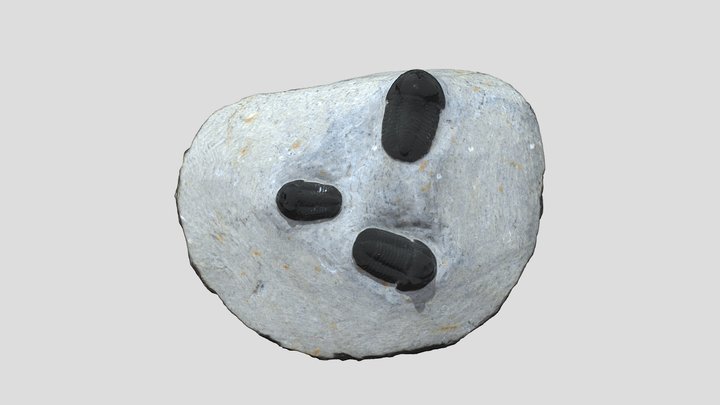
3D model
- Source
- Sketchfab
- Licence
- CC Attribution
- Commercial use
- cannot be read from the licence given — check the record
No picture of Gerastos granulosus was found. Wikipedia, Wikidata, iDigBio and Smithsonian Open Access were searched and had none.
GBIF was asked, and what came back is not recorded: nothing, or a picture this site could not tie to Gerastos granulosus, or no answer at all. This entry cannot say which.
This is what the site found, which is not the same as what exists.
Keep going
What may have been alongside itGerastos through timeFormations of the DevonianThe world it lived on
Occurrence data from the Paleobiology Database, CC BY 4.0. (Kielan 1954)