Globorotalia
Globorotalia is a genus of foraminifers belonging to the family Globorotaliidae. It is a single-celled protist large enough to be seen with a naked eye and is found in the fossil record back to the Paleocene. It is deep-dwelling planktonic foraminifers that inhabit the top few hundred meters of the ocean and constitute potential recorders of thermocline conditions. The genus has cosmopolitan distribution.

Hannes Grobe ( talk ) · CC BY 3.0 · via Wikipedia/Commons. May be a photograph of a specimen, or an artist’s reconstruction — an interpretation of a skeleton, since colour and soft tissue are almost never preserved.
On record
Recorded, not inferred- Sits inside
- GloborotaliidaePBDB
- Diet
- omnivorePBDB, for Foraminifera
- Life habit
- semi-infaunalPBDB, for Foraminifera
- Motility
- stationaryPBDB, for Foraminifera
Time the record covers
At least 125 million years on record.
The record covers at least 125.77 Mya to 11.7 ka. No occurrence read is dated outside 132.6 Mya to 0 Mya.
12,000+ occurrences of Globorotalia on record. The Paleobiology Database records this as a living group. Bar height is expected occurrences, not a count: each fossil is spread across the span it is dated to, so a tall narrow bar means tight dating and a low wide one means loose.
When
12,000 occurrences read- Early Cretaceousunder 1%
- Late Cretaceousunder 1%
- Paleoceneunder 1%
- Eoceneunder 1%
- Oligoceneunder 1%
- Miocene18%
- Pliocene31%
- Pleistocene49%
- Holoceneunder 1%
These are dates about fossils, not the animal: the record can only begin after it arose and end before it died out, so either end may reach further. Shares are expected occurrences: a fossil dated to a span is counted partly in each period it straddles. The read hit its cap, so every figure above is a floor and the shares are of the occurrences read. More on what this infers.
Found in
at least 46 formations
- Yorktown Formation · Chesapeake Group11
- Esmeraldas Formation8
- Ilaro Formation7
- Ihungia Formation6
- Corsicana Formation5
- Escudo de Veraguas Formation · Bocas del Toro Group4
Loading coastlines…
The named rock units Globorotalia has been recovered from, largest first. Drawn where the rock is now, not where it formed. The read hit its cap, so each count is a floor. 22 further formations hold fewer occurrences each and are not listed. 11,901 occurrences have no formation on record, which is common for older literature.
Found in the same rock
1,655 taxa- Globigerinoides ruber153 sites
- Orbulina universa101 sites
- Globigerina bulloides100 sites
- Neogloboquadrina acostaensis73 sites
- Trilobatus sacculifer70 sites
- Globigerinoides69 sites
- Globigerinella siphonifera68 sites
- Neogloboquadrina humerosa67 sites
- Pulleniatina obliquiloculata67 sites
- Globigerinoides obliquus65 sites
- Neogloboquadrina dutertrei65 sites
- Trilobatus immaturus64 sites
- Dentoglobigerina venezuelana63 sites
- Globigerinoides extremus63 sites
- Globigerinoides triloba63 sites
- Orbulina bilobata62 sites
- Trilobatus quadrilobatus62 sites
- Menardella61 sites
- Neogloboquadrina pseudopima61 sites
- Pulleniatina praecursor61 sites
- Sphaeroidinellopsis seminulina61 sites
- Globigerinoides conglobatus60 sites
- Globigerinoides elongatus60 sites
- Pulleniatina primalis60 sites
The Paleobiology Database records at least 410 sites for Globorotalia, and this reads 240 of them. The number is how many of those sites it was catalogued from too. The 24 sharing the most are listed.
This is not a list of everything alive at the time. It is only what has come out of the same ground as this animal and been written down.
Entered from
at least 150 references- Site U1476830
- Site U1479793
- Site U1474626
- Site U1483581
- Site U1482570
- Site U1475566
- Site U1478550
- Palaeobathymetric gradients across Timor during 5.7–3.3 Ma and implications for collision uplift524
- Site U1488470
- Site U1486440
- Site U1489350
- Site U1437274
Each of the 12,000 occurrences read was entered from one of these publications, ordered by how many each accounts for. This is not a search for papers mentioning the name. That read hit its cap, so each count is a floor. 138 further references are not listed. Each entry links to doi.org. Relayed as the Paleobiology Database holds them, not checked against what they resolve to.
Media and terms
Media content2
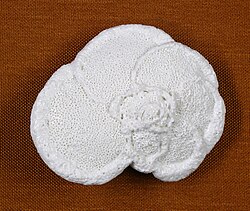
Picture of Globorotalia
- Source
- Wikipedia/Commons
- Credit
- Hannes Grobe ( talk )
- Licence
- CC BY 3.0
- Commercial use
- the licence allows it
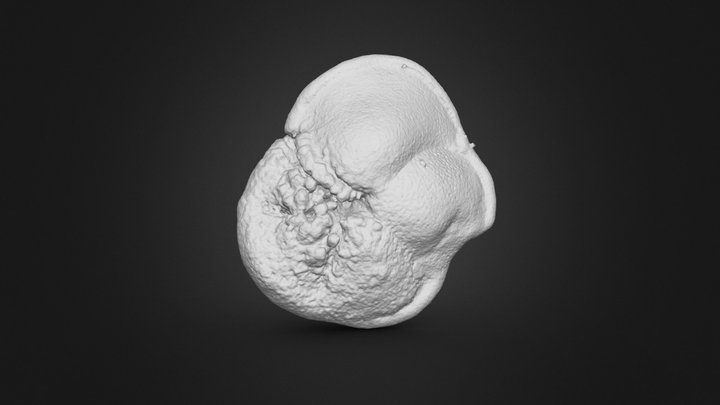
3D model
- Source
- Sketchfab
- Credit
- foraminarium
- Licence
- CC Attribution
- Commercial use
- cannot be read from the licence given — check the record
Smithsonian Open Access and MorphoSource were not reached for this taxon, so this list is what the others held rather than everything there is.
The description on this site
- Licence
- CC BY-SA 4.0
This is what the site found, which is not the same as what exists.
Keep going
What may have been alongside itGloborotaliidae through timeThe world it lived on
Occurrence data from the Paleobiology Database, CC BY 4.0. Cushman 1927