Gyropleura
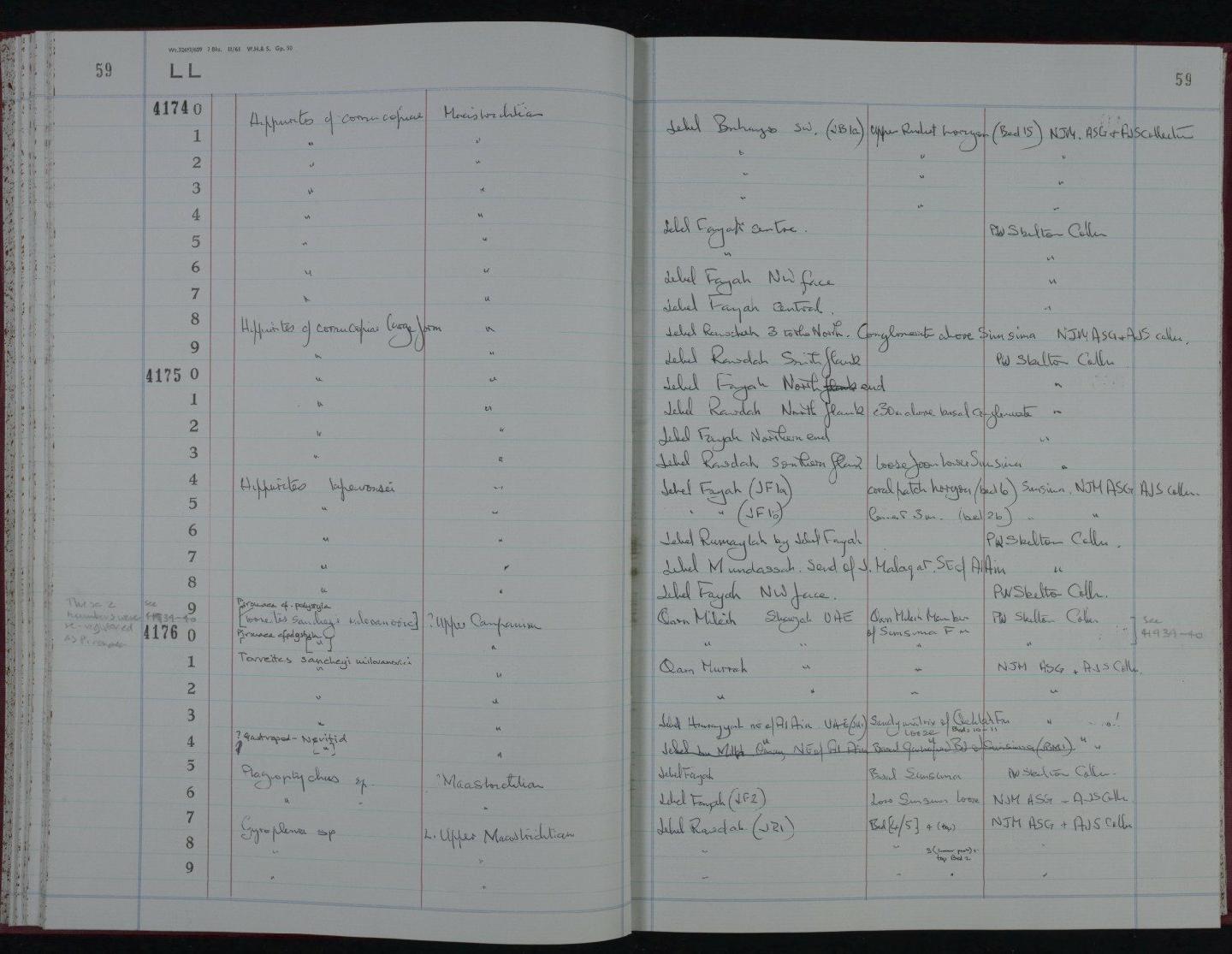
via iDigBio · CC BY · via iDigBio. May be a photograph of a specimen, or an artist’s reconstruction — an interpretation of a skeleton, since colour and soft tissue are almost never preserved.
On record
Recorded, not inferred- Sits inside
- MonopleuridaePBDB
- Diet
- suspension feederPBDB, for Hippuritida
- Life habit
- intermediate-level epifaunal, gregariousPBDB, for Hippuritida
- Motility
- stationary, attachedPBDB, for Hippuritida
- Vision
- blindPBDB, for Bivalvia
- Environment
- marinePBDB, for Hippuritida
Time the record covers
At least 21 million years on record.
The record covers at least 93.9 Mya to 72.2 Mya. No occurrence read is dated outside 100.5 Mya to 66 Mya.
26 occurrences of Gyropleura on record, most of them in the Late Cretaceous. Bar height is expected occurrences, not a count: each fossil is spread across the span it is dated to, so a tall narrow bar means tight dating and a low wide one means loose.
When
26 occurrences- Late Cretaceous100%
These are dates about fossils, not the animal: the record can only begin after it arose and end before it died out, so either end may reach further. Shares are expected occurrences: a fossil dated to a span is counted partly in each period it straddles. More on what this infers.
Found in
7 formations
- opoka Formation3
- Maastricht Formation1
- Prairie Bluff Formation1
- Greensand Formation1
- Maastrichtian chalk Formation1
- Ahlen Formation1
Loading coastlines…
The named rock units Gyropleura has been recovered from, largest first. Drawn where the rock is now, not where it formed. 17 occurrences have no formation on record, which is common for older literature.
Gyropleura and its relatives
Late CretaceousWhere Gyropleura and its relatives were recorded in the Late Cretaceous.
Found in the same rock
450 taxa- Spondylus14 sites
- Lyriochlamys11 sites
- Pseudolimea11 sites
- Hyotissa semiplana10 sites
- Plagiostoma hoperi10 sites
- Spondylus fimbriatus10 sites
- Dhondtichlamys pulchellus9 sites
- Entolium membranaceum9 sites
- Merklinia variabilis9 sites
- Panopea9 sites
- Pycnodonte vesicularis9 sites
- Atreta nilssoni8 sites
- Dhondtichlamys8 sites
- Granocardium8 sites
- Limatula8 sites
- Pholadomya8 sites
- Syncyclonema nilsoni8 sites
- Barbatia7 sites
- Limopsis7 sites
- Neithea (Neithea) sexcostata7 sites
- Pinna cretacea7 sites
- Placunopsis7 sites
- Camptonectes virgatus6 sites
- Cerithium6 sites
The Paleobiology Database records 19 sites for Gyropleura, and this reads all of them. The number is how many of those sites it was catalogued from too. The 24 sharing the most are listed.
This is not a list of everything alive at the time. It is only what has come out of the same ground as this animal and been written down.
Entered from
7 references- Unpublished data on Cretaceous-Paleocene molluscan assemblages14
- Maastrichtian non-cephalopod mollusks: Scaphopoda, Gastropoda and Bivalvia of the Middle Vistula Valley, central Poland7
- Lower Danian bivalves, Stevns Klint, Denmark; continuity across the K/T boundary1
- Paléoécologie et paléobiogéographie des faunes d'échinides du Cénomanien nord-aquitain (Charente-Maritime, France)1
- Maastrichtian, Danian and Thanetian beds in Dolenja Vas (NW Dinarides, Yugoslavia), microfacies foraminifers, rudists and corals1
- Upper Cretaceous (Maestrichtian) Mollusca from the Haustator bilira Assemblage Zone in the East Gulf Coastal Plain1
- Die Großfauna der Mukronatenkreide (unteres Obercampan) im östlichen Münsterland1
Each of the 26 occurrences read was entered from one of these publications, ordered by how many each accounts for. This is not a search for papers mentioning the name. Entries link to doi.org where the Paleobiology Database holds an identifier, and to its own record where it does not. Relayed as the Paleobiology Database holds them, not checked against what they resolve to.
Media and terms
Media content1
Picture of Gyropleura
- Source
- iDigBio
- Credit
- via iDigBio
- Licence
- CC BY
- Commercial use
- the licence allows it
No 3D scan was found. Smithsonian Open Access, MorphoSource and Sketchfab were all searched.
This is what the site found, which is not the same as what exists.
Keep going
What may have been alongside itMonopleuridae through timeFormations of the Late CretaceousThe world it lived on
Occurrence data from the Paleobiology Database, CC BY 4.0. Douvillé 1887