Halkyardia
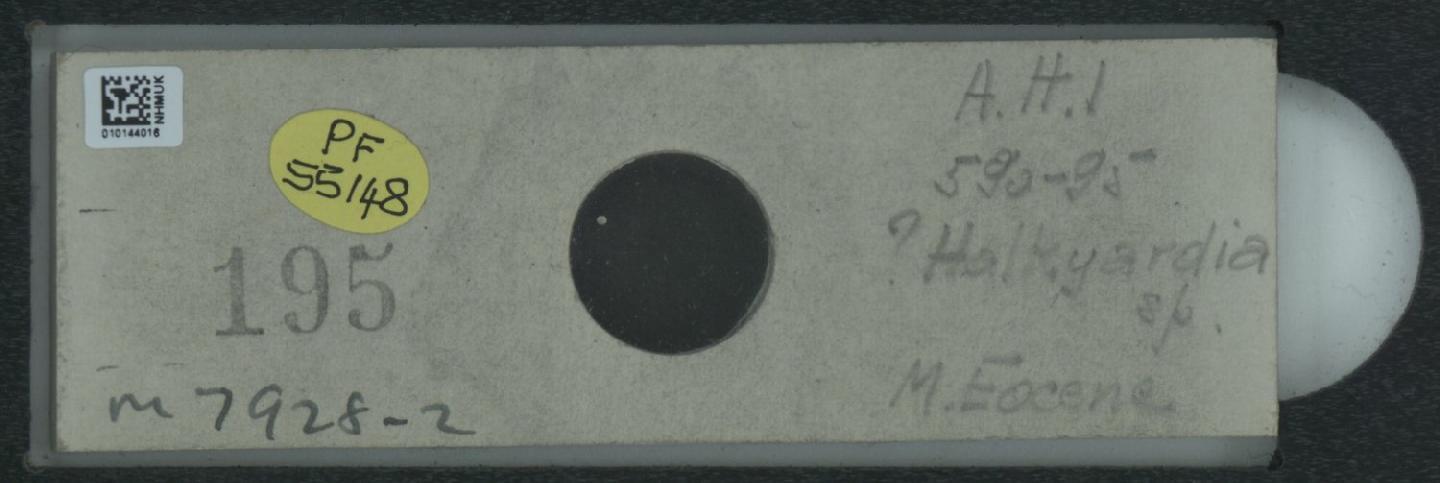
via iDigBio · CC BY · via iDigBio. May be a photograph of a specimen, or an artist’s reconstruction — an interpretation of a skeleton, since colour and soft tissue are almost never preserved.
On record
Recorded, not inferred- Sits inside
- CymbaloporidaePBDB
- Diet
- omnivorePBDB, for Foraminifera
- Life habit
- semi-infaunalPBDB, for Foraminifera
- Motility
- stationaryPBDB, for Rotaliina
- Environment
- outer shelf,marinePBDB, for Rotaliina
Time the record covers
At least 7.1 million years on record.
The record covers at least 41.03 Mya to 33.9 Mya. No occurrence read is dated outside 48.07 Mya to 23.04 Mya.
8 occurrences of Halkyardia on record, most of them in the Eocene. Bar height is expected occurrences, not a count: each fossil is spread across the span it is dated to, so a tall narrow bar means tight dating and a low wide one means loose.
When
8 occurrencesThese are dates about fossils, not the animal: the record can only begin after it arose and end before it died out, so either end may reach further. Shares are expected occurrences: a fossil dated to a span is counted partly in each period it straddles. More on what this infers.
Found in
4 formations
- Palizzi Formation2
- Qom Formation2
- Tossa / Igualada Formation1
- Santo Spirito Formation1
Loading coastlines…
The named rock units Halkyardia has been recovered from, largest first. Drawn where the rock is now, not where it formed. 2 occurrences have no formation on record, which is common for older literature.
Halkyardia and its relatives
EoceneWhere Halkyardia and its relatives were recorded in the Eocene.
Found in the same rock
111 taxa- Nummulites5 sites
- Discocyclina3 sites
- Heterostegina3 sites
- Amphisteginae indet.2 sites
- Asterocyclina2 sites
- Austrotrillina2 sites
- Borelis2 sites
- Dendritina rangi2 sites
- Miliolidae2 sites
- Neorotalia2 sites
- Operculina2 sites
- Penarchaias2 sites
- Peneroplis thomasi2 sites
- Planorbulina2 sites
- Praerhapydionina delicata2 sites
- Rotalidae indet.2 sites
- Scleractinia2 sites
- Sphaerogypsina2 sites
- Sphaerogypsina globula2 sites
- Sporolithon2 sites
- Subterraniphyllum thomasii2 sites
- Victoriella2 sites
- Actinacis cognata1 site
- Alveolinidae1 site
The Paleobiology Database records 7 sites for Halkyardia, and this reads all of them. The number is how many of those sites it was catalogued from too. The 24 sharing the most are listed.
This is not a list of everything alive at the time. It is only what has come out of the same ground as this animal and been written down.
Entered from
6 references- An inventory of the marine and transitional Middle/Upper Eocene deposits of the Southeastern Pyrenean Foreland Basin (NE Spain)2
- Transgression de l''Oligocene inferieur (formation de Palizzi) sur un karst a remplissage dans les zones internes calabro-peloritaines (Italie)2
- Lower Oligocene coralline algae of the Uromieh section (Qom Formation, NW Iran) and the oldest record of Titanoderma pustulatum (Corallinophycidae, Rhodophyta)1
- The lower Rupelian cluster reefs of Majella platform, the shallow water record of Eocene to Oligocene transition1
- Early Oligocene Larger Foraminiferal Biostratigraphy of the Qom Formation, South of Uromieh (NW Iran)1
- On Some Fossil Bryozoa From India1
Each of the 8 occurrences read was entered from one of these publications, ordered by how many each accounts for. This is not a search for papers mentioning the name. Entries link to doi.org where the Paleobiology Database holds an identifier, and to its own record where it does not. Relayed as the Paleobiology Database holds them, not checked against what they resolve to.
Media and terms
Media content1
Picture of Halkyardia
- Source
- iDigBio
- Credit
- via iDigBio
- Licence
- CC BY
- Commercial use
- the licence allows it
No 3D scan of Halkyardia was found in MorphoSource and Sketchfab.
Smithsonian Open Access was not reached for this taxon, so this list is what the others held rather than everything there is.
This is what the site found, which is not the same as what exists.
Keep going
What may have been alongside itCymbaloporidae through timeFormations of the EoceneThe world it lived on
Occurrence data from the Paleobiology Database, CC BY 4.0.