Hindella cassidea
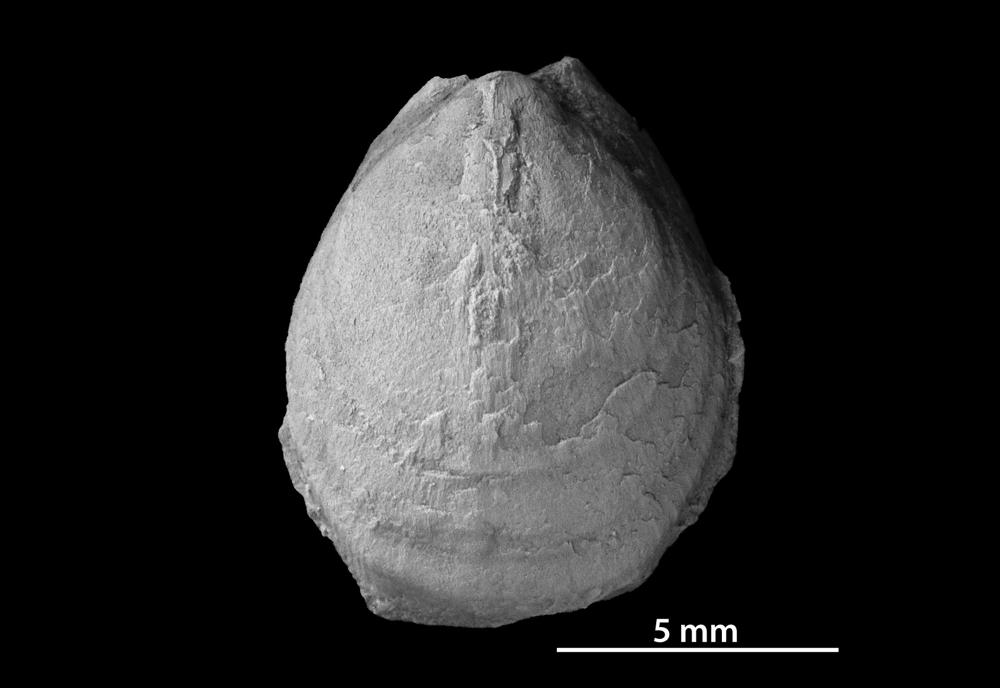
Hints, Linda · CC BY-NC 4.0 · via GBIF. May be a photograph of a specimen, or an artist’s reconstruction — an interpretation of a skeleton, since colour and soft tissue are almost never preserved.
On record
Recorded, not inferred- Sits inside
- HindellaPBDB
- Diet
- suspension feederPBDB, for Athyrididina
- Life habit
- low-level epifaunalPBDB, for Athyrididina
- Motility
- stationaryPBDB, for Athyrididina
- Vision
- blindPBDB, for Rhynchonellata
- Environment
- marinePBDB, for Lophophorata
Time the record covers
At most 9.7 million years on record.
Every occurrence read is dated to somewhere between 452.8 Mya and 443.1 Mya, and nothing in the dating separates them, so that window is what the record shows rather than a span.
23 occurrences of Hindella cassidea on record, most of them in the Ordovician. Bar height is expected occurrences, not a count: each fossil is spread across the span it is dated to, so a tall narrow bar means tight dating and a low wide one means loose.
When
23 occurrences- Ordovician100%
These are dates about fossils, not the animal: the record can only begin after it arose and end before it died out, so either end may reach further. Shares are expected occurrences: a fossil dated to a span is counted partly in each period it straddles. More on what this infers.
Found in
6 formations
- Langøyene Formation7
- Langåra Formation7
- Kuldiga Formation4
- Loka Formation3
- Langøyene Sandstone Formation1
- Husbergøya Formation1
Loading coastlines…
The named rock units Hindella cassidea has been recovered from, largest first. Drawn where the rock is now, not where it formed.
Hindella cassidea and its relatives
OrdovicianWhere Hindella cassidea and its relatives were recorded in the Ordovician.
Found in the same rock
97 taxa- Cliftonia psittacina9 sites
- Dalmanella testudinaria8 sites
- Eostropheodonta hirnantensis5 sites
- Helicelasma simplex5 sites
- Leptoskelidion loci5 sites
- Thebesia scopulosa5 sites
- Comatopoma4 sites
- Triplesia4 sites
- Borelasma crassitangens3 sites
- Dicranopeltis polytoma3 sites
- Globonema kokeni3 sites
- Hallopora3 sites
- Hirnantia sagittifera3 sites
- Streptelasma ostrogothicum3 sites
- Asperopora crustulenta2 sites
- Batostoma gracilis2 sites
- Diplotrypa baltica2 sites
- Eridotrypa suecica2 sites
- Fosselasma unicum2 sites
- Graptodictya boreniensis2 sites
- Hallopora dalmani2 sites
- Hallopora multipora2 sites
- Hallopora solbergiensis2 sites
- Harpidella occidentalis2 sites
The Paleobiology Database records 23 sites for Hindella cassidea, and this reads all of them. The number is how many of those sites it was catalogued from too. The 24 sharing the most are listed.
This is not a list of everything alive at the time. It is only what has come out of the same ground as this animal and been written down.
Entered from
7 references- Ecological associations in a regressive sequence: the latest Ordovician of the Oslo-Asker district, Norway12
- The commoner brachiopods of the latest Ordovician of the Oslo-Asker district, Norway4
- Hirnantian (latest Ordovician) bio- and chemostratigraphy of the Stirnas-18 core, western Latvia3
- The Hirnantian (Late Ordovician) brachiopod fauna of the East Baltic: Taxonomy of the key species1
- The earliest known Stegerhynchus (Rhynchonellida, Brachiopoda) from the Hirnantian strata (uppermost Ordovician) at Borenshult, Östergötland, Sweden1
- The Ordovician-Silurian boundary successions in Östergötland and Västergötland, S. Sweden1
- Late Ordovician and Earliest Silurian Meristellid Brachiopods in Scandinavia1
Each of the 23 occurrences read was entered from one of these publications, ordered by how many each accounts for. This is not a search for papers mentioning the name. Entries link to doi.org where the Paleobiology Database holds an identifier, and to its own record where it does not. Relayed as the Paleobiology Database holds them, not checked against what they resolve to.
Media and terms
Media content1
Picture of Hindella cassidea
- Source
- GBIF
- Credit
- Hints, Linda
- Licence
- CC BY-NC 4.0
- Commercial use
- the licence does not allow it
No 3D scan of Hindella cassidea was found in Smithsonian Open Access and Sketchfab.
MorphoSource was not reached for this taxon, so this list is what the others held rather than everything there is.
This is what the site found, which is not the same as what exists.
Keep going
What may have been alongside itHindella through timeFormations of the OrdovicianThe world it lived on
Occurrence data from the Paleobiology Database, CC BY 4.0. (Dalman 1828)