Homo erectus
Homo erectus is an extinct species of archaic human from the Pleistocene, spanning nearly 2 million years. It is the first human species to evolve a humanlike body plan and gait, to leave Africa and colonize Asia and Europe, and to wield fire. Some populations of H. erectus were ancestors of later human species, including H. heidelbergensis—the last common ancestor of modern humans, Neanderthals, and Denisovans. As such a widely distributed species both geographically and temporally, H. erectus anatomy varies considerably. Subspecies are sometimes recognized: H. e. erectus, H. e. pekinensis, H. e. soloensis, H. e. ergaster, H. e. georgicus, and H. e. tautavelensis.

Eduard Pop et al. · CC BY 4.0 · via Wikipedia/Commons. May be a photograph of a specimen, or an artist’s reconstruction — an interpretation of a skeleton, since colour and soft tissue are almost never preserved.
On record
Recorded, not inferred- Sits inside
- HomoPBDB
- Diet
- omnivorePBDB, for Hominidae
- Life habit
- ground dwellingPBDB, for Hominidae
- Motility
- actively mobilePBDB, for Osteichthyes
- Environment
- terrestrialPBDB, for Eutheria
Time the record covers
At least 1.6 million years on record.
The record covers at least 1.8 Mya to 129 ka. No occurrence read is dated outside 5.333 Mya to 11.7 ka.
41 occurrences of Homo erectus on record, most of them in the Pleistocene. Bar height is expected occurrences, not a count: each fossil is spread across the span it is dated to, so a tall narrow bar means tight dating and a low wide one means loose.
When
41 occurrences- Pliocene1%
- Pleistocene99%
These are dates about fossils, not the animal: the record can only begin after it arose and end before it died out, so either end may reach further. Shares are expected occurrences: a fossil dated to a span is counted partly in each period it straddles. More on what this infers.
Found in
5 formations
- Koobi Fora Formation17
- Nachukui Formation · Omo Group3
- Kapthurin Formation3
- Olduvai Formation2
- Olorgesailie Formation1
Loading coastlines…
The named rock units Homo erectus has been recovered from, largest first. Drawn where the rock is now, not where it formed. 15 occurrences have no formation on record, which is common for older literature.
Homo erectus and its relatives
PleistoceneWhere Homo erectus and its relatives were recorded in the Pleistocene.
Found in the same rock
381 taxa- Equus22 sites
- Metridiochoerus compactus14 sites
- Alcelaphini13 sites
- Hominidae13 sites
- Kolpochoerus limnetes13 sites
- Reduncini13 sites
- Tragelaphus strepsiceros12 sites
- Ceratotherium simum11 sites
- Gazella11 sites
- Hipparion11 sites
- Hippopotamus gorgops11 sites
- Kobus sigmoidalis11 sites
- Palaeoloxodon recki11 sites
- Tragelaphini11 sites
- Hippopotamus karumensis10 sites
- Giraffa9 sites
- Kobus kob9 sites
- Metridiochoerus hopwoodi9 sites
- Paranthropus boisei9 sites
- Aepyceros melampus8 sites
- Connochaetes gentryi8 sites
- Megalotragus isaaci8 sites
- Pelorovis turkanensis8 sites
- Adenota recki7 sites
The Paleobiology Database records 41 sites for Homo erectus, and this reads all of them. The number is how many of those sites it was catalogued from too. The 24 sharing the most are listed.
This is not a list of everything alive at the time. It is only what has come out of the same ground as this animal and been written down.
Entered from
20 references- Koobi Fora Research Project Volume 5 Plio-Pleistocene Archaeology14
- The Late Neogene elephantoid-bearing faunas of Indonesia and their palaeozoogeographic implications. A study of the terrestrial faunal succession of Sulawesi, Flores and Java, including evidence for early hominid dispersal east of Wallace's Line4
- Stratigraphy and Paleontology of pliocene and Pleistocene Localities West of Lake Turkana, Kenya3
- Plio-Pleistocene terrestrial mammal assemblage from Konso, Southern Ethiopia2
- Plio-Pleistocene mammalian biostratigraphy of Atlantic Morocco2
- Koobi Fora Research Project The Fossil Ungulates: Proboscidea, Perissodactyla, Suidae2
- Implications of new early Homo fossils from Ileret, east of Lake Turkana, Kenya1
- La faune de Nadaouiyeh Aïn Askar (Syrie centrale, Pléistocène moyen): aperçu et perspectives1
- Small mid-Pleistocene hominin associated with East African Acheulean technology1
- The first skull of Australopithecus boisei1
- Dated co-occurrence of Homo erectus and Gigantopithecus from Tham Khuyen Cave, Vietnam1
- Revised magnetostratigraphy of the Plio-Pleistocene sedimentary sequency of the Olduvai Formation (Tanzania)1
Each of the 41 occurrences read was entered from one of these publications, ordered by how many each accounts for. This is not a search for papers mentioning the name. 8 further references are not listed. Entries link to doi.org where the Paleobiology Database holds an identifier, and to its own record where it does not. Relayed as the Paleobiology Database holds them, not checked against what they resolve to.
Media and terms
Media content2

Picture of Homo erectus
- Source
- Wikipedia/Commons
- Credit
- Eduard Pop et al.
- Licence
- CC BY 4.0
- Commercial use
- the licence allows it
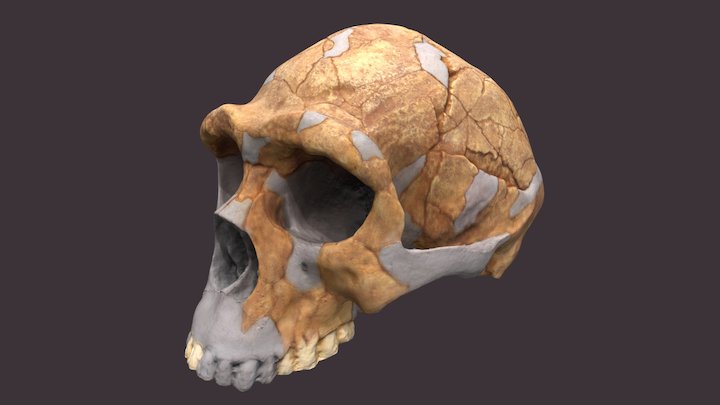
3D model
- Source
- Sketchfab
- Licence
- CC Attribution
- Commercial use
- cannot be read from the licence given — check the record
Smithsonian Open Access and MorphoSource were not reached for this taxon, so this list is what the others held rather than everything there is.
The description on this site
- Licence
- CC BY-SA 4.0
This is what the site found, which is not the same as what exists.
Keep going
What may have been alongside itHomo through timeFormations of the PleistoceneThe world it lived on
Occurrence data from the Paleobiology Database, CC BY 4.0. (Dubois 1892)